Introduction
Picture this: You step off the Delhi Metro after a smooth 40-minute ride, only to realise your office is still 3 km away. No auto is willing to take you for less than ₹100. Cab surge pricing has kicked in at 8:30 AM. The feeder bus left five minutes ago, and the next one won't arrive for 20 minutes. You're already running late.
That frustrating final stretch is the last-mile trap, and millions of Delhi Metro riders hit it every morning.
Delhi Metro logs over 6.46 million journeys daily, making it one of the world's busiest rapid transit systems. Yet for many commuters, the most stressful part isn't the metro ride—it's the 2–4 km gap between the station exit and their actual destination.
This piece breaks down why that gap persists, where common alternatives fail, and why EV scooter rentals are becoming the go-to fix for Delhi NCR commuters.
Key Takeaways
- Delhi Metro averaged 6.46 million journeys daily in 2025 across 374+ km, but most stations lack reliable last-mile options
- The mean last-mile distance for Delhi Metro commuters is 2 km, yet this short stretch causes outsized delays and added costs
- Existing solutions—autos, cabs, feeder buses—are expensive, unreliable, or too poorly scaled for daily ridership
- EV scooter rentals offer flexible, cost-effective, zero-emission transport for that final leg
Delhi Metro's Scale: Setting the Stage for the Last-Mile Problem
Delhi Metro moves millions of people every single day. In 2025, the network handled 2.35 billion (235.8 crore) passenger journeys, averaging 6.46 million daily. The single-day ridership record of 8.19 million was set on 8 August 2025—peak-hour pressure on a system already running near capacity.
The DMRC network spans 374.466 km across 271 stations and 10 colour-coded lines. Including the Noida-Greater Noida Aqua Line and Rapid Metro Gurugram, the Delhi-NCR footprint reaches approximately 416 km and 303 stations.
Daily operations run at scale:
- 343 trains completing 4,508 trips each day
- Roughly 1,40,112 train kilometres covered
- A punctuality rate of 99.9%
Geographic Spread Creates the Gap
Delhi Metro's reach extends far beyond the capital's core. Stations stretch across:
- Satellite cities like Noida, Gurugram, Faridabad, and Ghaziabad
- Peripheral residential clusters in Dwarka, Rohini, and East Delhi
- Newly developed commercial corridors and IT parks
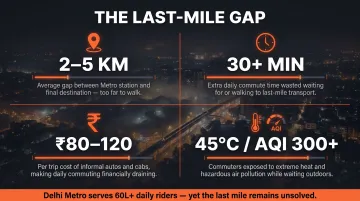
This geographic spread means commuters are often dropped at stations still 2–5 km from their homes or offices—especially in newly developed or peripheral areas where metro infrastructure arrived before complementary last-mile services.
When "Close" Isn't Close Enough
The metro gets riders close, but "close" in a megacity of 30+ million people can mean:
- 2–5 km of unpredictable traffic
- 30+ minutes of additional travel time
- ₹80–120 in extra transport costs per trip
- Physical exhaustion in Delhi's extreme heat or winter smog
This gap is the last-mile problem —and it affects millions of journeys every single day.
Understanding the Last-Mile Problem for Metro Commuters
Last-mile connectivity refers to the movement of people from a transit station to their final destination. In dense cities like Delhi, this short distance becomes disproportionately time-consuming, costly, and inconvenient.
Research by WRI India (2023) surveying 3,000 respondents across 10 Delhi Metro stations found the mean last-mile distance is 2 km (median: 1 km). That distance sounds short — but broken footpaths, extreme weather, and traffic make it anything but.
The Infrastructure Gap
Delhi currently operates only 100 feeder buses within a total government fleet of 5,336 buses, according to a February 2026 Times of India report. For a network serving 6.46 million daily riders, feeder coverage is nowhere near enough to meet demand. The government plans to procure 500 new 7-metre electric buses under the PM E-DRIVE Scheme, but deployment timelines remain unclear.
The demand gap is stark: even a conservative estimate — just 20% of daily riders needing last-mile help — puts 1.3 million journeys competing for those 100 feeder buses.
The Daily Commuter Experience
For office workers, the last-mile becomes a pressure point:
- Long waits outside metro exits for autos that may refuse short fares
- Surge pricing on app-based cabs during peak hours (8–10 AM, 6–8 PM)
- Crowded e-rickshaws with no fixed routes or schedules
- Walking in extreme weather—40°C summers, sub-10°C winters, or AQI exceeding 400
ICCT research (2025) found that 60% of all trips in Delhi are under 4 km, yet 31% of urban neighbourhoods lack a bus stop within 500 metres. This forces dependence on informal transport or private vehicles, undermining the metro's environmental and congestion-reduction goals.
Specific Groups Hit Hardest
Women commuters face compounded challenges. A 2021 study published in the Indian Journal of Labour Economics found 47.4% of women cited last-mile safety as a major concern. Poorly lit stretches, isolated metro exits, and unreliable transport at night make evening commutes particularly stressful. When the nearest metro station is beyond 3 km, regular usage by women drops to just 3.7%.
Udaiti Foundation research puts the severity in sharper relief: 79% of women report sexual harassment during first- and last-mile segments, and 12% avoid traveling after dark entirely.
The Systemic Consequence
The last-mile gap undermines decades of metro investment. WRI India's study noted that in Bengaluru, 70% of potential metro users avoid the metro entirely due to inconvenient last-mile access. Some Indian metro systems have achieved only 10% of projected ridership, putting at risk over US$25 billion in infrastructure investments. Delhi faces that same trajectory — unless affordable, on-demand last-mile options fill the gap that buses and autos have failed to close.
Why Existing Last-Mile Solutions Fall Short
Auto-Rickshaws and E-Rickshaws
Official Delhi Government fares set auto-rickshaw rates at ₹25 for the first 2 km, then ₹8/km thereafter. On paper, a 3 km ride should cost ₹33. In reality, commuters near metro stations face:
- Refusal for short distances during peak hours
- Negotiated fares of ₹80–120 for 2–5 km rides
- Meter non-compliance—drivers switch it off or never start it
- Long waits as autos hold out for longer, more profitable rides
E-rickshaws are cheaper but run no fixed routes or schedules. They're frequently overcrowded, and Delhi's transport authority has not brought them under a unified safety or fare framework — meaning commuters have no reliable fallback when autos refuse short trips.
App-Based Cabs and Bike Taxis
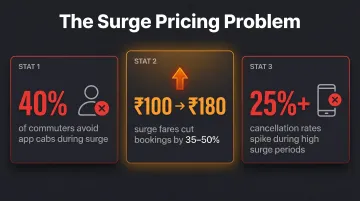
Ride-hailing apps introduce a different problem: surge pricing. The Central Government's Motor Vehicle Aggregator Guidelines (2025) cap surge at 2x base fare, but reporting by Outlook Business (July 2025) found that a standard ₹200 ride can jump to ₹400–500 during peak metro exit hours or rain.
Key surge pricing data:
- Over 40% of urban commuters avoid app-based cabs during surge periods
- For short trips, a fare jump from ₹100 to ₹180 cuts bookings by 35–50%
- Cancellation rates spike to 25%+ during high surge periods
Bike taxis remain banned in Delhi. The Centre issued guidelines in July 2025 permitting their operation, but Delhi's government has yet to adopt the policy — so Rapido, Ola, and Uber still can't run bike taxis legally here.
Walking and Cycling
Walking is free but impractical for most commuters:
- Extreme heat (40°C+ in summer) makes 2–3 km walks exhausting
- Air pollution (AQI often 300–500 in winter) poses health risks
- Lack of pedestrian infrastructure near most metro stations
- Safety concerns, especially for women and elderly commuters
Cycling shares the same infrastructure deficit. ITDP India research found 72% of non-cyclists would consider cycling if safe, continuous tracks were available — but near Delhi metro exits, those tracks rarely exist:
- Dedicated cycling lanes are absent at most stations
- Over 60% of existing tracks are blocked by parked vehicles or vendors
- No protected crossings connect cycle paths to metro entry points
How EV Scooter Rentals Bridge the Last-Mile Gap
EV scooter rentals offer a fundamentally different model: on-demand, affordable, zero-emission transport for the 2–5 km last-mile stretch.
How It Works
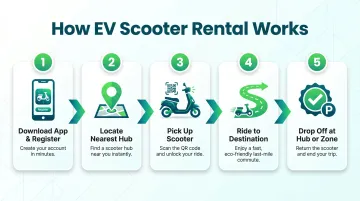
Riders can pick up an electric scooter near a metro exit using a smartphone app, ride it to their destination, and either return it to a designated hub or leave it in a designated zone. Payment covers only the minutes or kilometres used — no ownership, maintenance, or parking burden.
The rental process is simple:
- Download the app and register with Aadhar and driving licence (instant verification)
- Locate the nearest hub via the app
- Pick up a scooter (low-speed or high-speed variant)
- Ride to your destination (2–5 km typical range)
- Drop off at a hub or designated zone
Pricing Advantage Over Alternatives
Market pricing for EV scooter rentals varies, but operators like Yulu have benchmarked rates at approximately ₹2.5/minute for short trips. For a 3 km ride taking 8–10 minutes, that translates to ₹20–25 — significantly less than the ₹80–120 negotiated auto fare for the same distance.
Monthly cost comparison (2 trips/day × 22 workdays):
| Mode | Per-Trip Cost | Monthly Cost |
|---|---|---|
| Auto (3 km negotiated fare) | ₹90 | ₹3,960 |
| EV scooter rental (~10 min) | ₹25 | ₹1,100 |
| Savings | ₹65 | ₹2,860/month |
Over a full year, that gap adds up to more than ₹34,000 in savings — without changing a single other habit.
Flexibility and On-Demand Availability
Unlike feeder buses (fixed routes, fixed schedules) or autos (negotiation required), EV scooters are available instantly via app. This aligns with the commuter's reality: when the metro arrives at 8:47 AM and your meeting starts at 9:15 AM, you can't wait 15 minutes for a feeder bus.
WRI India's research found commuters are willing to travel up to 20 minutes to access stations, but modes with frequency exceeding 10 minutes are unlikely to be preferred. EV scooters eliminate wait time entirely.
The Specific Fit for Metro Commuters
EV scooters are purpose-built for last-mile distances:
- 2–5 km range covers the last-mile stretch without the excess of a full cab ride
- 25–55 km/h top speed keeps pace with city traffic without requiring a highway
- Swappable batteries mean no dead scooter surprises at peak hour
- Electric rates stay stable — no petrol price spikes affecting your daily spend
Bounce Daily has built this model specifically for Indian city commuters. Key operational details:
- Quick digital sign-up via Aadhar and driving licence verification
- Hubs active across Bengaluru, Delhi NCR, Hyderabad, Chennai, and Mumbai
- Low Speed variant (25 km/h) (driving licence assistance (available for a nominal ₹200-₹230 fee) at our hub — visit us or check our app to know more)
For commuters and gig workers making this trip twice a day, the math is straightforward: lower cost, no wait, no negotiation.
The Cost and Green Case for Choosing EV Scooter Rentals
Monthly Savings: The Math That Matters
Let's calculate the real monthly spend for a commuter making a 3 km last-mile trip twice daily:
Auto-rickshaw option:
- Negotiated fare per trip: ₹90 (realistic near metro stations)
- Daily cost: ₹180
- Monthly cost (22 workdays): ₹3,960
EV scooter rental option:
- Per-trip cost (~10 minutes): ₹25
- Daily cost: ₹50
- Monthly cost (22 workdays): ₹1,100
Monthly savings: ₹2,860 | Annual savings: ₹34,320
That ₹34,320 annual saving covers a month's rent in shared accommodation for most Delhi commuters—money recovered simply by switching how they cover the last three kilometres.
The Environmental Impact
Petrol two-wheelers in India emit approximately 60 g CO2/km (per CSE/Shakti Foundation research). Electric scooters produce zero tailpipe emissions. For a 3 km daily last-mile trip:
- Petrol two-wheeler: 60 g × 3 km × 2 trips × 22 days = 7.92 kg CO2/month
- Electric scooter: 0 kg CO2/month
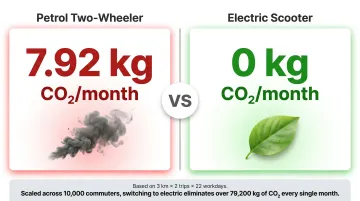
Scale that across thousands of commuters, and the reduction in emissions near metro stations—already among Delhi's most congested and polluted transit corridors—adds up fast.
Delhi's Air Quality Crisis
Transport is a major contributor to Delhi's chronic air pollution. Research published in ScienceDirect (2023) found local on-road transport contributes approximately 10% of daily mean PM2.5, rising to 17% when regional road transport is included. TERI's 2018 analysis (cited by ORF) estimated the transport sector accounts for 28% of PM2.5 emissions in Delhi, with two-wheelers contributing 7% of the total pollution load.
When thousands of commuters switch from petrol autos to electric scooters for last-mile journeys, the air quality improvement is trackable in the data. Bounce Daily alone has enabled riders to avoid over 10K+ CO2 tons while covering 30M+ kilometres on their fleet.
Urban Benefit Beyond Individual Choice
Those individual trips add up to measurable city-level change. Every EV scooter replacing a petrol auto near a metro station contributes to:
- Lower local PM2.5 and NO2 concentrations at high-traffic transit hubs
- Reduced noise pollution (electric motors are near-silent)
- Decreased congestion (scooters occupy less road space than autos or cars)
For a city that regularly records PM2.5 levels 10–15x the WHO safe limit, last-mile EV adoption is one of the few levers commuters can pull themselves.
Frequently Asked Questions
How many people use the Delhi Metro daily?
Delhi Metro recorded an average of 6.46 million journeys per day in 2025, totalling 2.35 billion journeys for the year. This makes it one of the world's most heavily used metro systems, ranking 6th globally by network length.
What is the highest daily ridership recorded by the Delhi Metro?
The single-day ridership record is 8.19 million journeys on 8 August 2025, surpassing the previous high of 7.87 million on 18 November 2024. Both figures reflect how consistently commuters depend on the network — and how much pressure falls on last-mile connectivity when millions arrive at the same stations.
How many Delhi Metro trains run each day?
Delhi Metro operates 343 trains running approximately 4,508 trips daily, covering around 1,40,112 train kilometres every day across its 10-line network. The system maintains a punctuality rate of approximately 99.9%.
Which Delhi Metro line is the most crowded?
The Blue Line (Dwarka to Noida Electronic City) is historically among the busiest, covering 56 km and serving major office and residential corridors across Delhi and Noida. The Yellow Line also experiences extremely high demand due to its central underground section connecting key commercial areas.
What are the three longest Delhi Metro lines?
The three longest operational lines are the Pink Line at 71.56 km (India's first ring metro), Blue Line at 56.11 km, and Yellow Line at 49 km. These longer lines often face the most acute last-mile challenges at their endpoints in peripheral areas.
The last-mile gap won't close on its own, but EV scooter rentals offer a solution that's available right now. For the millions of Delhi Metro riders stuck at that final 2–5 km stretch, renting an electric scooter means predictable costs, flexible timing, and no dependence on auto-rickshaw availability — while keeping emissions out of Delhi's already burdened air.