That tension — petrol costs eating into gig earnings — is exactly why the electric vs petrol scooter debate matters so much in India right now. With petrol in Bengaluru crossing ₹102.92 per litre in May 2026, the PM E-DRIVE subsidy extending to July 2026, and EV charging infrastructure scaling rapidly, this is no longer a question for early adopters. It's a financial decision with real monthly consequences.
This guide breaks down both options honestly — costs, range, maintenance, and which actually suits your life in India in 2026.
Key Takeaways
- Electric scooters cost roughly ₹0.15–0.35/km to run vs ₹2.00–2.50/km for petrol — a 6–16x gap that adds up fast for daily riders
- Petrol scooters still win on range convenience and serviceability in rural or Tier 3 areas
- EVs require less maintenance — no oil changes, no spark plugs, fewer mechanical failures
- For urban delivery workers and daily commuters, the economics have shifted decisively toward electric
- Your best option depends on where you ride, how far, and whether charging access is available to you
Electric Scooter vs Petrol Scooter: Quick Comparison
Upfront Cost
| Electric Scooter | Petrol Scooter | |
|---|---|---|
| Entry price | ₹94,434–₹1,85,373 | ₹76,684–₹90,000 |
| Government subsidy | ₹5,000 via PM E-DRIVE (until July 2026) | None |
| No-purchase option | Rental models like Bounce Daily | Limited |
The upfront premium for EVs ranges from ₹18,000 to over ₹1,00,000 depending on the models compared. For price-sensitive buyers — especially gig workers — this gap is real. Rental models sidestep it entirely, replacing a large one-time outlay with a predictable monthly plan and no EMI.
Running Cost per km
The running cost gap is where electric scooters pull decisively ahead:
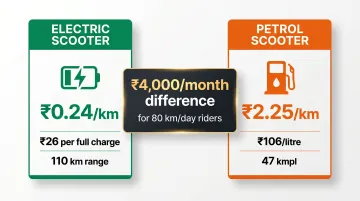
- Electric scooter: At ₹7/kWh domestic electricity, a full charge on a 3.7 kWh battery costs roughly ₹26. Over 110 km real-world range, that's approximately ₹0.24/km
- Petrol scooter: At ₹102.92/litre (Bengaluru, May 2026) and 47 kmpl ARAI mileage for the Honda Activa 6G, the cost is roughly ₹2.20/km
For a delivery partner doing 80 km/day, 25 days a month, that's a difference of roughly ₹4,000 per month in running costs alone.
Maintenance and Convenience
| Electric Scooter | Petrol Scooter | |
|---|---|---|
| Oil changes | Not required | Every 3,000–5,000 km |
| Service complexity | Simpler, but needs EV-trained mechanic | Standard mechanic available anywhere |
| Refueling time | 4–6 hours (home charging) or minutes (battery swap) | 5 minutes at any of India's 103,023 petrol pumps |
| Annual maintenance cost | Lower (fewer moving parts) | ₹7,000–14,000 estimated |
Petrol scooters win on refueling speed and service network reach. EVs win on lower service frequency and predictable running costs. Which trade-off matters more depends heavily on how many kilometres you cover each day — the next sections break that down by rider type.
Electric Scooter: What It Is and Why It Suits Indian Roads
An electric scooter replaces the combustion engine with a battery-powered electric motor. There's no fuel tank, oil changes, or exhaust pipe. You charge the battery — either overnight at home or through a battery swap at a hub — and it drives like any scooter.
The Two Variants That Matter in India
India's regulatory framework creates a meaningful split:
- Low Speed (up to 25 km/h): driving licence assistance (available for a nominal ₹200-₹230 fee) at our hub - visit us or check our app to know more. Legal under Indian motor vehicle rules as a low-speed EV. Ideal for students, first-time riders, and short-radius delivery
- High Speed (above 25 km/h): Requires a valid two-wheeler licence. Suited for full-day delivery shifts and longer commutes
This split is unique to India and directly shapes which variant fits your situation.
Why the Economics Work for Urban Riders
Beyond the cost-per-km savings, three factors make electric scooters a practical fit for Indian city use:
- Zero tailpipe emissions — relevant in Bengaluru and Delhi, where traffic congestion means you're idling frequently
- No petrol price exposure — electricity tariffs are more stable than fuel prices, which have risen steadily
- Reduced maintenance disruptions — fewer moving parts means fewer breakdowns, which matters when your income depends on your scooter running every day
Charging and Battery Swapping
Home charging works for most commuters — plug in overnight, wake up to a full battery. For delivery workers running 10–12 hour shifts, that's not practical. Battery swapping solves this: ride to a hub, swap a depleted battery for a charged one in minutes, and continue working. Services like Bounce Daily include unlimited swaps across their Bengaluru hub network as part of the rental plan, with no per-swap fee and no charging downtime.
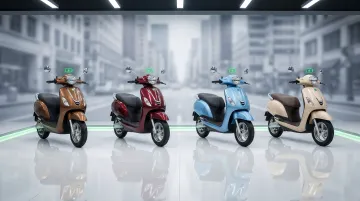
Popular Models in 2026
India sold 773,000 electric scooters in FY2025 — 11% of total scooter sales — a sign this is a mainstream market, not a niche one.
| Model | Real-World Range | Approx. Price |
|---|---|---|
| TVS iQube (2.2 kWh) | ~80 km | ₹94,434 |
| Ather 450X (3.7 kWh) | ~110 km | Contact dealer |
| Ola S1 Pro (4 kWh) | ~143 km | ₹1,29,863 |
| TVS iQube ST (5.3 kWh) | ~180 km | ₹1,85,373 |
Petrol Scooter: What It Is and Where It Still Holds Ground
A petrol scooter runs on an internal combustion engine (ICE). Fuel goes through a carburetor or fuel injection system, combustion drives the piston, and the wheel turns. That means more moving parts, more heat, and more maintenance — but it's also technology that every mechanic in India already knows.
Where Petrol Still Makes Sense
Petrol scooters hold their ground in three specific areas:
- Range: A Honda Activa 6G with a 5-litre tank at 47 kmpl covers roughly 235 km before needing a refuel — far beyond what most EVs manage on a single charge
- Refueling network: India has 103,023 petrol pumps vs 29,151 EV charging stations. In a Tier 2 or Tier 3 city, this gap is not theoretical — it's the difference between finishing your journey and being stranded
- Easy repairs, anywhere: Any mechanic in any town can fix a petrol scooter. EV-trained mechanics are still concentrated in metros
The True Cost Over Time
The lower upfront price is real, but the running cost accumulates. A delivery rider on a petrol scooter in Bengaluru typically spends:
- ₹3,000–4,500/month on fuel
- ₹500–800/month on servicing, oil changes, brake pads
- ₹500–1,000/month on breakdown repairs (averaged)
- ₹150–300/month on insurance
Total: ₹4,500–6,500/month, not counting the original vehicle purchase or EMI.
BS6 Phase II norms (mandatory since April 2023) add another layer: OBD-2 diagnostics and real driving emissions monitoring are now required on all new petrol scooters. That raises both vehicle complexity and repair costs — factors worth weighing against the sticker price.
Dominant Petrol Models
- Honda Activa 6G: 42% market share, 47 kmpl, ₹76,684 ex-showroom — the default choice for millions
- Suzuki Access 125: 45 kmpl, strong on highways
- TVS Jupiter 125: Popular for comfort on city roads
Honda sold 282,676 scooters in a single month (February 2026), up 48% year-on-year. For riders in cities without reliable EV charging or swap infrastructure, that demand makes complete sense.
Electric vs Petrol Scooter: Which Is Actually Better for You?
No universal answer exists. The right choice depends on five variables:
- Daily km ridden
- Access to home charging or a battery swap hub
- Whether you're buying or renting
- Sensitivity to petrol price fluctuations
- City vs semi-urban or rural location
The Gig Worker Maths
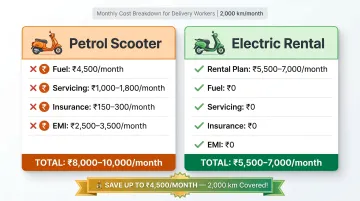
Here's a monthly comparison for a delivery partner doing 80 km/day, 25 days/month (2,000 km/month):
| Cost Item | Petrol Scooter | Electric (Rental) |
|---|---|---|
| Fuel / electricity | ₹4,500 | Included in rental |
| Servicing + repairs | ₹1,000–1,800 | ₹0 (managed by provider) |
| Insurance | ₹150–300 | Included in rental |
| EMI / upfront | ₹2,500–3,500 | ₹0 |
| Estimated total | ₹8,000–10,000 | ₹5,500–7,000 (rental) |
The savings widen the more you ride. At 150 km/day, the petrol cost alone crosses ₹6,700/month — that's a ₹2,000–3,000/month swing in favour of electric.
Regulatory Direction in 2026
India's policy environment favours EVs:
- BS6 Phase II adds cost and electronic complexity to petrol scooters
- PM E-DRIVE provides ₹5,000 per electric two-wheeler, extended to July 31, 2026. The scheme is fund-limited, so timing matters
- Delhi's GRAP restrictions periodically limit older petrol vehicles during high-pollution periods, a sign of tightening urban emission controls
Situational Recommendations
Go electric if:
- You ride daily in a metro or large city
- You have access to home charging overnight or a battery swap hub nearby
- You're a delivery worker covering 60+ km/day
- You want predictable monthly costs without exposure to fuel price spikes
Stick with petrol if:
- You're in a Tier 3 city or rural area with no reliable EV charging infrastructure
- You regularly need to cover 150+ km per day across varied terrain
- You need a vehicle that any roadside mechanic can fix anywhere in India
The Rental Middle Path
The upfront cost of buying an EV stops many gig workers from switching — even when the monthly savings are obvious. Bounce Daily addresses that directly. Their 100% electric rental fleet covers both High Speed (55 km/h, 70 km range) and Low Speed (25 km/h, 85 km range) variants, with battery swapping built in and all maintenance handled centrally. Delivery partners get same-day digital onboarding with just Aadhaar and a driving licence — no EMI, no purchase, no servicing bills.
Real-World Example: Delivery Partners Who Made the Switch
Three Bounce Daily delivery partners — Goutam Behera, Karanbir Das, and Champalal — capture what the switch looks like in practice.
Petrol costs of ₹3,000–4,500/month were eating into delivery earnings, and unpredictable repair bills could sideline a rider without warning. A broken-down scooter doesn't just cost repair money — it costs an entire day's income.
Bounce Daily's rental model removed both barriers at once. No upfront purchase. Battery swapping at hubs meant no mid-shift charging wait. Digital onboarding (Aadhaar plus driving licence) through the app meant they could start riding the same day.
Their feedback speaks to what actually matters on the ground:
- Goutam Behera: "The build quality is top-notch and it runs smoothly every single day. Truly a reliable ride."
- Karanbir Das: "I've been using Bounce for over a year now — way more cost-effective than petrol bikes, and I've never faced any issues with the battery."
- Champalal: "Bounce is really easy to rent — the whole process is quick and simple. Plus, it saves a lot of battery and runs efficiently throughout the day."
These aren't early-adopter testimonials. Karanbir's year on the road covers Bengaluru's traffic, summer heat, and a full-day delivery schedule — conditions that test any scooter.The Bounce Daily fleet has now covered 30M+ kilometres and avoided 10,000+ tonnes of CO₂ across its operational history. For delivery partners running 80–100 km daily in Indian cities, the financial case is already proven. The only remaining variable is how quickly you can get on the road.
Conclusion
Electric scooters are the smarter long-term choice for urban riders, daily commuters, and anyone doing high-mileage delivery work in Indian cities. Lower running costs, less maintenance, and stability against fuel price swings add up to real monthly savings — especially once you factor in that petrol in Bengaluru has already crossed ₹100/litre.
Petrol scooters remain genuinely practical for riders in semi-urban or rural areas, those who regularly cover long distances across terrain where charging isn't available, and anyone who needs a vehicle that can be serviced at a roadside workshop in any corner of India.
For the majority of two-wheeler riders in Indian metros — and particularly for the estimated 5+ million delivery workers who depend on their scooter for income — the economics of electric have already shifted. Charging infrastructure has expanded, the model range has matured, and rental services like Bounce Daily now let delivery riders switch without the burden of a purchase or EMI. Getting on an electric scooter has never been more straightforward.
Frequently Asked Questions
Which is better: electric scooter or petrol scooter?
It depends on how and where you ride. Electric is better for city commuters and high-mileage delivery workers — lower running costs and less maintenance make a measurable difference monthly. Petrol suits riders in Tier 3 cities or rural areas where charging infrastructure hasn't reached yet.
What is the cost per km for an electric scooter?
At average domestic electricity tariffs of ₹5–8/kWh, an electric scooter costs roughly ₹0.15–0.35 per km. A petrol scooter in Bengaluru runs around ₹2.00–2.50 per km at current fuel prices — making EVs 6–16x cheaper to run per kilometre.
Can an electric scooter be used like a regular petrol scooter?
Yes, for city use — daily commutes, delivery runs, and errands. Range limits only matter on longer trips where charging access is thin. For delivery workers, battery swapping eliminates the wait entirely, keeping you on the road without a 4–6 hour charging stop.
Which is better, EV or petrol, over 3 years?
EVs win on total cost of ownership over 3 years in India — high fuel prices and low electricity tariffs make the gap significant for daily riders. Renting rather than buying removes the upfront cost problem entirely, so the savings start from day one. Petrol only stays competitive where EV infrastructure is genuinely absent.
What are EV, BEV, HEV, and PHEV?
EV covers any electric vehicle. BEV (Battery Electric Vehicle) runs entirely on electricity — the type covering nearly all electric scooters sold in India. HEV and PHEV both combine petrol engines with electric motors, with PHEVs also supporting external charging. For practical purposes in India, "electric scooter" means BEV.