Introduction
Picture this: It's 1 PM on a Friday in Bengaluru. Suresh, a Zomato delivery partner, watches his scooter's battery dip to 15% mid-shift. He pulls into a charging station, plugs in, and waits. Thirty minutes pass. An hour. His phone buzzes with missed delivery requests. Each notification represents lost income—orders he can't accept while his scooter charges.
Now imagine the alternative: Suresh rides into a battery swap station, removes his depleted battery pack, slots in a fully charged one, and rides out—all in under two minutes. No waiting. No lost orders. Just seamless work.
That's the promise of battery swapping—and India's 2022 Battery Swapping Policy is the framework making it real. If you're a gig worker or EV renter in Bengaluru, here's what the policy actually means for your daily earnings and how to use the growing swap infrastructure to your advantage.
Key Takeaways
- India's 2022 NITI Aayog Battery Swapping Policy separates battery ownership from vehicle ownership, cutting EV costs by 30-40%
- Swap a depleted battery for a fully charged one in under 2 minutes at swap stations, compared to 4-6 hours for home charging
- Gig workers riding 140+ km/day save roughly 37% per km versus petrol with no charging downtime
- Confirm battery compatibility before renting — only scooters with removable, standardized batteries work at swap stations
- Renting a swap-compatible scooter (rather than owning one) is the lowest-friction way for gig workers to access this infrastructure today
What Is Battery Swapping and How Does It Work?
Battery swapping replaces the traditional "plug in and wait" model with instant energy replenishment. Instead of connecting your EV to a charger for 30 minutes to several hours, you pull into a swap station, hand over your depleted battery pack, and receive a fully charged one. Sun Mobility's Quick Interchange Stations complete this process in under two minutes—Honda's e:SWAP network claims under one minute. That's faster than filling a petrol tank.
How a Swap Station Works
A battery swapping station is essentially a vending machine for energy. The facility stores dozens of battery packs, charges them under controlled conditions, and distributes them to riders on demand. Here's what a typical swap looks like for a two-wheeler rider in Bengaluru:
- Open the swap station app (SUN Mobility Driver or your rental provider's app)
- Locate the nearest station along your route
- Pull into the station — most are at metro stations, fuel pumps, or high-traffic delivery zones
- Remove your depleted battery from the scooter's compartment
- Place it in the return slot
- Collect a fully charged battery from the dispense slot
- Insert the fresh battery and ride off
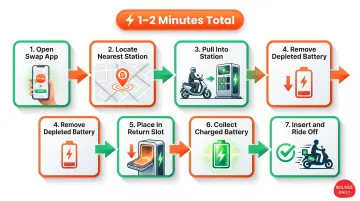
The entire exchange takes 1-2 minutes. No cables, no waiting, and no income lost to charging downtime.
Critical Compatibility Requirement
Not all electric scooters support battery swapping. Only vehicles specifically designed with removable, standardized battery packs can use swap stations. Most standard EVs sold today have fixed batteries integrated into the frame—these cannot be swapped.
Before renting any EV for gig work, confirm two things:
- Does the scooter have a removable battery compartment?
- Is the battery compatible with swap networks in your city?
Bounce Daily's fleet covers both High Speed (55 km/h, 70 km range) and Low Speed (25 km/h, 85 km range) variants—both come with swappable batteries, so you can use Bengaluru's swap stations from day one without any additional setup.
India's Battery Swapping Policy: What It Actually Says
The Policy Origin and Intent
India's NITI Aayog Draft Battery Swapping Policy was published on April 20, 2022. Important clarification: this remains a draft policy, not enacted law. The government accepted public comments through June 2022 but has not yet issued a final notification.
The policy's core objectives:
- Decouple battery cost from vehicle cost to reduce upfront EV purchase prices by 30-40%
- Offer flexibility as an alternative to fixed charging infrastructure
- Establish technical standards for interoperability without stifling innovation
- De-risk the ecosystem through regulatory support to unlock competitive financing
- Promote partnerships between battery providers, OEMs, and financial institutions
- Enable lifecycle management including reuse and end-of-life recycling
Battery-as-a-Service (BaaS) Explained
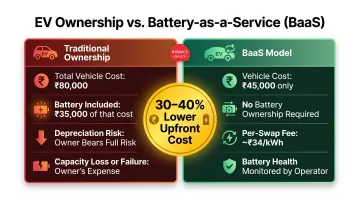
The policy promotes Battery-as-a-Service (BaaS)—a model where users pay for energy and usage rather than owning the battery outright. For gig workers, the difference is direct:
- Traditional EV ownership: You buy the vehicle for ₹80,000, including a ₹35,000 battery. You own it, bear the depreciation risk, and pay for any capacity loss or failure.
- BaaS model: You buy (or rent) the vehicle for ₹45,000—without the battery. You pay a per-swap fee (currently ~₹34/kWh, targeting ₹20/kWh) or a subscription. The battery provider owns it, monitors health, and replaces underperforming units.
For a delivery worker who couldn't afford ₹80,000 upfront, a ₹45,000 vehicle or a daily rental becomes accessible. According to the Centre for Science and Environment, BaaS reduces purchase prices by 30-40%.
Standardization: The Promise vs. Reality
The NITI Aayog policy emphasizes common battery form factors—standardized shapes, connectors, and communication protocols so different brands' batteries work across multiple swap networks. In theory, a Sun Mobility battery could work at a Honda e:SWAP station.
That's not the current reality. The Bureau of Indian Standards (BIS) has not yet finalized mandatory standards for swappable battery form factors, interoperable connectors, or BMS-to-EV communication. These standards remain "in development." The Ministry of Heavy Industries convened its second stakeholder consultation in April 2026, but formal standardization timelines are not confirmed.
What this means for gig workers: Swap networks remain proprietary today. A battery from Sun Mobility's network cannot be used at a Honda e:SWAP station, and vice versa. When you choose a swap-compatible EV, you're effectively choosing a swap network ecosystem. Check which network has the best coverage in your delivery zone before committing.
Government Incentives: Where the Money Flows
GST Status—Critical Update:
You may have heard that swappable batteries received a GST reduction to 5% in 2022. The reality is more complicated:
- Electric two-wheelers: Taxed at 5% GST
- Lithium-ion battery packs sold with the vehicle: Reduced to 5% GST following the June 2022 GST Council meeting
- Swappable batteries sold separately and charging/swapping services: Remain at 18% GST
As of September 2025, this rate asymmetry persists across the EV ecosystem. Industry estimates that reducing GST from 18% to 5% on a ₹40,000 battery would save approximately ₹5,200 per unit—savings that could flow directly into lower swap fees for riders.
PM E-DRIVE Scheme:
Notified September 2024, the PM E-DRIVE scheme provides:
- Total outlay: ₹10,900 crore
- e-2W subsidy: ₹2,500/kWh capped at ₹5,000 per vehicle
- Target: 24.79 lakh electric two-wheelers by March 2028 (scheme extended from March 2026)
Despite its scale, the scheme contains no specific provisions for battery swapping operators or BaaS models. The ICCT identified in 2022 that FAME II subsidies (₹15,000/kWh) did not apply to vehicles sold without pre-fitted batteries—the exact segment swapping targets. That structural gap has carried forward into PM E-DRIVE.
What the Policy Does NOT Cover
The draft policy designates the Battery Provider as the single point of contact for complaints and mandates BMS-enabled batteries with IoT monitoring. Significant grey areas remain:
Consumer protection gaps:
- No framework for degraded battery liability—what happens if you receive a battery with 40% capacity at a swap station?
- No standardized battery health disclosure requirement at the point of swap
- No clear enforcement mechanism for quality standards
- Liability for battery damage during swapping remains ambiguous
These gaps matter. As a gig worker, if you swap a battery mid-shift and discover it delivers only 30 km range instead of the expected 70 km, your rental agreement—not the policy—determines your recourse.
Why Battery Swapping Is a Game-Changer for Gig Workers and EV Renters
Why Battery Swapping Changes the Math for Gig Workers and EV Renters
The Income Impact of Downtime
Charging time is unpaid time. Here's what that actually costs during a shift:
Charging scenario:
- Home charging: 3-5 hours
- Public Level 2 charging: 1-1.5 hours
- Even fast charging: 30-60 minutes
During peak lunch or dinner delivery windows (12-2 PM, 7-9 PM), a one-hour charging stop means:
- 4-6 missed delivery orders
- ₹200-₹400 in lost earnings
- Reduced daily trip count affecting weekly incentive tiers
Swapping scenario:
- Swap time: 1-2 minutes
- Missed orders: Zero
- Earnings continuity: Uninterrupted
A Zomato and Blinkit survey of 2,300+ delivery partners found that 61% cited range concerns and 51% pointed to limited charging/swapping stations as barriers to EV adoption. The income anxiety is real—and swapping directly addresses it.
Cost Advantage Over Petrol
Bengaluru petrol price (as of May 2026): ₹102.92 per litre
The International Council on Clean Transportation (ICCT) analyzed Total Cost of Ownership over five years and found stark differences based on daily utilization:
| Daily Usage | Petrol (ICE) | Battery Swapping | Savings |
|---|---|---|---|
| ~40 km/day (low) | ₹3.34/km | ₹2.60/km | 22% |
| ~160 km/day (high) | ₹2.28/km | ₹1.44/km | 37% |
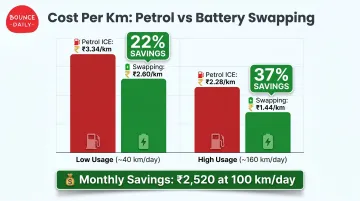
At high daily utilization—typical for full-time gig workers—battery swapping beats both petrol and home charging on cost. An hour lost to charging during peak hours costs more in missed orders than the marginal energy savings from overnight home charging.
For a delivery worker covering 100 km/day:
- Petrol cost: ₹228/day (₹6,840/month)
- Swapping cost: ₹144/day (₹4,320/month)
- Monthly savings: ₹2,520
Over a year, that's ₹30,240 in fuel savings alone—enough to cover several months of vehicle rental or contribute significantly to household income.
No Ownership, No Depreciation Risk
Under BaaS, you don't own the battery. This removes the single biggest financial anxiety for EV adopters: battery degradation.
Lithium-ion batteries lose capacity over time. A battery that delivered 70 km when new might provide only 50 km after 2-3 years of heavy use. In a traditional ownership model, this capacity loss hits your pocket—either through reduced earning capacity (more frequent charging stops) or expensive battery replacement (₹30,000-₹40,000).
With BaaS and swapping, that risk shifts entirely to the operator:
- Battery performance is the swap operator's problem, not yours
- If you receive an underperforming battery, you simply swap it at the next station
- Swap operators manage battery health centrally with controlled charging (optimal temperature, managed rates, partial cycling)
- Professional battery management extends cycle life significantly—a 2023 study in Energy Reports found that batteries charged within optimal depth-of-discharge windows last 7.4x longer than deeply cycled batteries
Range Anxiety Solution for Long Shifts
Gig workers often operate 8-12 hour shifts covering 80-120 km across wide urban areas. Range anxiety—the fear of running out of charge mid-shift with no charging option nearby—is the top cited barrier to EV adoption (61% in the Zomato survey).
Battery swapping transforms this calculation:
Traditional EV with fixed battery:
- You must plan your route around charging station locations
- A 70 km range means you're hunting for a charger by 50 km
- If the charger is occupied or broken, you're stranded
- Anxiety compounds with every delivery farther from a known charging point
Swap-compatible EV:
- You plan routes around swap station locations (growing rapidly—3,000+ stations India-wide)
- A depleted battery is a 2-minute stop, not a shift-ender
- Stations are increasingly located at metro stops, fuel pumps, and delivery hubs
- Predictable refueling means predictable earnings
Bounce Daily: Rental Access Without Ownership
For gig workers not ready to purchase an EV outright, Bounce Daily offers a practical on-ramp. Key features:
- Swap-compatible fleet: Both High Speed (55 km/h, 70 km range) and Low Speed (25 km/h, 85 km range) variants feature swappable batteries
- No heavy upfront cost: Rent by the day, week, or month—no ₹45,000-₹80,000 purchase barrier
- Instant digital onboarding: Upload Aadhaar + driving license in the app, get instant verification, and ride the same day
- Fleet management included: Vehicle maintenance, tracking, and uptime handled centrally—you focus on deliveries, not repairs
Bounce Daily's model removes three traditional barriers simultaneously: ownership cost, maintenance hassle, and infrastructure uncertainty. You access swap-compatible EVs and the swap network without committing capital.
Battery Swapping vs. Charging: A Practical Comparison for Delivery Workers
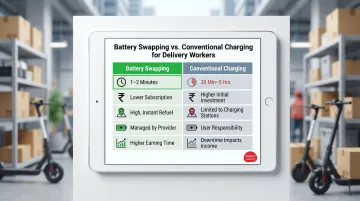
| Dimension | Battery Swapping | Conventional Charging |
|---|---|---|
| Time to replenish | 1-2 minutes | 30 min (fast) to 3-5 hours (home) |
| Upfront cost | No battery ownership with BaaS (30-40% lower vehicle cost) | Full battery cost embedded in vehicle price |
| Flexibility | Depends on swap station density in your delivery zone | Depends on charging point availability + willingness to wait |
| Battery health risk | Station-maintained packs with professional charging; swap out poor performers | Self-managed charging habits; degradation hits your pocket |
| Income impact | Minimal downtime = maximum earning hours | 30-60 min downtime per charge during peak hours = lost orders |
When Swapping Works Best
Battery swapping delivers maximum advantage for:
- Riders logging 100+ km/day in delivery, ride-hailing, or logistics
- Gig workers with unpredictable hours who can't rely on overnight home charging
- Those earning during lunch and dinner rushes, where every minute of downtime costs orders
- 12+ hour shift workers covering wide urban areas
The ICCT's analysis confirms swapping becomes the most economical option above 140 km/day utilization.
When Charging Still Makes Sense
Conventional charging remains practical for:
- Commuters covering 30-50 km/day who can plug in at home overnight
- Residents with dedicated parking and home charging already in place
- Recreational riders not depending on the vehicle for income
- Zones where swap station density is still too low for reliable coverage
Limitations to Know About
Three practical constraints are worth understanding before you commit:
Coverage gaps: India now has approximately 3,000 battery swap stations, but coverage remains concentrated in metro cities. Per the CII/Prosus report, 90% of required infrastructure is yet to be built. Before choosing a swap-compatible EV, map stations along your actual delivery corridors — fewer than 3-4 accessible points in your zone means range anxiety is still a real risk.
Proprietary networks: Interoperability standards are not yet finalized, so swap networks remain closed ecosystems. A Bounce Daily scooter on Sun Mobility's network cannot use Honda e:SWAP stations, and vice versa. Pick your network based on coverage in your specific area.
Market trajectory: The swap market is projected to grow from USD 48 million in 2025 to USD 518 million by 2034 — so coverage gaps should narrow over time, but plan for today's map, not tomorrow's.
The 80/20 Charging Rule for Hybrid Use
Even with swappable EVs, some riders charge conventionally at home overnight (particularly Bounce Daily's High Speed variant, which supports both charging and swapping). When you do charge:
Keep charge levels between 20% and 80% during regular use.
Research published in ScienceDirect shows that limiting depth of discharge significantly extends battery cycle life. Batteries regularly charged to 100% or drained to 0% degrade faster due to increased electrochemical stress.
Staying in the 20-80% window reduces that stress consistently across hundreds of charge cycles.
Practical application:
- Charge overnight to 80% (not 100%)
- Swap or recharge when battery drops to 20-25% (not 5%)
- Avoid DC fast charging exclusively—studies show it increases degradation by 16% versus AC charging
This matters for renters: some rental agreements hold you responsible for battery health. Following the 80/20 rule protects you from potential charges for excessive degradation.
How to Start Using Battery Swapping in India as a Gig Worker or EV Renter
Step 1: Confirm Vehicle Compatibility
Before renting any EV, verify it supports battery swapping. "Swap-compatible" means:
- The scooter has a removable battery compartment (not a fixed, integrated battery)
- The battery form factor matches a swap network's specifications
- The vehicle is homologated for use with swappable batteries (ARAI Type Approval)
For Bounce Daily renters: Both scooter variants (High Speed and Low Speed) feature swappable batteries and are designed for Bengaluru's swap infrastructure. Compatibility is built-in.
If you're considering a different rental provider or network, ask explicitly: "Is this scooter compatible with [specific swap network in your city]?" Don't assume all EVs can swap.
Step 2: Map the Swap Network in Your City
Bengaluru: India's Emerging Swap Hub
Bengaluru currently leads Indian cities in two-wheeler swap infrastructure:
Sun Mobility:
- 19 swap stations at Bengaluru Metro (BMRCL) stations along Green and Purple lines
- Plans to extend to all 69 metro stations
- 630+ active stations nationally; 900+ planned across 20+ cities
- Swap time: Under 2 minutes
- App: SUN Mobility Driver (shows battery state of charge, distance to empty, nearest stations)
Honda e:SWAP (HEID):
- Target: 250 stations in Bengaluru by March 2026
- BMRCL and HPCL partnerships for metro and fuel pump locations
- Swap time: Under 1 minute
- Compatible with Honda ACTIVA-e and QC1 scooters
In just one month of operation (December 2024), Sun Mobility's 19 BMRCL metro stations supported 125,000 km of travel and served 19,000 EVs—demonstrating real, at-scale use by Bengaluru's delivery workforce.
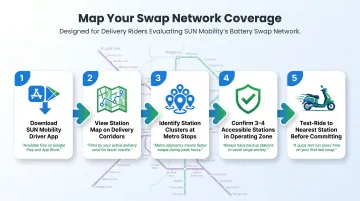
How to map your coverage:
- Download the SUN Mobility Driver app
- View the station map overlay on your typical delivery corridors
- Identify clusters (e.g., metro stations along your routes)
- Confirm at least 3-4 accessible stations within your regular operating zone
- Test-ride to the nearest station before committing to a rental
Step 3: Understand Your Rental Agreement's Battery Terms
For EV renters, your rental contract should specify:
- Who pays swap fees? Is swapping included in your daily/weekly rental rate, or billed per swap?
- Are swap visits capped? Some agreements limit the number of swaps per day or week.
- What if a swapped battery underperforms? Know the process to report poor battery health and who bears the cost of lost earning time.
- Home charging rules: If your rental includes charging capability, check whether the agreement enforces the 80/20 charge limit or penalizes degradation.
A clear rental agreement protects you from surprise charges and clarifies responsibilities. If your provider's terms are vague on swap fees or battery health liability, ask for written clarification before signing.
Step 4: Start With a Rental to Test the Model
For gig workers not ready to commit to a swap-compatible EV, renting is a low-commitment way to test the model before deciding:
Why start with Bounce Daily:
- Rent daily, weekly, or monthly — no upfront capital required
- Upload Aadhaar + DL in the app for same-day verification and pickup
- Both variants have swappable batteries, so you experience the full swap workflow from day one
- Bounce manages maintenance, tracking, and uptime centrally — if a scooter has issues, you swap vehicles, not just batteries
- Franchise partners get a pipeline of verified delivery riders ready to rent, reducing customer acquisition effort
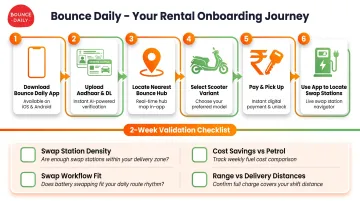
Onboarding process:
- Download the Bounce Daily app
- Upload Aadhaar and driving license for instant verification
- Locate the nearest Bounce hub via the app
- Select your scooter variant (High Speed or Low Speed based on license and range needs)
- Pay via the app and pick up your scooter
- Use the app to locate swap stations along your routes
After a week or two of actual deliveries, you'll have the data to make a confident call. Testing through rental lets you validate:
- Whether swap station density in your zone meets your daily needs
- How the swap process fits into your actual workflow
- Whether the cost savings versus petrol justify the switch
- Whether the EV range matches your typical delivery distances
Most riders know within two weeks whether the model works for them.
Frequently Asked Questions
What is the battery swapping process?
A rider pulls into a swap station, returns the depleted battery pack, and collects a fully charged one from the dispense slot—the whole process takes 1-2 minutes. Most stations use app-based systems to locate nearby stations and log swap transactions.
What is the battery swapping policy?
India's 2022 NITI Aayog Battery Swapping Policy decouples battery ownership from vehicle ownership, enabling Battery-as-a-Service models where users pay per swap rather than buying the battery upfront. The policy aims to standardize battery packs to grow affordable EV access across India, though BIS standards remain in development and the policy itself is still a draft.
Can EV batteries be swapped?
Only EVs designed with removable, standardized battery packs can use swap stations—most conventional EVs have fixed batteries that cannot be swapped. Before choosing a vehicle, confirm swap compatibility with your rental provider or look for "swap-compatible" labeling on the scooter.
What is the difference between battery swapping and battery charging?
Charging keeps the battery in the vehicle and takes 30 minutes to several hours depending on charger type (1-5 hours for home charging, 30-90 minutes for fast charging). Swapping replaces the depleted battery with a fully charged one at a station in 1-2 minutes, eliminating wait time entirely and allowing gig workers to maximize earning hours during peak periods.
Does battery swapping have a future?
In India, the outlook is positive. Government policy support, approximately 3,000 operational swap stations (growing to a projected USD 518 million market by 2034), and strong demand from commercial and gig-economy riders are driving expansion. Two-wheeler swapping is leading adoption, with Bengaluru emerging as a hub through metro-integrated stations and operator partnerships with BMRCL, IOCL, and HPCL.
What is the 80/20 rule for batteries?
The 80/20 rule means keeping your EV battery charge between 20% and 80%—avoiding full drains or full charges—to reduce electrochemical stress and extend cycle life by up to 7.4x. For renters who charge at home between shifts, following this rule helps avoid battery damage fees at return.
Bottom line: India's battery swapping ecosystem is no longer theoretical—it's operational, growing, and increasingly accessible to gig workers in cities like Bengaluru. The policy framework remains imperfect (draft status, GST asymmetry, missing interoperability standards), but market forces are filling the gaps. For delivery partners covering 100+ km/day, swapping delivers measurable income protection through eliminated downtime and roughly 37% cost savings versus petrol.
The question isn't whether to go electric—it's whether to own or rent, and whether your delivery zone has the swap infrastructure to support your shift. Bounce Daily's rental model removes the ownership barrier while giving you immediate access to swap-compatible scooters and Bengaluru's expanding swap network. Start with a week-long rental, map the stations along your corridors, and let the data decide.
For gig workers in swap-ready corridors, the economics already work. The infrastructure is here—the decision is yours.