Introduction
It's 2 PM on a sweltering Bengaluru afternoon. A delivery rider pulls up to a traffic signal, glances at his phone—three orders queued—then down at his scooter's battery indicator: 8% remaining. The nearest charging point is 15 minutes away, and a full charge will take four hours. At ₹102 per working hour, that's over ₹400 in lost earnings, not counting the orders he'll miss while waiting.
This plays out thousands of times daily across India's gig economy, where approximately 12 million workers depend on two-wheelers for their livelihood. As electric scooter adoption surges—India sold a record 1.08 million electric scooters in FY2026, a 41% year-over-year increase—the charging bottleneck has become the single biggest operational challenge for delivery workers.
Battery swapping addresses this directly: replace a depleted battery with a fully charged one in under five minutes, and riders stay on the road earning rather than sitting at a charging station for hours.
Key Takeaways
- Battery swapping replaces a depleted battery with a fully charged one in under 5 minutes, versus 4-6 hours for plug-in charging
- Riders avoid ₹400-600 in lost earnings per charging session by eliminating downtime during peak working hours
- Swap stations use Battery Management Systems to charge, monitor, and certify each battery before it's dispensed
- Under Battery-as-a-Service models, operators own the batteries — riders bear no degradation risk or replacement costs
- The system works best for high-usage gig workers—food delivery partners, e-commerce drivers—who can't afford extended breaks
What Is Battery Swapping?
Battery swapping is the process of exchanging a discharged battery pack from an electric scooter with a fully charged, pre-conditioned one at a designated swap station. Unlike plug-in charging—where the battery remains in the vehicle for 4-6 hours—swapping compresses that wait to minutes, allowing riders to return to work almost immediately.
Commercial delivery vehicles in India often run 15-20 hours per day, travelling 5-6 times more than personal vehicles. Standard charging takes 4 hours 18 minutes for an Ather 450X or 6 hours 30 minutes for an Ola S1 Pro.
For a rider earning ₹102 per hour, a single mid-shift charge costs ₹408-663 in lost income. That's an untenable burden for gig workers whose earnings depend directly on vehicle uptime.
That said, swapping isn't available everywhere or on every scooter. It requires purpose-built vehicles with standardised, removable battery packs. Specifically, the battery must match the station's:
- Form factor — physical dimensions and housing design
- Voltage rating — compatible power output for the vehicle
- Connector type — standardised interface for safe, fast exchange
Interoperability across these three factors is what makes any swap network actually function.
How Does Battery Swapping Work?
Battery swapping follows a defined sequence: arrival, battery removal, insertion of a charged unit, and return to the road. Each stage is engineered for speed.
Arriving at the Swap Station
Riders locate swap stations through mobile apps that display nearby station availability and charged battery inventory in real time. Check-in typically takes under a minute: the rider pulls up to the station bay, verifies their account on the app, and confirms battery availability.
For Bounce Daily riders, the app integrates hub location features, allowing users to find the nearest station and initiate the swap process digitally before they even arrive.
The Swap Process
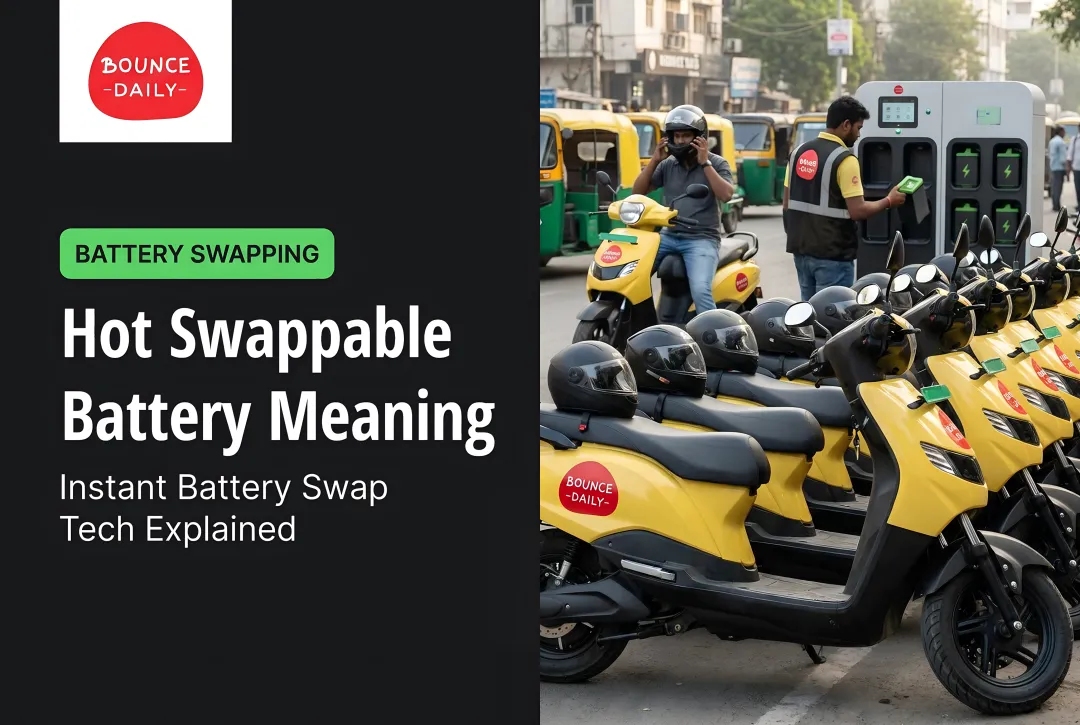
The physical swap is straightforward. The rider (or station attendant, depending on the station model) unlocks the depleted battery pack from the scooter's designated compartment and slides it out. A fully charged unit from the station's battery rack is then inserted into the same slot. Connectors click into place, the system verifies the connection, and the scooter is operationally reset.
This is only possible because the battery pack is standardised and modular—the same form factor, voltage, and connector type across all vehicles in the fleet. Standardisation is the non-negotiable foundation: without it, each scooter would require a unique battery, making pooled swap infrastructure impossible.
Real-world swap times reflect how well that standardisation holds up under daily use:
Real-world swap timelines:
- Gogoro (Taiwan): 6 seconds
- ZEWAY (France): 50 seconds
- SUN Mobility (India): Under 2 minutes
- Battery Smart (India): Approximately 2 minutes
Most Indian networks complete the swap in under 5 minutes total station time, including check-in and payment.
Battery Management Inside the Station
Each swap station actively charges, monitors, and conditions batteries using a Battery Management System (BMS). The BMS tracks:
- State of Charge (SoC) – current charge level
- State of Health (SoH) – overall battery health and remaining useful life
- Cell voltage – voltage at the individual cell level
- Temperature – real-time thermal monitoring during charging and storage
- Usage history and cycle count – tracking charge/discharge cycles
- Fault detection – identifying thermal runaway risks or cell anomalies
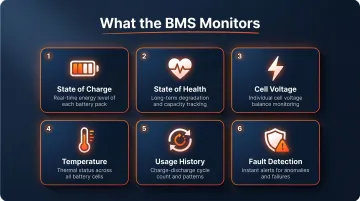
Only batteries that pass safety and charge verification qualify for swap. Every unit a rider receives has been actively vetted for charge level and cell health before it reaches the rack.
Back on the Road
The rider leaves the station with a guaranteed full charge—no guessing about battery percentage or wondering if it will last the shift. The scooter is operationally reset and ready for the next delivery cycle, typically within 2-5 minutes of arrival.
Why Battery Swapping Saves Time: The Numbers That Matter
A delivery rider earning ₹102 per hour who waits 4 hours for a plug-in charge loses ₹408 in potential earnings. A 6-hour charge cycle for an Ola S1 Pro costs ₹612 in lost time. A 2-minute battery swap eliminates virtually all of that downtime.
For riders working 10-12 hour shifts, the compounding effect is even more significant. Many need to top up once or twice during peak delivery windows. With plug-in charging, that means two extended breaks totalling 8-12 hours of lost work time per day. With swapping, two stops of under 5 minutes each—less than 10 minutes total downtime.
Battery Smart claims its network increases a driver's daily earnings by as much as 50%, primarily by eliminating charging downtime. Operational networks like Battery Smart complete over 2 million monthly swaps across 1,000+ locations—a figure that reflects just how heavily active riders depend on swap infrastructure daily.
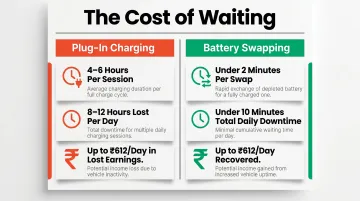
At a glance, the time difference between the two charging models is significant:
- Plug-in charging: 4-6 hours per session, 8-12 hours lost per day across two top-ups
- Battery swapping: Under 2 minutes per swap, under 10 minutes total daily downtime
- Earnings impact: Up to ₹612/day recovered by eliminating charge waits
Range anxiety effectively disappears with this model. Riders no longer need to monitor battery percentage mid-route or cut deliveries short to reach a charger. Knowing a full replacement is always nearby changes route planning—riders can accept orders farther from their base, confident a swap is available if needed.
Home charging overnight works for commuters with predictable schedules and dedicated parking. Gig workers on variable shifts, or those renting scooters rather than owning them, often lack that option. Swapping fills the infrastructure gap directly, turning battery replenishment into a quick stop rather than a multi-hour commitment.
What Happens to Batteries at the Swap Station?
While a rider is out delivering, the depleted battery they left behind is being conditioned. Swap stations use slow-charging protocols to preserve cell longevity, cooling systems to manage heat (especially critical in Indian summers), and BMS monitoring to detect faults before the battery re-enters rotation.
Most swap networks operate under a Battery-as-a-Service (BaaS) model: the battery is owned by the operator, not the rider. This removes the battery degradation risk and replacement cost from the rider entirely. Under BaaS:
- Riders pay only for energy consumed — similar to refuelling at a petrol pump
- The operator manages battery health across the entire pool
- Battery replacement and maintenance costs never fall on the rider
NITI Aayog's Draft Battery Swapping Policy (April 2022) formally endorses this model, proposing to decouple battery ownership from vehicle ownership and extend EV subsidies to swappable-battery vehicles. SUN Mobility, for example, charges ₹40.70 per kWh for battery energy at its swap stations; Battery Smart charges ₹50–80 per swap for electric scooters.
Swap operators typically track battery health across their full lifecycle, retiring packs before capacity or safety drops. Most electric scooter batteries are rated for 300–500 full charge cycles before noticeable capacity loss; premium lithium-ion batteries can last 800–1,000 cycles with proper care.
Managed rotation ensures degraded units are pulled from circulation before they affect rider performance — keeping the fleet reliable across thousands of batteries.
Who Benefits Most from Battery Swapping?
Food delivery workers, e-commerce delivery partners, and intercity couriers benefit most—anyone whose income depends directly on vehicle uptime. For these riders, swapping is more practical and affordable than waiting to charge. Blinkit reports 80% of its Gurgaon last-mile fleet is already electric, with approximately 50,000 EV delivery partners as of March 2025. Major platforms including Zomato, Swiggy, and Flipkart have pledged 100% EV fleets by 2030.
Rental models built around swappable batteries take this further. Riders who rent rather than own get a full-featured EV without worrying about battery ownership, maintenance, or degradation costs. Bounce Daily's rental service in Bengaluru is built around exactly this model, offering two variants:
- Low Speed (25 km/h, 85 km range, swappable battery only, with driving licence assistance (available for a nominal ₹200-₹230 fee) at our hub): ideal for hyperlocal delivery workers in dense urban areas. Visit us or check our app to know more.
- High Speed (55 km/h, 70 km range, requires driving licence, chargeable and swappable battery): suitable for longer-range delivery routes with flexible charging options Both variants remove the upfront cost of battery ownership and ensure riders always have access to a functioning power source. Testimonials from Bounce Daily riders like Karanbir Das highlight the practical benefits: "Way more cost-effective than petrol bikes—I've never faced any issues with the battery."
Commuters are a secondary but growing segment. Those with predictable routes and home charging access can rely on plug-in options. But urban commuters in dense cities with limited parking or power access benefit from swap station convenience—especially under rental models that remove the burden of ownership entirely.
Frequently Asked Questions
What is battery swapping?
Battery swapping is the process of replacing a discharged electric scooter battery with a fully charged one at a designated swap station. The entire process takes under 5 minutes, with no charging wait time required.
What is battery float charging?
Float charging is a maintenance charging method that keeps a fully charged battery at its optimal voltage without overcharging. In swap stations, float charging principles are used to hold batteries in standby condition between uses, maintaining readiness without degrading the cells.
What is the 20-80% battery care rule?
The 20-80% rule recommends keeping charge levels between 20% and 80% to maximise battery longevity. Swap station BMS systems apply this principle by conditioning batteries to optimal levels rather than always charging to 100%.
How long does a battery swap take for an electric scooter?
Most electric scooter battery swaps take between 50 seconds and 5 minutes depending on station design and location. Indian networks like SUN Mobility and Battery Smart average under 2 minutes, while Gogoro in Taiwan achieves swaps in 6 seconds. A full plug-in charge, by comparison, takes 4-6 hours.
Is battery swapping safe for electric scooters?
Yes, when done through an operator-managed swap station with a BMS. The system verifies battery health, monitors temperature and voltage, and checks connection integrity before every swap.
Can all electric scooters support battery swapping?
No. Battery swapping requires purpose-built modular battery compartments and standardised connectors, and not all scooters are designed for it. Riders should confirm swap compatibility before choosing a vehicle or rental plan — Bounce Daily offers swap-enabled models on both scooter variants.