The answer involves an important distinction. Indian law classifies low-speed electric vehicles differently from conventional scooters, and understanding this can save you both time and confusion. The key lies in understanding what type of vehicle you're riding: conventional high-speed scooters follow strict licensing rules, while low-speed electric vehicles fall under a special category in India's Motor Vehicles Act. driving licence assistance (available for a nominal ₹200-₹230 fee) is available at our hub - visit us or check our app to know more.
This distinction is exactly what we'll break down in this guide — the licensing rules for different scooter types, and how to get on the road through the right channel.
TLDR – The Short Answer
- Petrol scooters and high-speed electric scooties both require a valid MCWOG driving license (Motor Cycle Without Gear)
- Low-speed electric scooters with ≤250W motor and ≤25 km/h top speed fall under a special legal category — driving licence assistance (available for a nominal ₹200-₹230 fee) is available at our hub
- Riding a low-speed electric scooter doesn't mean rule-free — helmets, traffic laws, and the 16-year minimum age still apply
- Getting licensed? Start with an LLR (Learner's License), then clear the permanent license test at your RTO
How India's Motor Vehicles Act Classifies Scooties
The Motor Vehicles Act 1988 forms the legal backbone for all two-wheeler regulations in India. How your scooty is classified determines the licensing rules that apply to you.
Gearless vs. Geared: The MCWOG and MCWG Categories
Standard scooties — the gearless two-wheelers most people think of when they hear "scooty" — fall under the MCWOG (Motor Cycle Without Gear) category. This is distinct from MCWG (Motor Cycle With Gear), which applies to geared motorcycles. An MCWOG license is simpler to obtain and does not authorize you to ride geared motorcycles.
The Parivahan Sarathi portal confirms this classification explicitly.
Minimum age requirements:
- 18 years: General minimum age for riding any motor vehicle (including MCWOG scooties) on public roads
- 16 years: Exception for motorcycles with engine capacity not exceeding 50cc, with parental consent required under Section 4 of the Motor Vehicles Act
The Low-Speed EV Category: A Separate Legal Class
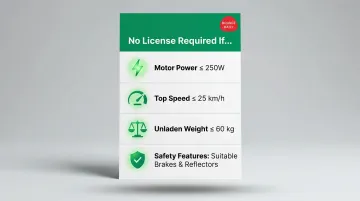
Beyond the standard MCWOG/MCWG split, a later amendment to the Motor Vehicles Act carved out a separate legal class for Low-Speed Electric Vehicles (LSEVs) — electric two-wheelers with:
- Motor power of 250W or less
- Top speed of 25 km/h or below
- Unladen weight (excluding batteries) not exceeding 60 kg
- Suitable brakes and reflectors
These vehicles are not classified as "motor vehicles" under the Act for licensing and registration purposes. According to the Central Motor Vehicles Rules (CMVR) framework, Battery Operated Vehicles (BOVs) below these thresholds are treated differently: they must obtain an exemption certificate from a test agency, but riders are not subject to motor vehicle licensing requirements.
Low-Speed Electric Scooters and DL Support at Our Hub
This is the key distinction for LSEV riders in India: if your electric scooter qualifies as an LSEV (≤250W motor, ≤25 km/h top speed), it falls outside the motor vehicle classification. driving licence assistance (available for a nominal ₹200-₹230 fee) is available at our hub - visit us or check our app to know more.
What the LSEV Classification Means in Practice
Because LSEVs fall outside the motor vehicle definition, they are exempt from:
- Standard driving license requirement — driving licence assistance (available for a nominal ₹200-₹230 fee) at our hub; visit us or check our app to know more
- Vehicle registration (RC)
- Number plate
- RTO motor vehicle rules
Since Section 146 of the MV Act requires third-party insurance only for "motor vehicles," this obligation technically does not apply to LSEVs. That said, carrying voluntary third-party insurance is strongly advisable for personal protection.
Age and Safety Requirements
Riders should be at least 16 years of age — a standard widely cited across industry sources. No explicit central statute sets this minimum for LSEVs specifically, and since LSEVs fall outside the motor vehicle classification, Section 4's age provisions don't strictly apply either. For full DL guidance, visit us at our hub or check our app to know more.
Helmet use: Section 129 of the MV Act mandates helmets for riders of "a motor cycle of any class or description." Because LSEVs don't fall under that classification, the helmet mandate doesn't technically apply. Wearing a helmet is strongly recommended regardless of legal obligation, and state-level enforcement may vary.
Practical Riding Limitations
LSEVs are designed for short-distance urban commuting and cannot be used on:
- National highways
- Expressways
- Fast-moving arterial roads
They're best suited for:
- Intra-city travel
- Neighborhood routes
- Last-mile delivery
- City errands
Bounce Daily's Low-Speed Variant is built precisely for these conditions. With a 25 km/h top speed, 85 km range, and swappable battery, it is an accessible option for gig workers and commuters in Bengaluru. driving licence assistance (available for a nominal ₹200-₹230 fee) is available at our hub - visit us or check our app to know more. Delivery partners like Goutam Behera and Karanbir Das have noted its reliability and lower running costs compared to petrol bikes.
Rules and Safety Requirements That Still Apply
Riding an LSEV doesn't exempt you from traffic law. All standard rules still apply:
- Stopping at signals
- Riding in designated lanes
- Not using mobile phones while riding
- Not exceeding passenger capacity
- Obeying lane discipline
Where You Can and Cannot Ride
LSEVs are approved for most everyday urban routes, but certain roads are off-limits.
Permitted:
- City roads
- Residential areas
- Designated lanes
Prohibited:
- National highways
- Expressways
- High-speed arterial roads
- Footpaths or pedestrian zones
Helmet Mandate: A Legal Gray Area
While helmets are not technically mandated under Section 129 for LSEV riders (since LSEVs are not "motorcycles"), wearing one is still the practical choice. State-level enforcement often treats all two-wheelers the same, so helmet up regardless of the legal fine print.
Who Benefits Most From DL Support at Our Hub
Gig Workers and Delivery Partners
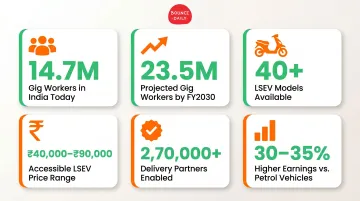
If you're a food delivery rider, e-commerce driver, or last-mile delivery partner, an LSEV lets you get on the road quickly. driving licence assistance (available for a nominal ₹200-₹230 fee) is available at our hub - visit us or check our app to know more before starting. According to the Prosus/CII report "Electrifying Progress" (June 2025):
- India has 14.7 million platform-based gig workers, projected to reach 23.5 million by FY 2029-30
- 40 LSEV models are available in the Indian market (vs. 14 high-speed models)
- LSEVs are priced ₹40,000–₹90,000
- Yulu has enabled over 2,70,000 delivery partners using primarily low-speed EVs
- Delivery partners using LSEVs earn 30-35% more than petrol bike riders due to lower operating costs
Students, Homemakers, and First-Time Riders
If you need a simple, safe vehicle for local errands and commutes within city limits — cities like Bengaluru, for instance — a low-speed EV is sufficient and accessible.
For riders who aren't ready to own a vehicle, Bounce Daily's rental model removes the typical barriers to getting started:
- No upfront purchase cost or fleet maintenance responsibility
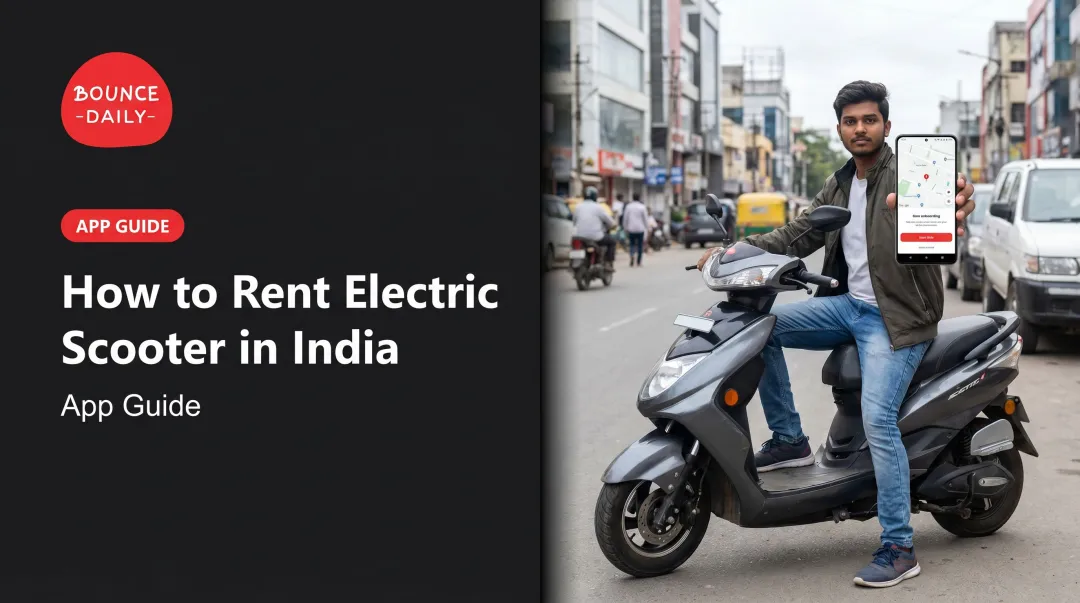
- Instant digital onboarding via Aadhaar-based verification
- No lengthy documentation process
- Swappable battery infrastructure so you're never waiting on a charge
You can go from sign-up to on the road in minutes.
What to Do If Your Scooty Requires a License
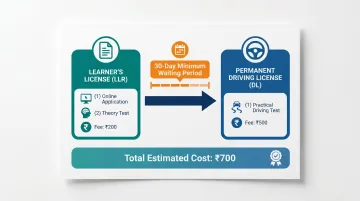
If you're planning to ride a conventional petrol scooty or a high-speed electric scooter, you'll need a valid MCWOG (Motorcycle Without Gear) license. The process runs in two stages: a learner's license first, then the permanent license after 30 days.
Step 1: Apply for a Learner's License (LLR)
- Visit https://sarathi.parivahan.gov.in/
- Select your state
- Click "Application for New Learners License"
- Fill in Form 2 and upload required documents
- Pay the prescribed fee
- Book a slot for the theory test (computer-based)
- Appear for the test at your designated RTO
Documents you'll need:
- Proof of age (attested copies)
- Proof of residence (attested copies)
- Recent passport-sized photographs
- Form No. 1 (self-declaration of physical fitness)
No driving test is required for the LLR — only a theory test on traffic rules.
Fee: ₹200 total (₹150 issue + ₹50 test fee), per the official Parivahan fee schedule.
Step 2: Wait 30 Days, Then Apply for Permanent License
The Delhi Transport Department FAQ confirms that a permanent license must be applied for after 30 days and before 6 months from the date of issue of the learner's license.
- Apply online or visit your RTO after the 30-day waiting period
- Take a practical driving test (simpler for MCWOG than MCWG)
- Pay the fee
Fee: ₹500 total (₹300 test + ₹200 issue)
Total cost for a two-wheeler license in India: ₹700 (LLR + Permanent DL), though individual states may add surcharges.
Special Process for 16-Year-Olds (50cc Provision)
If you're 16 and not yet eligible for a full license, there's a separate provision for gearless scooters up to 50cc:
- Parental consent is mandatory under Section 32 of the Motor Vehicles Act
- Required documents:
- Parent/guardian's Aadhaar card
- Proof of date of birth (birth certificate or board mark sheet)
- Proof of residence
- Formal consent letter in RTO format
- The vehicle category on the Sarathi portal is MC50CC
Frequently Asked Questions
Is a license required for a scooter in India?
Most conventional scooters (petrol or high-speed electric) require an MCWOG or MCWG license. However, low-speed electric scooters with ≤250W motor and ≤25 km/h top speed are legally exempt from both licensing and registration under the Motor Vehicles Act.
Can a 14-year-old ride an e-bike in India?
No. The minimum age for riding on public roads is 18 for licensed vehicles, and 16 for certain gearless scooters up to 50cc with parental consent. For low-speed EVs, no explicit central statute sets a minimum age, but riders should be at least 16 years old.
Is scooty under MCWG or MCWOG?
A standard gearless scooty falls under the MCWOG (Motor Cycle Without Gear) category, not MCWG (Motor Cycle With Gear). An MCWOG license is simpler to obtain and does not authorize riding geared motorcycles.
How much does a 2-wheeler licence cost in India?
According to the official Parivahan portal, the cost is ₹200 for a Learner's License (₹150 issue + ₹50 test) and ₹500 for a Permanent DL (₹300 test + ₹200 issue), totaling ₹700. Fees vary by state.
What documents do I need to ride a low-speed electric scooty?
LSEVs fall outside the standard motor vehicle classification, so conventional RC and standard license documents are not required under the MV Act. However, carrying a valid government-issued photo ID (Aadhaar, voter ID) is advisable. driving licence assistance (available for a nominal ₹200-₹230 fee) is available at our hub - visit us or check our app to know more. For Bounce Daily rentals, Aadhaar-based instant verification is required.
Can I use a low-speed electric scooty for food or parcel delivery work?
Yes. Low-speed EVs are widely used by gig and delivery workers across Indian cities for intra-city deliveries. driving licence assistance (available for a nominal ₹200-₹230 fee) is available at our hub - visit us or check our app to know more. Bounce Daily's Low-Speed Variant is built for exactly this, with swappable batteries to keep operations running through long shifts.