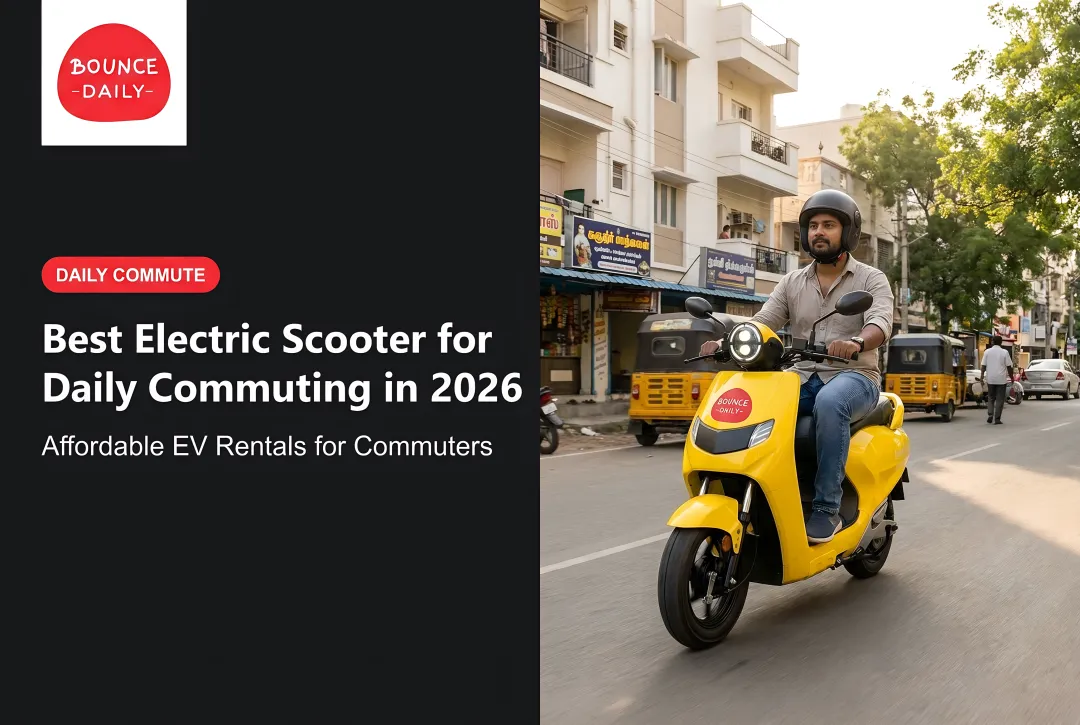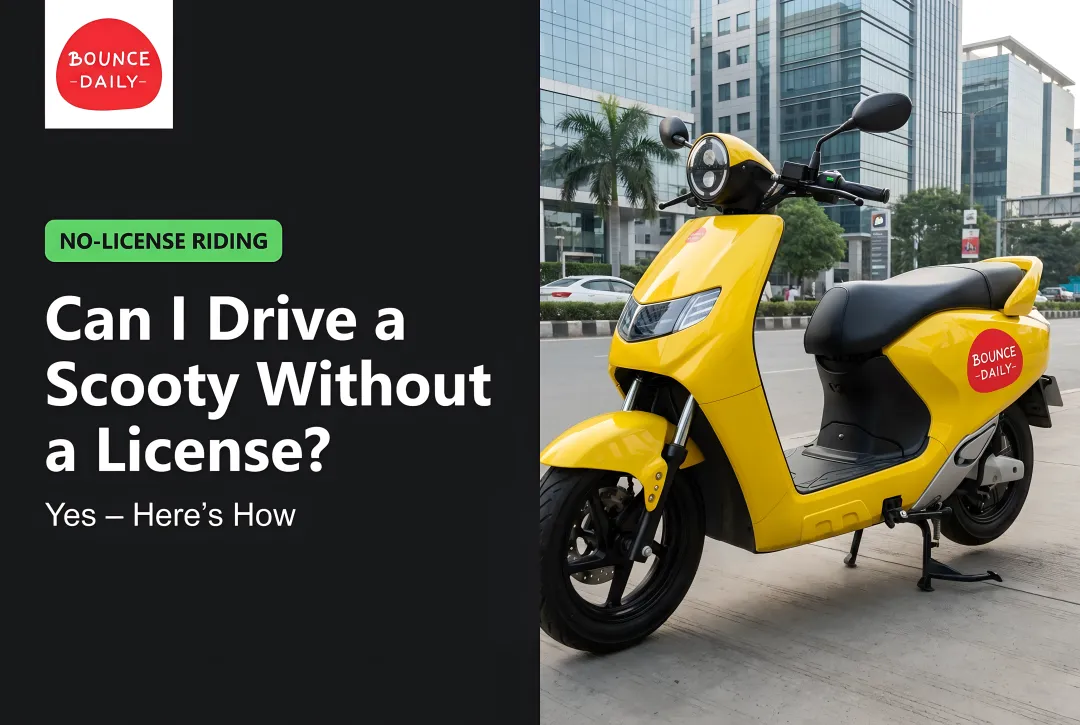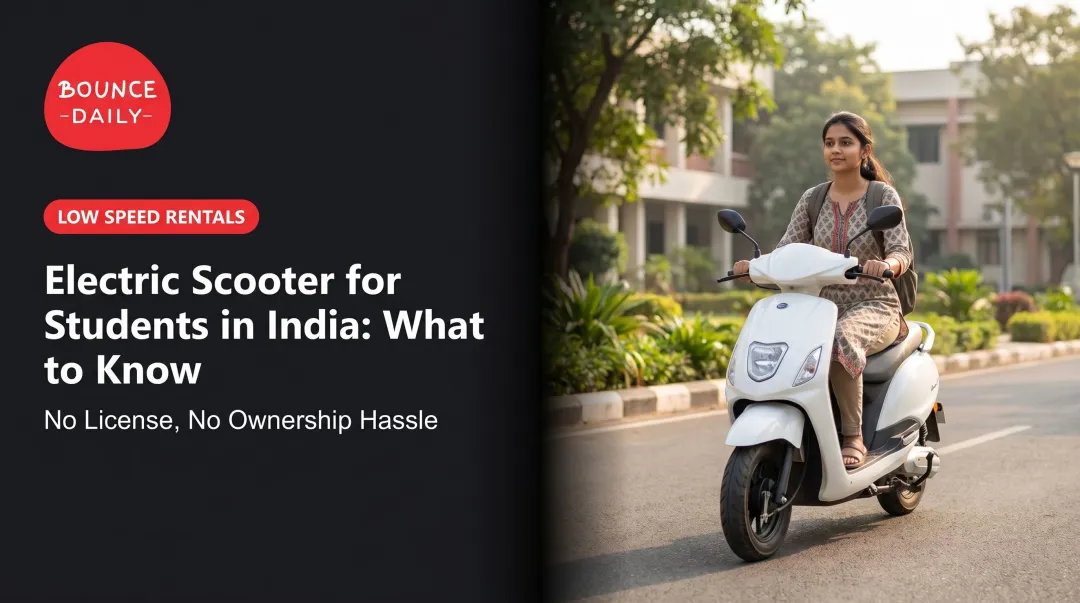
The honest answer is: it depends entirely on the scooter. A specific category of electric scooters in India is legally exempt from requiring a driving license or vehicle registration. This exemption isn't because the vehicle runs on a battery — it's because of precise technical thresholds defined under Indian motor vehicle law.
This article covers exactly what makes a scooter license-free, which models qualify, what features matter most, and how Bounce Daily's rental option removes the ownership barrier entirely.
Key Takeaways
- Scooters rated below 0.25 kW (250W) with a top speed below 25 km/h are exempt from license and registration under CMVR Rule 2(u)
- The exemption is about power and speed limits — popular models like Ola S1, Ather 450X, and TVS iQube do not qualify
- Only purpose-built low-speed EVs meet the threshold; being electric alone is not enough
- In Bengaluru, Bounce Daily's Low Speed rental (25 km/h, 85 km range) offers no-license, same-day onboarding
What Makes an Electric Scooter License-Free in India?
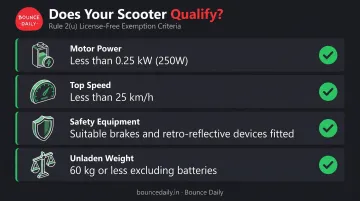
India's license-free scooter rules come down to one specific regulation. The legal basis is CMVR Rule 2(u), brought into effect by MoRTH Notification G.S.R. 291(E) dated 24 April 2014. Under this rule, a two-wheeled battery-operated vehicle (BOV) certified by an approved testing agency is not deemed a motor vehicle if it meets all of the following:
- Motor thirty-minute power: less than 0.25 kW (250W)
- Maximum speed: less than 25 km/h
- Suitable brakes and retro-reflective devices fitted
- Unladen weight excluding batteries: 60 kg or less
India's Motor Vehicles Act (MVA) applies its licensing requirement (Section 3) and registration requirement (Section 39) only to motor vehicles. If your scooter qualifies under Rule 2(u), it falls outside that definition — no RC, no number plate, no DL needed.
The "Just Electric" Misconception
People often assume any electric scooter is automatically license-free. That's wrong. High-speed electric scooters — including Ather 450X, Ola S1 Pro, TVS iQube S, and Bajaj Chetak — require full registration, a valid two-wheeler driving license, and mandatory third-party insurance, exactly like petrol vehicles.
The exemption is only for scooters that stay within the 0.25 kW and 25 km/h thresholds.
The term "L1 category" is sometimes used loosely in this context. Strictly speaking, CMVR's Category L1 definition covers motorcycles up to 45 km/h design speed — which doesn't directly map to the Rule 2(u) exemption. The correct legal framing is low-speed battery-operated vehicle exempt under CMVR Rule 2(u).
Why This Matters for Gig Workers
NITI Aayog estimated India had 77 lakh gig workers in FY 2020-21, projected to grow to 2.35 crore by FY 2029-30. Many of these workers — particularly in food delivery and quick-commerce — are young, from semi-urban backgrounds, and don't yet hold a full driving license. The low-speed exemption removes a genuine entry barrier.
What About Helmet Rules?
MVA Section 129 requires protective headgear for motorcycle riders. While the direct applicability of this section to Rule 2(u) exempt vehicles has not been separately clarified in an official government source, the practical and safety-conscious approach is clear: wear a BIS-certified helmet regardless. The license exemption does not suspend basic road safety obligations.
Note: No verified official MoRTH or NHAI source was found in research that specifically prohibits Rule 2(u) low-speed scooters from highways or expressways. Riders should check with their local RTO for jurisdiction-specific guidance.
Electric Scooters in India That Don't Need a License
Important note before this section: The research for this article verified product specifications against official manufacturer sources, ARAI/ICAT certification data, and published brochures. Several models commonly listed elsewhere as "license-free" — including the Ampere Zeal EX (official brochure lists 1200W and 55 km/h) — did not pass this verification check. The models below are positioned in the low-speed category, but always confirm current specifications on the VAHAN portal or official ARAI/ICAT certification before purchasing, as product lines can change.
Three options worth knowing about are listed below — two for purchase, one for rental.
Hero Electric Optima CX (Low-Speed Variant)
Hero Electric is one of India's most established electric two-wheeler brands, with a service network spanning hundreds of cities. The Optima CX low-speed variant is designed for short-range urban use — commutes under 40-50 km daily, last-mile delivery runs, and first-time EV adoption.
Its main practical advantage beyond the license exemption: Hero Electric's service density. For gig workers and students outside metro cores, finding a service point matters as much as the scooter's specs.
Key things to know before buying:
- Wide service network across Tier 1 and Tier 2 cities — easier to find repair support
- Check current motor/battery specs directly on Hero Electric's official site or the VAHAN portal, as certified specs change
- FAME II or state EV subsidies may apply — confirm at point of purchase
- Verify Rule 2(u) compliance (≤250W, ≤25 km/h) via ARAI or ICAT certification before buying
Kinetic Green Zing
Kinetic Green brings legacy two-wheeler brand recognition to the low-speed EV space. The Zing targets hyperlocal urban and semi-urban riders, and its footprint in Tier 2 and Tier 3 cities sets it apart — where high-speed EV service infrastructure is sparse, a lightweight, easily repairable scooter from a brand with regional presence is worth considering.
Key things to know before buying:
- Strong Tier 2 and Tier 3 city presence — better regional serviceability than most low-speed options
- Check current motor/battery specs directly on Kinetic Green's official site
- Confirm Rule 2(u) compliance (≤250W, ≤25 km/h) via ARAI/ICAT certification — aggregator listings are not a substitute for official data
Bounce Daily Low Speed Rental (No-Ownership Option)
For gig workers and delivery partners in Bengaluru who want a license-free scooter without buying one, Bounce Daily's Low Speed rental variant is the only rental option on this list.
Bounce Daily — the EV rental service from Bounce Infinity — re-entered the market in April 2025 after a three-year pause, targeting delivery partners working with Swiggy, Zomato, Blinkit, Zepto, and similar platforms.
| Specification | Details |
|---|---|
| Top Speed & Range | 25 km/h certified top speed; 85 km claimed range per charge |
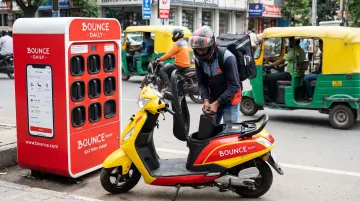
| Battery | Swappable battery only; unlimited swaps at Bengaluru hubs included in rental |
| Onboarding | Aadhaar-only KYC; no driving license required; same-day digital onboarding via Bounce Daily Android app |
| Rental Plans | Daily, weekly, and monthly tiers available in-app |
| What's Included | Insurance, maintenance, GPS tracking, anti-theft, breakdown recovery — all managed by Bounce |
The battery swap system is the operational standout. A swap takes minutes — comparable to a petrol stop — and is included in every rental plan at no extra charge.
Delivery partner Karanbir Das, who has used Bounce for over a year, put it simply: "Way more cost-effective than petrol bikes, and I've never faced any issues with the battery."
Goutam Behera adds: "The build quality is top-notch and it runs smoothly every single day."
For gig workers on 10-12 hour shifts, the 85 km range, unlimited swaps, and zero maintenance responsibility remove the friction that makes most low-cost EV options impractical.
Key Features to Look for in a License-Free Electric Scooter
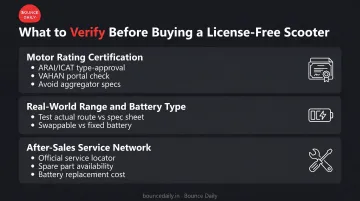
Not all scooters marketed as "low-speed" or "no-license" actually qualify under Rule 2(u). Before you choose, check these three things: motor certification, real-world range, and after-sales reach.
Motor Rating Certification
The legal gate is motor thirty-minute power below 0.25 kW. Some manufacturers advertise "low-speed" models but list peak motor power above 250W — peak power is not the same as the continuous rating used in Rule 2(u) compliance. To verify:
- Check the ARAI or ICAT type-approval certificate for the specific variant
- Cross-check against the VAHAN portal registration records
- Don't rely on aggregator spec sheets — go directly to manufacturer-certified documents
Real-World Range and Battery Type
Low-speed EVs typically cover 40-85 km per charge under normal use. Two things matter here:
- Manufacturer range figures are measured under ideal conditions. If you're covering 60-80 km daily on delivery, test or confirm the scooter handles your actual route — not the spec sheet number
- For delivery riders, a swappable battery keeps earnings intact — fixed-battery scooters need hours of home charging, which cuts directly into shift time
After-Sales Service Network
A ₹45,000 scooter with no nearby service centre can cost more in downtime and repair delays than a ₹60,000 scooter with a dealer 2 km away. For Tier 2 and Tier 3 city buyers especially:
- Check the brand's official service locator, not just dealer claims
- Ask specifically about spare part availability and typical wait times
- Factor in battery replacement cost over a 2-3 year ownership horizon
How to Choose: A Quick Decision Framework
Use this table to match your situation to the right option:
| Your Situation | Best Option |
|---|---|
| No license, short-radius commute or last-mile delivery | Bounce Daily Low Speed rental — 25 km/h, 85 km range, Aadhaar-only onboarding |
| No license, student or first-time rider in Bengaluru | Bounce Daily Low Speed rental — no DL required, same-day digital signup |
| Have a DL, need higher speed for longer delivery routes | Bounce Daily High Speed rental — 55 km/h, 70 km range, DL + Aadhaar onboarding |
| No capital for EMI or petrol, gig worker in Bengaluru | Bounce Daily rental — daily/weekly/monthly plans, maintenance and insurance included |
Conclusion
The no-license electric scooter category in India is clearly defined: motor power below 0.25 kW and top speed below 25 km/h, as established by CMVR Rule 2(u) under MoRTH Notification G.S.R. 291(E). Riders who stay within these thresholds can commute without registration paperwork or a driving license — which removes a real barrier for gig workers, students, and first-time riders getting started.
Two important reminders before you act on this:
- Verify, then buy. Regulations and product lines both change. Always confirm Rule 2(u) compliance via official ARAI/ICAT certification for any specific variant before purchasing — not from a spec aggregator website.
- Think total cost of ownership. Battery replacement, service costs, and charging infrastructure should factor into your decision alongside the sticker price.
If you're in Bengaluru and want to start riding without buying, Bounce Daily's Low Speed rental is built for exactly that situation. Key features:
- Aadhaar-only onboarding — no driving license needed
- Insurance included and fleet maintained by Bounce
- Swappable battery support at Bounce hubs
Download the Bounce Daily app to find your nearest hub and view current rental plans.
Frequently Asked Questions
Can you ride an electric scooter without a license in India?
Yes — if the scooter qualifies under CMVR Rule 2(u) (motor below 0.25 kW, top speed below 25 km/h), it is not deemed a motor vehicle, so MVA Section 3's license requirement does not apply. Riders must still follow road safety rules, including wearing a BIS-certified helmet.
What is the minimum age to ride a license-free electric scooter?
The Motor Vehicles Act sets the general minimum age for riding at 16 years (for vehicles with engine capacity not exceeding 50cc) and 18 years for motor vehicles. No separate minimum age for Rule 2(u) exempt scooters has been confirmed from official sources — check with your local RTO for definitive guidance.
Do low-speed electric scooters need to be registered in India?
No. Because Rule 2(u) exempt scooters are not deemed motor vehicles, MVA Section 39's registration requirement does not apply. You don't need an RC or number plate, but you should carry proof of purchase and confirm the scooter carries valid Rule 2(u) compliance certification.
What is the speed limit for a license-free electric scooter in India?
The top speed must be certified below 25 km/h for the Rule 2(u) exemption to apply. A scooter with a higher certified speed — or a higher-rated motor — is classified as a registrable motor vehicle and requires a valid driving license.
Can delivery partners use a license-free electric scooter for gig work?
Yes. Low-speed Rule 2(u) scooters are well-suited for hyperlocal last-mile delivery within city limits. Bounce Daily offers low-speed rental options for gig workers in Bengaluru that require only Aadhaar for onboarding.
Is insurance required for a license-free electric scooter?
MVA Section 146 mandates third-party insurance for motor vehicles. Since Rule 2(u) exempt scooters aren't classified as motor vehicles, this requirement technically doesn't apply — but third-party insurance is strongly advisable. Delivery platforms may independently require proof of coverage, so verify with your platform and local RTO.