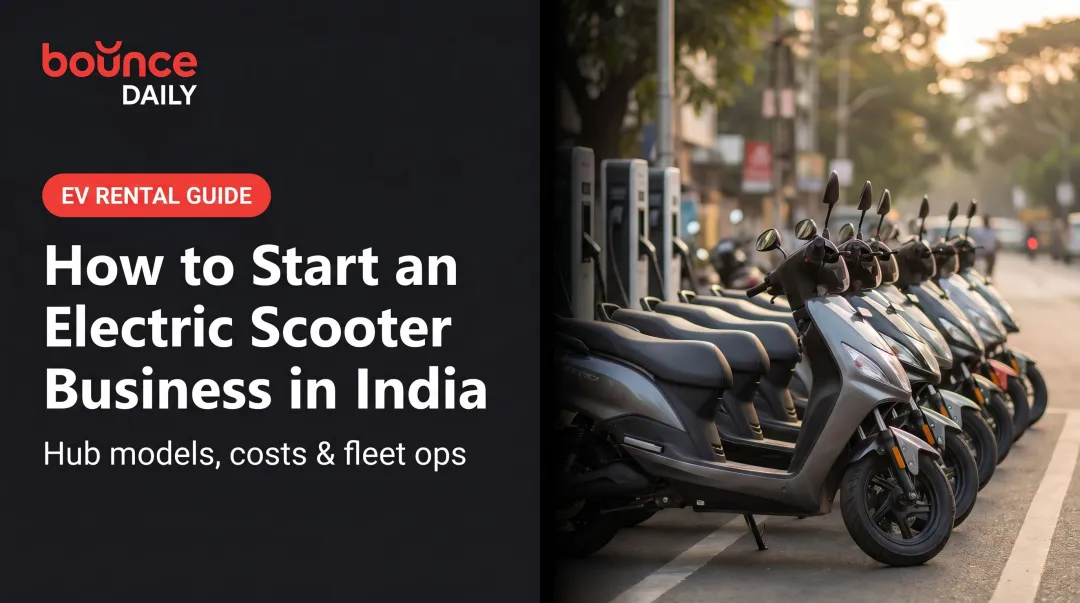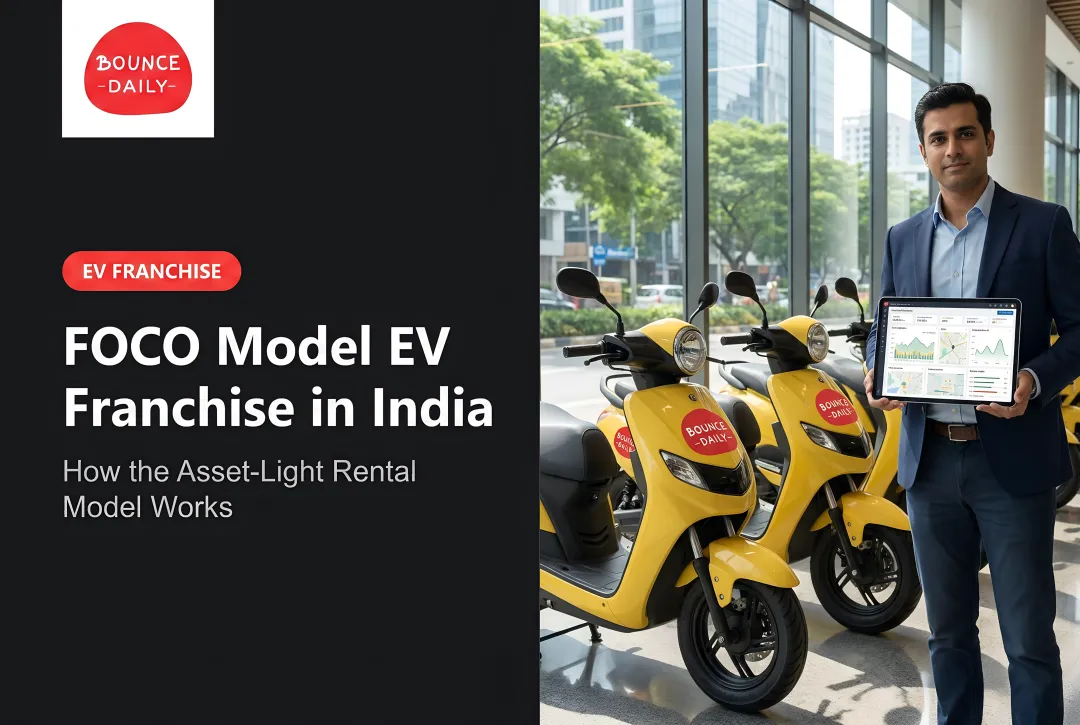
Unlike capital-intensive dealership models requiring showrooms and large inventory, or infrastructure-heavy charging stations, an EV rental hub focuses on one thing: putting electric scooters in the hands of riders who need affordable, reliable daily transport. This guide walks you through what launching an EV rental hub in India actually involves—from evaluating the opportunity to running day-to-day operations.
Key Takeaways
- An EV rental franchise means owning and operating a fleet of electric scooters that riders rent on daily or weekly terms—primarily gig workers and commuters
- Entry costs start from approximately ₹3.8 lakh for a 5-vehicle fleet in rental-focused models, far below ₹15–50 lakh dealership setups
- Revenue comes from daily rental fees; profitability depends on fleet utilization rate, local rider demand, and operating costs
- Launch in five steps: validate local demand, choose a franchise partner, set up your location and fleet, onboard riders, then track and optimize
- Most franchisees target break-even within 6–12 months, depending on fleet size and how fast you onboard riders
What Is an EV Rental Franchise in India?
An EV rental franchise is a business where an entrepreneur owns a fleet of electric scooters and rents them to riders on flexible terms—typically daily or weekly—earning recurring income per vehicle deployed.
This model differs fundamentally from other EV business types:
- No vehicle sales, showroom buildout, or inventory financing — unlike EV dealerships
- No land acquisition or infrastructure play — unlike EV charging stations
- No ownership transfer — riders pay for daily mobility access, not the asset itself
How you operate depends on your scale and ambition. Three formats are common in India:
- Owner-operated hubs with 5–15 vehicles, managed directly with low overhead
- Franchise-supported setups where partners like Bounce Daily provide fleet management, verified rider pipelines, maintenance tracking, and platform support
- Multi-hub operations for entrepreneurs expanding across locations once the model becomes reliably profitable
Riders are primarily gig workers—food delivery, e-commerce, logistics—and daily commuters who need affordable transport without the cost or commitment of ownership.
What to Know Before You Start an EV Rental Hub
Starting an EV rental hub is more than riding India's EV growth wave. The day-to-day work involves fleet management, rider coordination, maintenance discipline, and cashflow awareness from week one.
Key realities specific to EV rental:
- Expect the first 3–6 months to be hands-on: setting up systems, onboarding riders, closing operational gaps, and building local reputation
- Fleet utilization doesn't peak immediately — it grows as your rider base expands and retention improves over time
- Battery health, charging cycles, and vehicle condition tracking all require either in-house capability or a franchise partner with managed service support
- Security deposits, spare battery inventory, and maintenance reserves add up fast — cashflow planning separates profitable hubs from struggling ones
Common early mistake: Overestimating daily utilization. New operators often assume 90%+ from day one, without accounting for maintenance downtime, weather, or slow-demand periods. A realistic early-stage target is 50–70%.
Why Start an EV Rental Hub in India?
This business works under specific conditions — and those conditions are increasingly common across Indian cities.
Market fundamentals:
According to JMK Research, India's electric two-wheeler sales reached 1.14 million units in FY2025, up 21% from the previous year. Separately, NITI Aayog projects India's gig economy will employ over 1 crore (10 million) workers in 2024-25, growing to 2.35 crore by 2029-30. About 35% of gig workers are in delivery and logistics—your core customer segment.
Conditions that make this business viable:
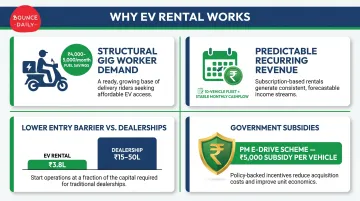
- Structural demand from gig workers: Food delivery and e-commerce riders need reliable, affordable daily transport. Many prefer renting over ownership to avoid upfront costs and maintenance responsibility. Delivery riders typically spend ₹4,000–5,000 per month on fuel riding petrol bikes—electric rentals can cut this cost by 70–80%
- Predictable, recurring revenue: Daily rental fees from a consistent rider pool create income stability absent in sales-based models. A 10-vehicle fleet at 70% utilization generates predictable monthly cashflow within 2–3 months of full operation
- Lower entry barrier than dealerships: No showroom buildout, no large inventory purchase. Franchise models like Bounce Daily provide fleet management support, verified rider leads, maintenance tracking, and digital onboarding—reducing operational complexity for first-time entrepreneurs
- Government subsidies and EV targets: The PM E-Drive scheme offers subsidies of ₹5,000 per E2W (Year 2 rates, extended until July 31, 2026). States like Maharashtra add another ₹10,000 subsidy. India targets 30% EV penetration by 2030, giving hub operators a multi-year demand runway
That said, not every market or operator profile is a fit. Skip this model if:
- Your target city has low delivery partner density
- You can't dedicate 3–6 months to hands-on setup
- You expect passive income without active management
- Local charging infrastructure is absent or unreliable
How to Launch Your EV Rental Hub — Step by Step
The most common launch mistake is rushing to acquire fleet before validating whether local rider demand and pricing work in your specific area. Follow this five-stage execution framework instead.
Step 1 — Validate Local Rider Demand and Pricing
Identify meaningful rider clusters:
Look for concentrations of gig workers—food delivery partners, e-commerce riders, logistics drivers—who currently use petrol bikes and would switch to affordable EV rentals.
How to validate:
- Speak directly to delivery aggregators (Zomato, Swiggy, Blinkit) and local fleet operators
- Interview riders at delivery hubs: What do they spend monthly on fuel and maintenance? What daily rental rate would work for them?
- Visit dark kitchens, logistics hubs, and residential areas where delivery partners congregate
Pricing sanity check:
Your rental rate must cover per-vehicle operating costs (charging, maintenance, depreciation, insurance) and still yield margin. The common error is pricing based on what riders want to pay rather than what the business needs to survive.
Example calculation:
If your all-in daily operating cost per vehicle is ₹80 (charging ₹20, depreciation ₹40, maintenance reserve ₹15, overhead ₹5) and you charge ₹120/day, your gross margin is ₹40 per vehicle per day. At 70% utilization over 25 working days, that's ₹700 monthly margin per vehicle—before fixed costs.
Don't proceed until you've confirmed viable pricing and verified at least 20–30 riders expressing genuine interest.
Step 2 — Choose the Right Franchise Partner and Model
Not all franchise models are equal — evaluate what's included and what you're actually responsible for before committing.
Key factors to compare:
| Factor | What to Ask | Why It Matters |
|---|---|---|
| Franchise fee structure | One-time fee? Revenue share? Minimum commitment? | Affects upfront capital and ongoing profitability |
| Rider sourcing support | Does partner bring verified riders or do I acquire independently? | Determines how fast you reach breakeven utilization |
| Fleet management | Who handles maintenance, tracking, battery health? | Defines your day-to-day workload |
| Charging infrastructure | Provided? Swappable batteries available? | Impacts vehicle downtime and revenue |
| Break-even expectations | What utilization rate is typical? Timeline? | Sets realistic financial projections |
What end-to-end support actually means:
Partners like Bounce Daily provide:
- Verified delivery rider pipeline with digital onboarding (instant Aadhaar + DL verification)
- Fleet management covering maintenance, tracking, and uptime
- No heavy documentation burden
- Training and marketing creatives
- Two scooter variants: High Speed (55 km/h, 70 km range, requires license) and Low Speed (25 km/h, 85 km range, with driving licence assistance (available for a nominal ₹200-₹230 fee) at our hub) — visit us or check our app to know more
For new operators without prior fleet experience, that combination of pre-verified riders and managed logistics is what separates a smooth launch from a costly one.
Entry investment ranges:
GBG EV's franchise model starts at approximately ₹3.8 lakh + GST for 5 vehicles, positioning rental hubs as far more accessible than ₹15–50 lakh dealership models.
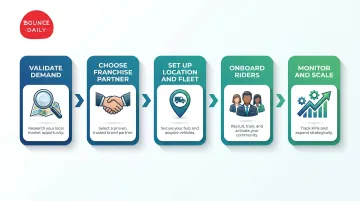
Step 3 — Set Up Location, Fleet, and Legal Basics
Choose the right hub location:
- Prioritize proximity over visibility: Residential areas near delivery partner clusters, dark kitchens, or logistics hubs work better than high-street commercial locations
- Space requirements: Parking for your fleet, basic charging setup (or access to battery swap stations), small office/waiting area
- Accessibility: Easy for riders to reach via public transport or short ride
Legal and compliance setup:
- Business registration: Sole Proprietorship (simplest), LLP, or Private Limited (if planning significant scale)
- GST registration: Mandatory if turnover exceeds ₹20 lakh for services
- Trade license: From local Municipal Corporation; typically ₹200–500 annual fee, 7–15 day processing in metro cities
- RTO compliance: The Bike Renting Scheme 1997 requires commercial vehicle registration for rental fleets (minimum 5 vehicles). Exception: low-speed EVs under 25 km/h don't require registration, simplifying compliance
Charging infrastructure decision:
For a rental business, vehicle downtime equals lost revenue. Battery swap capability—where available—offers significant operational advantage over charge-and-wait models. SUN Mobility operates 620+ swap points across India, with battery swaps taking under 2 minutes vs. 4–6 hours for conventional charging.
Step 4 — Onboard Riders and Build Daily Operations
Create a simple onboarding process:
- Digital ID verification (Aadhaar, driving license if applicable)
- Clear rental agreement with terms spelled out
- Security deposit structure (typically ₹2,000–5,000 depending on vehicle value)
- Vehicle handover checklist covering condition, battery state, accessories
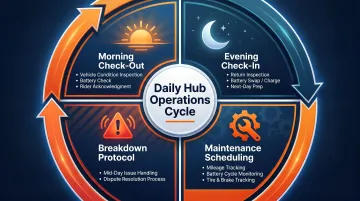
Establish daily operational workflows:
- Morning check-out: Vehicle condition inspection, battery check, rider acknowledgment
- Evening check-in: Return inspection, battery swap/charge, next-day prep
- Maintenance scheduling: Track mileage, battery cycles, tire condition, brake health
- Breakdown protocol: Clear process for handling mid-day issues or disputes
Common miss:
Not setting clear rider expectations upfront—vehicle care responsibilities, late return policy, damage terms, cleaning standards. Unclear terms create disputes and drive up vehicle wear costs. Document everything and have riders sign acknowledgment.
Pricing and plan structure:
While specific Bounce Daily pricing isn't publicly listed, market references show operators like Zypp Electric offering ₹29/day promotional rates for gig workers. Sustainable market rates typically range ₹100–150/day depending on vehicle variant, city, and plan duration (weekly/monthly discounts common).
Step 5 — Monitor Utilization, Market Locally, and Stabilize Before Scaling
Track the metrics that drive profitability:
- Fleet utilization rate: Vehicles rented ÷ total fleet, measured daily
- Average rental duration: Days per rental cycle
- Rider retention rate: Percentage of riders continuing beyond first month
- Per-vehicle revenue vs. operating cost: Your core unit economics
Build local visibility through practical outreach:
- Connect with delivery aggregator networks (Zomato, Swiggy, Blinkit) in your area
- Post in local rider WhatsApp groups and Telegram channels
- Partner with nearby dark kitchens or logistics hubs
- Offer referral incentives for existing riders bringing new customers
- Word-of-mouth from satisfied riders is the most effective channel in this segment
Fix operational gaps before expanding fleet:
Scaling a poorly utilized or unprofitable model compounds your losses. Reach stable 70%+ utilization and positive unit economics on your initial fleet before adding more vehicles.
Break-even timeline expectations:
Industry sources suggest most rental franchises target break-even within 6–12 months. Factors affecting timeline:
- Initial fleet size (smaller fleets stabilize faster but generate less absolute revenue)
- Local rider density and acquisition speed
- Operational efficiency (minimizing downtime, optimizing charging)
- Franchise partner support quality (pre-verified riders accelerate ramp-up)
Frequently Asked Questions
How much does an electric vehicle franchise in India cost?
EV rental franchise costs vary significantly by model and fleet size. Dealership-style franchises range ₹15–50 lakhs due to showroom and inventory requirements. Rental hub models start much lower—approximately ₹3.8 lakh for a 5-vehicle fleet in operator-managed models. Your total investment includes vehicles, initial working capital, location setup, and legal compliance.
What are the typical profit margins for an electric vehicle franchise in India?
Rental profitability is driven by fleet utilization, not per-unit sales margin. At 70% utilization and ₹120 daily rental, a single vehicle generates roughly ₹2,100 monthly revenue. After charging, maintenance, and depreciation, net margin per vehicle typically lands at ₹500–1,000 monthly.
Is an EV rental franchise different from an EV dealership?
Yes, fundamentally. Rental hubs generate recurring income from riders renting by the day or week; dealerships earn from one-time vehicle sales. Rental requires lower capital (no showroom), a different customer base (gig workers vs. buyers), and daily operational management rather than sales cycle management. Once utilization holds steady, rental revenue is more predictable than dealership income.
What documents are needed to start an EV rental hub in India?
Core requirements are business registration, GST registration (if turnover exceeds ₹20 lakh), a trade license from your local Municipal Corporation, and RTO commercial vehicle registration for 5+ vehicles. Note: low-speed EVs under 25 km/h are exempt from RTO registration. Franchise partners typically walk new owners through each step.
Do riders need a driving license to rent electric scooters?
Low-speed scooters under 25 km/h and 250W are classified as non-motor vehicles — driving licence assistance (available for a nominal ₹200-₹230 fee) is available at our hub - visit us or check our app to know more - which widens your eligible rider base considerably. High-speed variants above 25 km/h do require a valid DL, but command higher daily rental rates in return.
How long does it take to break even with an EV rental hub?
Break-even timelines depend on fleet size, local rider demand, and daily utilization rates. Industry benchmarks suggest 6–12 months for operators achieving 60–70% utilization. Franchise partners with pre-verified rider pipelines help new operators reach stable utilization faster, cutting through the cold-start problem.
Conclusion
Launching an EV rental hub isn't about riding the EV trend—it's about executing a recurring-income local business correctly. The fundamentals are straightforward: get these four things right from the start:
- Validate demand in your target area before committing capital
- Choose a franchise partner that reduces operational complexity
- Build rider relationships that sustain daily utilization
- Track the unit economics that determine profitability
The hubs that stabilize fastest focus on pricing that covers costs and yields margin, consistent daily operations, and a rider base that grows through retention and referral—before scaling fleet size or adding locations.
In India's gig economy, the demand side is proven. The franchise partners who win are the ones who nail execution at the unit level first.