The interest is coming from a wide range of people: salaried professionals seeking additional income, delivery entrepreneurs managing small fleets, investors exploring EV infrastructure, and gig workers thinking about owning rather than renting.
This guide covers what starting an electric scooter business in India actually involves — the model choices, compliance requirements, and execution decisions that determine whether early-stage operators survive or stall.
Key Takeaways
- An electric scooter business in India can take several forms: rental fleet, EV dealership, franchise partnership, or last-mile delivery fleet — each with distinct capital and operational needs
- India's electric two-wheeler market reached 1.4 million units in FY2026, up 22% year-on-year — the market opportunity is real and growing
- Before starting, clarify your business model, understand startup costs, and validate local demand
- Compliance is mandatory from day one: GST registration, vehicle insurance, and relevant state EV policies
- Stability before scaling — build consistent operations before adding more vehicles or locations
What Is an Electric Scooter Business in India?
An electric scooter business is any commercial venture that generates revenue by providing access to electric two-wheelers — through retail sales, recurring rentals, or franchise partnerships with established EV brands.
The core value delivered differs by model. For end users — gig workers, commuters, delivery partners — it reduces transportation costs by ₹3,000–4,500 a month or more. For the business owner, it creates a recurring, asset-backed income stream.
The Main Business Formats Operating in India Today
| Format | How It Works | Who It Suits |
|---|---|---|
| Owner-operated rental fleet | Buy or finance scooters, rent to delivery riders or commuters daily/weekly/monthly | Entrepreneurs with operational bandwidth and local rider networks |
| EV dealership/showroom | Authorised retailer for an EV brand; earns on vehicle sale margins and service | Investors with showroom space and brand franchise capital |
| Brand franchise partnership | Partner with an established EV rental brand (e.g., Bounce Daily); earn rental revenue while the brand handles operations | First-time operators; passive income seekers |
| B2B fleet lease | Supply scooters to delivery companies (Swiggy, Zomato, Blinkit logistics partners) under contract | Operators with fleet management experience and B2B relationships |
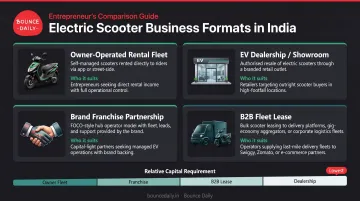
Each model has a different investment threshold, risk profile, and time-to-revenue. For first-time operators or those without prior fleet experience, franchise partnerships offer the lowest barrier — the brand handles vehicle maintenance, insurance, and rider acquisition while you earn on the rental revenue.
Why Start an Electric Scooter Business in India?
The conditions for an electric scooter business in India are unusually well-aligned right now — but only for operators who can manage assets and local demand effectively.
The Demand Drivers Are Structural
Electric two-wheeler sales: FY2026 saw 1,401,663 electric two-wheeler units retailed in India, with 22% year-on-year growth. Electric scooters and mopeds account for 88.6% of that volume.
Gig economy scale: NITI Aayog estimated 7.7 million gig workers in 2020-21, projected to reach 23.5 million by 2029-30. Delivery-based gig workers have grown approximately 21% annually over the last three years. These riders need affordable, reliable vehicles — and many can't or won't buy their own.
Petrol costs: A delivery rider on a petrol scooter spends ₹3,000–4,500 per month on fuel alone, with total monthly operating costs running ₹4,500–6,500 once servicing, insurance, and repairs are included. Electric alternatives cut that cost by roughly half — creating sustained, price-sensitive demand that isn't going away.
Government support: Central and state-level policies have lowered the cost of EV adoption across the board:
- GST on EVs reduced to 5% (down from 12%); EV chargers/charging stations also taxed at 5%
- PM E-DRIVE scheme carries a ₹10,900 crore outlay with e-2W support extended to 31 July 2026
- Karnataka's Clean Mobility Policy 2025-30 adds road tax and registration exemptions on top
The Franchise Route Lowers the Bar
For first-time operators, building an independent fleet from scratch requires solving charging infrastructure, maintenance, rider acquisition, and payment collection simultaneously. Franchise partnerships like Bounce Daily's FOCO-style hub programme offer an alternative: the partner provides capital and the hub location, while Bounce handles:
- Fleet management and scheduled maintenance
- GPS tracking, insurance, and anti-theft coverage
- A verified rider pipeline ready to rent from day one
Bounce Daily has logged 30M+ kilometres driven across its fleet, providing operational proof that the model works at scale.
Early Decisions That Matter When Starting
Most early failures here trace back to setup complexity — not motivation. Getting these three decisions right before you spend anything saves months of painful course-correction.
True Startup Costs
Costs vary significantly by model:
- Small rental fleet (5–10 scooters): Budget ₹3–8 lakh for vehicles, plus charging infrastructure, parking space, insurance, and 2–3 months of working capital
- EV dealership: Showroom fit-out, brand franchise investment, and inventory carrying costs push budgets considerably higher; OEMs like TVS, Ola Electric, and Ather have strict space and capital requirements
- Franchise partnership: Capital-light by design — no parts warehouse, service bay, or mechanic team needed
Competitive Reality
Research your target area before spending anything. Check:
- How many EV rental or dealership operators already exist nearby
- Which delivery platforms (Swiggy, Zomato, Blinkit, Zepto) are active in the area and how dense the rider population is
- What competitors charge — and whether you can price competitively while maintaining a viable margin
Once you've validated demand, compliance is the next gate to clear before operations can start.
Legal and Compliance Friction
- Register for GST before collecting any revenue
- Insure every scooter under commercial vehicle coverage — personal policies won't cover fleet operations
- Check local body permit requirements for running a parking or charging hub
- Karnataka's 25% capital subsidy on charging stations, for example, can cut setup costs — confirm what your state offers before finalizing your budget
How to Start an Electric Scooter Business in India — Step by Step
Follow these steps in sequence. Skipping validation or rushing past setup decisions is the most common reason early-stage EV businesses underperform.
Step 1 – Identify Your Business Model and Target Customer
Decide which model fits your capital, location, and goals:
- EV rental fleet: Best for operators with local rider networks and hands-on management appetite
- EV dealership/showroom: Requires brand franchise capital and a physical retail setup
- Franchise partnership: Best for first-time operators seeking lower complexity and faster time-to-revenue
- B2B fleet lease: Suits operators with existing relationships with delivery companies
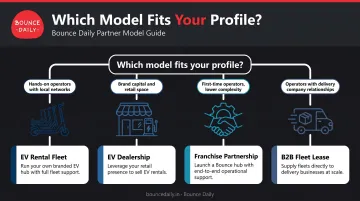
Your primary customer shapes every downstream decision. A gig worker renting daily has completely different needs from a delivery company ordering 20 scooters, or a retail buyer in a Tier-2 city — get specific about who you're serving before moving on.
Step 2 – Validate Demand and Pricing Viability
Before investing, speak to delivery partners in your target area. Check:
- Gig worker density — how many active Swiggy, Zomato, Blinkit, and Zepto riders operate locally
- How many EV rental or dealership businesses already exist nearby
- Whether local commuter demand is strong enough to support a mixed rental base
Next, stress-test your numbers. Add up fleet EMIs or purchase costs, maintenance, charging, insurance, and staff — and verify the rent or margin you can realistically charge still leaves operating profit. Many first-time operators skip this and spend months discovering the unit economics don't work.
Step 3 – Define Your Revenue Structure
Decide how the business makes money:
- Rental model: Daily, weekly, or monthly revenue per scooter
- Dealership: Vehicle sale margins plus service and spare parts income
- Franchise model: Recurring rental revenue from a hub operation, with the parent brand managing operations
Factor in seasonality — delivery volume spikes during festive periods and dips during monsoon in some cities. Build that variance into your monthly projections from the start.
For franchise operators, Bounce Daily structures revenue around predictable monthly rental income rather than one-time transactions. Specific terms are disclosed during partner onboarding — call 08069760700 for details.
Step 4 – Handle Legal, Compliance, and Risk Setup
Key compliance steps specific to an electric scooter business in India:
- GST registration: Required before revenue collection begins; EVs are taxed at 5%
- Vehicle registration: Low-speed electric scooters (under 25 km/h, motor power under 0.25 kW) are not classified as motor vehicles under CMVR rules — but higher-speed variants require full registration and appropriate licensing for riders
- Commercial vehicle insurance: Mandatory for every fleet vehicle
- Local permits: Check with your municipal authority for parking hub or fleet operation permits
- Government incentives: The PM E-DRIVE scheme currently supports e-2Ws through 31 July 2026. Karnataka operators can access road tax and registration exemptions, plus a 25% capital subsidy (up to ₹3 lakh per station) for battery swapping stations
Step 5 – Build Your Fleet and Operating Process
Start lean. Five to ten scooters is a manageable first fleet for a new operator — scaling an unstable operation just amplifies problems.
Vehicle selection by use case:
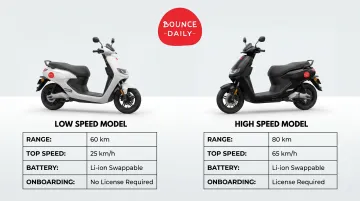
- Low-speed variants (under 25 km/h): Better for dense urban delivery where speed isn't critical; no licence required for riders — opens the market to students and first-time riders
- High-speed variants (45–55 km/h): Better for longer commutes and multi-zone delivery shifts
Bounce Daily's two-variant approach illustrates this well. The Low Speed model (25 km/h, 85 km range, swappable battery, Aadhaar-only onboarding) serves hyperlocal delivery and student commuters. The High Speed model (55 km/h, 70 km range, chargeable and swappable battery, requires a valid DL) covers longer delivery shifts and cross-city commutes.
Create simple, repeatable daily workflows for:
- Battery charging or swapping
- Rider check-in and check-out
- Maintenance scheduling
- Payment collection
Document these early. They become the handoff when you hire staff.
Step 6 – Set Up Capacity, Staffing, and Support
Assess whether the business can be run solo in the early phase. For most rental models, a single operator can manage 5–10 scooters initially — but avoid overhiring before revenue is stable.
Identify support dependencies early:
- Charging infrastructure: Either install charging points or locate near battery swap hubs
- EV service partner: A brand-authorised technician or service agreement, unless maintenance is handled centrally (as in franchise models)
- Digital tools: Fleet tracking, payment collection, and rider management — even a basic spreadsheet beats nothing in the early phase
If operational complexity is a concern, franchise models remove most of it. Bounce Daily, for instance, handles vehicle maintenance, GPS tracking, insurance, breakdown recovery, and rider onboarding centrally — the partner provides the hub location and capital; Bounce manages the rest.
Step 7 – Go to Market and Acquire Your First Customers
For rental and fleet businesses:
- Connect directly with gig worker communities and delivery platform partner networks
- Post in local housing society WhatsApp groups and delivery rider Facebook groups
- Reach out to delivery platform city-ops teams — they often have internal referral systems for riders seeking vehicle solutions
For dealerships:
- Focus on local visibility and test drive events
- Build referral networks with housing finance companies and EV loan providers
Essential digital presence:
- Google Maps listing with accurate hours and location
- WhatsApp Business number for instant inquiries
- 2–3 credibility signals: fleet photos, pricing transparency, and early rider testimonials
Step 8 – Monitor, Stabilise, and Plan for Growth
Track these metrics in your first six months:
- Fleet utilisation rate: What percentage of your scooters are earning on any given day
- Daily rental revenue: Per scooter, per week
- Maintenance cost per vehicle: Monthly
- Rider retention: What percentage of riders renew after their first rental period
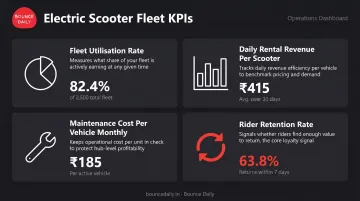
Fix operational gaps and pricing misalignments before scaling. Adding more scooters to an unstable system increases problems proportionally. Bounce's own history illustrates this — the company scaled to 25,000 scooters and 1.2 lakh daily rides before pivoting to an electric-first model. The operators who scale well are the ones who already know exactly why their first ten scooters worked.
Conclusion
Starting an electric scooter business in India is viable right now — provided you treat it like a real business. That means validating demand before committing capital, building operations before launching publicly, and tracking unit economics before pushing to scale.
Whether you build an independent rental fleet, apply for a dealership, or partner through a franchise model like Bounce Daily's hub programme, the fundamentals hold across every path: know your customer, control your costs, and execute consistently. The market is expanding. If your operation is structured well from day one, you're in a strong position to grow with it — rather than scramble to catch up later.
Frequently Asked Questions
Which electric scooter is most selling in India?
As of May 2026, TVS Motor Co led monthly electric two-wheeler sales at 42,415 units, followed by Bajaj Auto (39,142), Ather Energy (28,211), Vida (19,051), and Ola Electric (15,141). Rankings shift frequently — check the latest VAHAN or SMEV data for current figures.
What is the investment needed to start an electric scooter business in India?
Investment varies by model. A small rental fleet of 5–10 scooters typically requires ₹3–8 lakh in vehicle procurement plus working capital. Dealerships run higher based on brand showroom and inventory requirements; franchise partnerships offer lower capital entry with no service-bay costs.
Do I need a licence to start an electric scooter rental business in India?
The business itself needs GST registration, commercial vehicle insurance, and potentially local operating permits. For riders, low-speed electric scooters (under 25 km/h) don't require a driving licence under CMVR rules — but high-speed variants do. Requirements also vary by state, so check local regulations.
What are the different types of electric scooter businesses I can start in India?
The main models are:
- EV rental fleet — daily/weekly/monthly rentals to individual riders
- EV dealership/showroom — authorised retail sales of scooters
- Brand franchise partnership — hub operator earning rental income with brand support
- B2B fleet leasing — long-term supply to delivery companies
Each model has different capital requirements and income timelines.
How long does it take to break even in an electric scooter business in India?
Break-even depends on model, location, and utilisation. A well-managed rental fleet in a high-demand area can reach break-even in 6–12 months; dealerships typically take longer based on monthly sales volume. Model your unit economics — including rental yield or per-unit margins — before committing capital.
Is an EV franchise a good option for first-time entrepreneurs?
Franchise partnerships reduce setup complexity significantly. Bounce Daily's FOCO-style model, for example, handles fleet management, GPS tracking, insurance, breakdown recovery, and rider acquisition centrally — the partner provides capital and hub space. For first-time operators without fleet or automotive experience, this is a lower-risk entry than building an independent fleet from scratch.