Introduction
Most franchise failures in India's gig economy don't stem from poor locations or weak demand. They happen because new partners are left to navigate operations, fleet handling, and customer acquisition on their own—without structured backing.
The EV rental sector is booming. With India's gig workforce projected to grow from 1 crore (10 million) in 2024-25 to 2.35 crore (23.5 million) by 2029-30, driven by delivery platforms and quick commerce, the opportunity is real.
But entering this market without operational infrastructure leads to expensive mistakes: idle fleet time, rider churn, and preventable costs that erode margins before revenue stabilizes.
This article breaks down what EV franchise training and support looks like in practice — the operational infrastructure that determines whether a franchise partner profits or struggles from day one.
Key Takeaways
- EV franchise training spans onboarding, fleet management, operations, and marketing to accelerate partner earnings from day one
- Ongoing operational backing matters more than one-time training; it removes operational gaps partners would otherwise navigate alone
- Partners leveraging structured support see faster ramp-up, lower error rates, and more consistent rental revenue
- Weak support has a direct cost: idle fleet, rider churn, and avoidable missteps that eat into margins
- Bounce Daily's franchise program builds training into every stage of operations — not just the launch week
What Is EV Franchise Training and Support
EV franchise training and support is the complete system a franchisor provides to help partners set up, operate, and grow an electric vehicle rental business. It covers everything from product familiarity and onboarding processes to fleet coordination and rider acquisition.
For high-volume rental models like Bounce Daily, this means the partner manages a local hub while the franchisor handles the heavy lifting:
- Technology & app infrastructure for digital rider onboarding
- Fleet supply and maintenance so partners aren't sourcing or servicing scooters independently
- A ready pipeline of riders—gig workers and delivery partners serving platforms like Zomato, Swiggy, and e-commerce logistics
- End-to-end guidance from setup through day-to-day operations
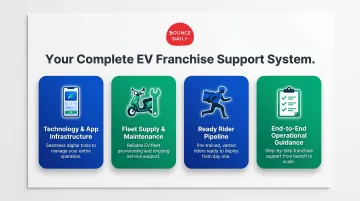
The result: a franchise partner can run a profitable rental hub from day one, without building any of that infrastructure from scratch.
Key Advantages of EV Franchise Training and Support
Each advantage below addresses a specific challenge franchise partners face when entering the EV rental space without prior experience. Together, they connect to measurable outcomes: time to first rental, fleet utilization rates, rider retention, revenue consistency, and cost of acquisition.
Structured Onboarding That Gets Partners Operational Quickly
Structured onboarding in an EV franchise model covers:
- Product knowledge: Scooter variants (low-speed vs. high-speed), battery types (chargeable vs. swappable), and use-case differences
- Digital verification procedures: Instant Aadhaar and driving license verification through app-based systems
- Rental workflow: From rider sign-up to handoff, including document validation and scooter allocation
A well-designed onboarding system, like Bounce Daily's app-based digital onboarding with instant verification, compresses the ramp-up period. Partners learn the system by doing, not by reading manuals.
Every day spent figuring out basics is a day of lost rental revenue. Structured onboarding directly shortens the gap between signing the franchise agreement and earning the first rupee. Organizations with structured onboarding saw a 60% improvement in revenue year-over-year and a 63% jump in customer satisfaction, according to CareerPlug's cross-franchise data.
Partners trained on both low-speed and standard variants can match the right scooter to the right rider from day one, reducing mismatches and disputes. For the low-speed variant, driving licence assistance (available for a nominal ₹200-₹230 fee) is available at our hub — visit us or check our app to learn more.
KPIs impacted:
- Days to first rental
- Onboarding completion rate
- Early-stage rider complaint rate
- Partner confidence scores in first 30 days
This matters most for partners with no prior EV or fleet experience — the training removes the expertise barrier that would otherwise make the category inaccessible to most investors.
Fleet Management Handled by the Franchisor
Fleet upkeep is one of the highest-friction points in any vehicle rental business: maintenance scheduling, battery health monitoring, replacement logistics, and keeping scooters ride-ready.
Franchise models where the company handles all of this (as Bounce Daily does) remove that burden entirely. The partner focuses on local operations and rider relationships while the franchisor manages the asset backend.
Fleet downtime is a direct revenue killer. If scooters aren't ride-ready, partners lose bookings and riders go elsewhere. In the B2C shared scooter model, Bounce revenue contracted by 83% during COVID, driven partly by fleet underutilization and operational challenges.
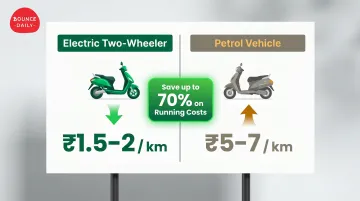
Partners don't need to hire mechanics, source parts, or manage battery swap logistics independently. These are handled through the franchisor's infrastructure, cutting overhead and hands-on time. Fleet operators report running electric two-wheelers at ₹1.5–2 per km versus ₹5–7 per km for petrol vehicles.
KPIs impacted:
- Fleet utilization rate
- Average daily rentals per scooter
- Maintenance cost per unit
- Partner time spent on non-revenue tasks
The impact compounds at scale. When a partner grows from 5 to 20+ scooters, self-managed fleet maintenance becomes a full-time job — franchisor-led management is what makes that growth feasible.
Built-In Demand Pipeline and End-to-End Marketing Support
Franchise support isn't just about operational readiness — it's about ensuring riders walk through the door from the start. A built-in demand pipeline, like the steady flow of verified delivery riders Bounce Daily connects partners with, means partners don't start from zero on customer acquisition.
Marketing support fills the rest of the gap: ready-to-use creatives, brand assets, and local campaign guidance mean partners launch with visibility, not just a location.
The first 60–90 days are the most vulnerable period for any new franchise. Partners without a demand pipeline often idle their fleet and start questioning the investment. A franchisor-sourced rider network — delivery partners from e-commerce and food delivery platforms — removes that cold-start risk entirely.
Quick commerce rider onboarding is accelerating at 70–80% growth, and the sector will require 1.5 million riders by FY2030, according to Bernstein Research. As delivery partners build rental habits at a specific hub, repeat bookings increase, utilization rates rise, and revenue becomes more predictable — without ongoing outbound marketing spend.
KPIs impacted:
- Rider acquisition cost
- Repeat rental rate
- Fleet idle time percentage
- Average monthly rental revenue per scooter
This is most decisive in new markets where the partner has no existing customer base. In cities like Bengaluru, where 87.6% of gig workers earning ₹500–1,000 per day are concentrated, a verified rider pipeline can fill a fleet within days of opening.
What Happens When Training and Support Are Missing or Ignored
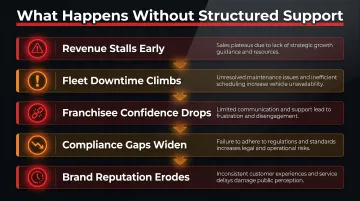
Partners entering the EV rental space without structured franchisor support face predictable operational consequences. Each gap compounds the next — and most show up within the first 90 days.
Revenue stalls in the early months. Without a structured launch plan, partners spend the first weeks figuring out basics rather than activating riders. Franchisor-backed models consistently show higher survival rates in the early years compared to independent operators going it alone.
Fleet downtime climbs without centralized maintenance. Idle scooters and riders who don't return are the result. Partners default to reactive fixes rather than scheduled preventive maintenance — and uptime suffers for it.
Filling the fleet becomes a costly guessing game. Without a verified rider pipeline, partners turn to local advertising that erodes margins when cash flow is tightest. Monthly churn on delivery and ride-hail platforms runs as high as 20%, driven largely by income uncertainty. Partners without structured demand generation absorb that churn directly.
Unverified rider onboarding adds financial risk. No standardized verification means a higher chance of scooter misuse or damage — and unplanned repair costs that weren't in the budget.
Unsystematized operations cap growth. Partners who scale without documented processes hit a ceiling fast. There's nothing to hand off, nothing to replicate, and no path to running multiple hubs.
How to Get the Most Value from Your EV Franchise Support
Franchise training and support delivers greater returns over time — but only when partners engage with it actively, not just during onboarding.
Three habits separate high-earning hubs from average ones:
- Enforce digital verification on every rental. Shortcuts in Aadhaar and driving licence checks create asset risk and disputes. Bounce Daily's instant verification takes seconds — consistency is the only variable.
- Use provided brand assets instead of improvising local messaging. In markets where EV rentals are still new, brand consistency builds rider trust faster than custom creatives ever will.
- Schedule regular data reviews with franchisor support. These sessions surface which scooter variants are over- or under-deployed, which rider segments retain best, and where booking friction hides.
Partners who engage with all three consistently tend to hit utilization targets faster and sustain them. The support system is built to keep working for you — but only if you use it.
Conclusion
EV franchise training and support isn't a perk—it's the operational architecture that determines whether a partner builds a profitable rental hub or manages a costly, idle fleet.
The three pillars—structured onboarding, franchisor-managed fleet operations, and built-in demand and marketing support—work together to drive utilisation from day one. Consistent onboarding means scooters are on the road faster. Managed fleet operations reduce downtime. And a steady pipeline of verified gig workers — delivery riders, food delivery partners, e-commerce drivers — means hubs aren't waiting for demand to show up.
For franchise partners operating under Bounce Daily's hub model, that support doesn't stop after launch. Fleet tracking, uptime management, and marketing creatives remain active throughout the partnership. The hubs that grow are the ones where partners lean into that infrastructure rather than work around it.
Frequently Asked Questions
What types of franchise training and support are provided?
Core categories include operational onboarding (product knowledge, rider verification, rental workflows), fleet management handled by the franchisor, marketing creatives and brand support, and access to a verified rider pipeline. The best programs cover all of these from day one, not just initial classroom training.
How long does EV franchise onboarding typically take?
Onboarding timelines vary by franchisor, but models built on digital-first verification and simplified documentation — Bounce Daily's, for instance — are designed to get partners operational within days, not weeks.
Do franchise partners need prior experience in the EV or vehicle rental sector?
No. Structured EV franchise programs are specifically designed to eliminate the expertise barrier. Partners receive product training on scooter variants, battery types, and operational procedures, making prior EV experience unnecessary.
Who handles fleet maintenance and battery management in an EV franchise model?
At Bounce Daily, fleet management — maintenance, battery health, and replacement logistics — is handled centrally by the company. Partners stay focused on rider relationships and hub operations, not mechanical upkeep.
What marketing support do EV franchise partners receive?
Partners receive ready-to-use marketing creatives, brand assets, and local campaign guidance provided by the franchisor. In demand-pipeline models, partners also receive a steady flow of verified delivery riders without needing to run independent acquisition campaigns.
Can EV franchise partners scale to multiple hubs or locations?
Yes. Multi-hub scaling works best when the franchisor handles fleet management centrally — as Bounce Daily does. That centralised infrastructure turns expansion into a repeatable process rather than an operational burden.