Introduction
Picture a delivery partner midway through a Bengaluru afternoon shift. Orders are piling up, the app is buzzing, but the scooter's battery indicator drops into the red zone. For riders on conventional plug-in electric scooters, this moment forces an impossible choice: stop for 4–6 hours to recharge and lose half a day's earnings, or push through and risk getting stranded mid-delivery.
Hot swappable battery technology eliminates this dilemma. Instead of waiting hours at a charging point, a rider pulls into a swap station, clicks out the drained pack, and clicks in a fully charged one — in under two minutes. Yet most delivery partners haven't had this explained in practical terms.
This guide covers exactly that: how swappable batteries work, what the Battery Management System does to keep each exchange safe, and why a 2-minute swap can mean the difference between a full day's earnings and an early shutdown.
Key Takeaways
- A hot swappable battery can be removed and replaced while the device remains powered on, with zero shutdown or data loss
- Power continuity is maintained through dual-battery configurations or bridge-battery systems that hold power during the physical swap
- Swaps take under 2 minutes at commercial stations, versus 4–6 hours for standard plug-in charging
- Primary applications include electric two-wheelers, warehouse robots, medical carts, and telecom infrastructure
- Safety relies on Battery Management Systems, pre-charge circuits, and sequenced contacts that prevent inrush current and arcing
What Is a Hot Swappable Battery?
A hot swappable battery is one that can be physically removed from a powered-on device and replaced with a charged unit — without shutting the device down, losing stored data, or interrupting operation. This contrasts sharply with conventional batteries that require complete system shutdown before removal to avoid electrical damage or data corruption.
The operational gap this technology addresses is straightforward: conventional charging forces devices and vehicles into long idle periods. For a delivery rider, a 4–6 hour charging cycle isn't just inconvenient — it's structurally incompatible with gig economy operations where vehicles run 15–20 hours per day and riders have only 20–30 minute windows for recharging.
Hot swap technology was built to eliminate that downtime entirely — in environments where continuous operation directly impacts income.
What Hot Swappable Is NOT
Hot swapping vs. hot plugging: Hot plugging means adding a new component to a live device without removing an existing one (like plugging in a USB drive while your laptop runs). Hot swapping specifically involves removing an existing component and replacing it with a new one while the device stays powered. Both happen without shutdown, but the swap includes a removal step that hot plugging does not.
Hot swapping vs. cold swapping: Cold swapping requires powering down the entire system before removing or replacing a component. It's the default mode for most consumer electronics and older vehicle batteries.
Why Hot Swap Remains Relevant Despite Fast Charging
Even the fastest two-wheeler fast charging in India — Ola's Hypercharger adds 50% charge in 18 minutes — still requires the vehicle to remain stationary and connected for the entire duration. Battery swapping separates the refueling step entirely from the vehicle's operation cycle. The rider walks away with a full battery in under 2 minutes while the depleted battery charges in the station's background queue. No other refueling method comes close to that turnaround for a working rider.
Two Common Hot Swap System Architectures
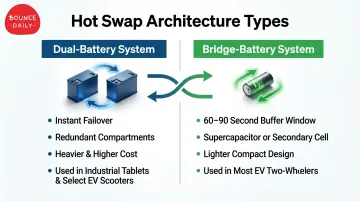
Two designs dominate the market:
- Dual-battery systems: A second onboard battery takes over the instant the first is disconnected — power never drops. Common in rugged industrial tablets and EV scooter models where weight and cost allow for redundant battery compartments.
- Bridge-battery systems: A small internal reserve (typically a supercapacitor or secondary cell) holds power for 60–90 seconds during the swap. This gives the rider time to disconnect the depleted battery, insert the charged replacement, and lock it in place. Most EV two-wheelers use this model, or rely on full swap-station designs where the station's own power rail maintains vehicle electronics during the exchange.
How Does a Hot Swappable Battery Work?
Hot swappable batteries work through four stages: initiation, power handoff, physical exchange, and resumption. Each stage is designed to keep the power supply continuous and prevent electrical faults.
Initiation
The swap process begins when battery state-of-charge drops below a threshold. In electric two-wheelers, this is typically a user-triggered event: the rider notices the low-battery indicator, pulls into a swap station, and either manually initiates the exchange or lets the station's automated system take over.
Operational dependencies at this stage:
- The swap station must have a pre-charged replacement battery ready
- Networks like Battery Smart and Sun Mobility manage charging queues of batteries in the background, ensuring riders always find a full unit waiting
- The station's inventory management system tracks battery health, charge cycles, and availability in real time
Core Operation
The moment the depleted battery is disconnected, either a second onboard battery or the swap station's own power rail takes over. The scooter's electronics never lose their power feed — the transition is seamless because the backup source is already live before the old battery comes out.
Physical mechanics:
- Purpose-built battery compartments use quick-release latches and tool-free access
- Standardized connectors allow the swap to complete in seconds
- Sequenced contact design: Ground and power contacts use physically longer pins that connect first, establishing a stable reference before data or control lines engage
- Data and communication contacts use shorter pins that disengage before power contacts, preventing voltage spikes during disconnection
Battery Management System (BMS)
Those physical mechanics work because the BMS is managing the handoff behind the scenes. It monitors battery voltage, current, temperature, and state-of-charge in real time. During a swap, it controls the connection sequence to prevent inrush current — a sudden surge that occurs when a fully charged battery connects to a live circuit with uncharged downstream capacitors.
Why inrush protection matters:
- Without it, current spikes of thousands of amps can damage system components or cause contactors to weld closed
- Pre-charge circuits in the BMS use a resistor to gradually ramp up the new battery's connection, allowing downstream capacitors to charge slowly before the main positive contactor closes
- The BMS monitors voltage rise along the expected curve; if it detects a "soft-short" (voltage doesn't rise) or "hard-short" (immediate overcurrent), it terminates precharge to prevent damage
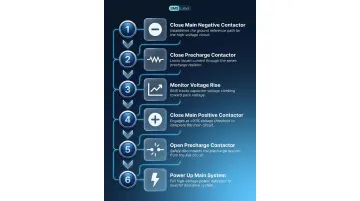
Six-step contactor sequence (from BMS perspective):
- Close Main Negative Contactor
- Close Precharge Contactor (current flows through resistor)
- Monitor Voltage (ensure gradual rise)
- Close Main Positive Contactor (only after load voltage reaches ~90% of battery voltage)
- Open Precharge Contactor
- Power up main system components
Output / Result
The scooter resumes normal operation within seconds of the new battery locking in — no reboot, no motor hesitation. For a delivery partner, that means leaving the Battery Smart or Sun Mobility swap station in under 2 minutes and getting straight back on the route.
Hot Swappable vs. Conventional Charging: What's the Real Difference?
The core operational distinction is simple: conventional charging tethers the scooter and rider to a fixed point for 4–6 hours; hot swapping takes under 2 minutes and lets riders return to the road immediately.
| Method | Time Required | Rider Action | Operational Impact |
|---|---|---|---|
| Standard home charging (Ather 450S) | 6 hr 36 min to 80% | Vehicle parked at home | Cannot work during charge cycle |
| Ather Grid fast charging | 1.5 km/min (0-50% SOC) | Vehicle stationary at Grid station | Partial charge; still requires stop time |
| Ola Hypercharger | 18 min to 50% | Vehicle stationary at station | Fastest plug-in option; still 10x slower than swap |
| Battery Smart swap | Under 2 minutes | Walk to station kiosk | Full battery; return to work immediately |
| Sun Mobility swap | Under 2 minutes | Walk to station kiosk | Full battery; zero downtime |
Income Impact for Gig Workers
Delivery fleet vehicles run 15–20 hours per day, with riders typically having only 20–30 minute windows for recharge during lulls. A 4–6 hour charging cycle doesn't fit that window. Riders are forced to either:
- Charge overnight (limiting daily range to a single battery's capacity)
- Stop mid-shift and lose productive hours
A delivery partner who stops for 4 hours to charge loses 4 hours of potential deliveries — that's a direct cut to daily earnings. Hot swap removes that tradeoff, keeping riders on the road across full shifts.
Trade-Offs
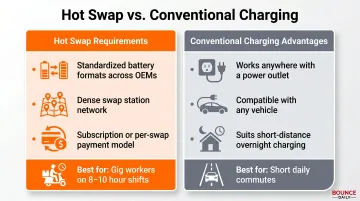
Hot swap requires:
- Standardized battery formats across OEMs
- Dense swap station infrastructure in service areas
- Subscription or per-swap payment models
Conventional charging works:
- Anywhere there is a power outlet
- With any vehicle regardless of battery standardization
- For riders who operate short daily distances and can charge overnight
The right choice depends on how frequently the rider operates and whether swap stations are accessible in their city. For gig workers doing 8–10 hour shifts, swap networks like Battery Smart (1,600+ stations across 50 cities) or Sun Mobility (650+ stations) provide the infrastructure needed to make hot swap viable.
Where Are Hot Swappable Batteries Used?
Electric Two-Wheelers and Delivery Scooters
Electric two-wheelers and delivery scooters represent one of the fastest-growing applications of hot swap battery technology, particularly in dense urban markets like Indian cities where riders need to cover high distances without stopping. India's battery swapping market for electric two-wheelers was valued at USD 26.72 million in 2025, with at least 98 battery-swapping firms now operating nationally.
Bounce Daily's electric scooters are purpose-built for gig workers who need all-day uptime without charging delays. Both variants support swappable batteries:
- High Speed (55 km/h, 70 km range) — chargeable and swappable battery options
- Low Speed (25 km/h, 85 km range) — swappable battery only (driving licence assistance (available for a nominal ₹200-₹230 fee) at our hub — visit us or check our app to know more)
This means delivery partners in Bengaluru can complete full shifts without the 4–6 hour charging interruptions that make conventional EVs impractical for daily gig work.
Major delivery platform adoption:
- Blinkit: 80% electric fleet in Gurgaon with approximately 50,000 EV delivery partners
- Amazon India: 10,000+ EVs across 500+ cities by 2024
- Zomato and Swiggy: Active partners with Sun Mobility and Battery Smart swap networks
Industrial and Enterprise Applications
Hot swap technology proves itself in high-stakes environments where stopping to recharge is operationally unacceptable:
Medical workstations and carts:
- Battery-powered Workstation-on-Wheels (WoW) medical carts use hot-swappable LFP batteries with 8–12+ hours of runtime
- UPS backup ensures devices stay powered during battery changes, preventing data loss during patient care
Warehouse robots and AGVs:
- Swappable batteries enable service and industrial robots to maintain 24/7 operations, minimizing downtime and boosting efficiency
- Automated battery swap stations can exchange robot batteries in seconds without human intervention
Telecom infrastructure:
- Telecom power solutions adopt hot swap technology for plug-and-play installation with fully front-accessible operation
- Enables live battery replacement in active tower cabinets without interrupting signal transmission
Where Hot Swap Performs Best
The pattern across every use case is the same: operations that run on tight schedules and tighter margins. Delivery fleets, hospital floors, and factory lines cannot absorb multi-hour charging windows. Hot swap technology works precisely because it treats battery replacement like a fuel stop — seconds, not hours — keeping workers productive and revenue flowing throughout the day.## Conclusion
Hot swappable batteries are a system-level design decision that eliminates the structural downtime built into conventional charging. The Battery Management System with pre-charge circuits, sequenced electrical contacts, mechanical quick-release latches, and swap station infrastructure all work together to make the transition seamless and electrically safe.
For a gig worker, delivery partner, or fleet operator evaluating electric scooters, understanding that a vehicle supports hot swap versus only plug-in charging is the difference between a scooter that fits a full 10-hour workday and one that doesn't. India's battery swapping infrastructure has grown to over 1,600 stations across 50 cities, with networks like Battery Smart and Sun Mobility specifically targeting the gig economy segment.
Bounce Daily's swappable battery model is built around the need for all-day uptime, giving delivery partners in Bengaluru a practical path to electric mobility without the range anxiety or charging downtime that makes conventional EVs difficult for gig work. As quick commerce platforms continue their shift toward 100% electric fleets by 2030, hot swap technology provides the infrastructure foundation that makes zero-emission delivery work practical at scale.
Frequently Asked Questions
What does hot-swappable battery mean?
A hot-swappable battery can be removed and replaced while the device is still powered on — no shutdown required. A bridge battery or the swap station's power rail maintains power continuity throughout the physical swap.
How does hot swapping work?
The depleted battery is disconnected while a backup power source maintains continuity. The new battery connects via sequenced contacts controlled by the BMS, which uses pre-charge circuits to prevent inrush current. Normal operation resumes within seconds — the entire process takes under 2 minutes at commercial stations.
Is hot swapping safe?
Yes. Modern hot swap systems use BMS-level voltage monitoring, pre-charge circuits to prevent inrush current, and sequenced contact disconnection to stabilize power before data lines engage. In India, AIS-156 Amendment 4 and IS 17896 set mandatory safety requirements for swappable packs and swap stations.
What is the difference between hot plugging and hot swapping?
Hot plugging means adding a new component to a live device without removing an existing one (like plugging in a USB drive). Hot swapping means removing an existing component and replacing it with a new one while the device stays powered. Both happen without shutdown, but swapping involves a removal step that hot plugging does not.
What is a hot-swap circuit?
A hot-swap circuit is the BMS-integrated control system that manages safe battery transitions. It sequences pre-charge, monitors voltage rise, and controls power and data contacts to prevent inrush current and terminate the swap if faults like soft-shorts or hard-shorts are detected.