Introduction
Petrol crossed ₹100 per litre in most major Indian cities — and that single number is reshaping how millions of gig workers, commuters, and fleet operators think about two-wheelers. With dense urban populations and a delivery economy running on tight margins, India has emerged as one of the fastest-growing micromobility markets in Asia-Pacific. Yet most delivery partners, commuters, and entrepreneurs still struggle to navigate this fragmented landscape — unsure whether to move to electric fleets, which pricing models actually hold up, or where the next wave of growth is headed.
Understanding what's driving this market in 2026 has direct financial consequences. The decisions are concrete: a franchise operator putting ₹10–40 lakh into a battery swap hub, a delivery partner picking between petrol and electric, an investor deciding whether a rental platform can scale. Getting the timing and model right determines whether the next three to five years are profitable — or wasted.
Key Takeaways
- India's rental market is projected to exceed USD 1.1 billion by 2030, growing at 19% CAGR
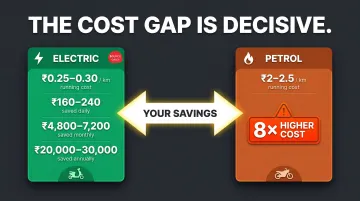
- Electric scooters cost ₹0.25–₹0.30/km versus ₹2–₹2.5/km for petrol—an 8x operating advantage driving fleet conversion
- 23.5 million gig workers projected by 2029-30 create sustained rental demand from food delivery and quick commerce
- UPI payments and instant Aadhaar-based verification bring 950 million+ internet users within reach of app-based rentals
- Tier-2 cities like Jaipur and Lucknow represent the next expansion frontier as Bengaluru and Mumbai mature
Electric Scooters Are Replacing Petrol Bikes in India's Rental Fleets
Fleet electrification means rental operators are swapping internal combustion engine bikes for battery-powered scooters at an accelerating pace. This shift accelerated sharply in 2025–2026, driven by three converging forces: vehicle supply, infrastructure maturity, and hard-to-argue-with unit economics.
India registered 1.4 million electric two-wheelers in FY2026, up 22% year-on-year, representing 6.54% of total two-wheeler sales. E-2Ws now command 57% of India's entire EV market, demonstrating that supply chains and manufacturing capacity have reached fleet-scale readiness. Operators no longer face months-long vehicle delivery delays or limited model choices.
Battery Infrastructure Solves Range Anxiety
Early EV fleets faced a critical problem: downtime. Charging a scooter for 3-4 hours mid-shift killed delivery partner productivity. Battery-swapping infrastructure has eliminated this bottleneck.
Sun Mobility operates 900+ swap stations across 20+ cities, processing 1.4 million monthly swaps as of December 2025. Swap time? Under two minutes. Their Indofast joint venture with Indian Oil Corporation targets 10,000 stations across 40+ cities by 2030, with franchise investments starting at ₹10-40 lakh per compact station.
Bounce Daily's fleet features both chargeable and swappable battery options across its high-speed (55 km/h, 70 km range) and low-speed (25 km/h, 85 km range) variants, giving operators flexibility based on route profiles. The low-speed model's 85 km range easily covers a full delivery shift without mid-day swaps for most urban routes.
The Economic Case Is Decisive
The running cost gap between electric and petrol is striking:
- Electric scooters: ₹0.15–0.35/km in running costs
- Petrol bikes: ₹2–2.5/km — roughly 8x higher
- Daily savings (80–100 km rider): ₹160–240
- Monthly savings per vehicle: ₹4,800–7,200
- Annual savings per vehicle: ₹20,000–30,000
Battery-as-a-Service models have closed the upfront cost gap too. By separating battery ownership from vehicle purchase, BaaS reduces EV acquisition costs by 35–50%, making fleet conversion accessible even for smaller operators.
Yulu's 45,000-vehicle fleet reached $30 million in annual recurring revenue with EBITDA profitability since April 2025, confirming the unit economics hold at scale.
India's Gig Economy Boom Is Creating Unprecedented Demand for Scooter Rentals
India's gig workforce isn't just growing—it's exploding. NITI Aayog projects the gig economy will expand from 10 million workers in 2024-25 to 23.5 million by 2029-30. Quick commerce alone is projected to reach $12.97 billion by 2029, driven by platforms like Blinkit, Zepto, Swiggy Instamart, and JioMart expanding into Tier-2 cities.
The Vehicle Ownership Barrier
Most delivery partners cannot afford to buy or maintain a personal vehicle. A new petrol scooter requires ₹60,000-90,000 upfront plus ongoing fuel, insurance, and maintenance costs. For workers entering the gig economy with limited capital, this is prohibitive. Daily or weekly scooter rentals eliminate the ownership burden while providing immediate earning capability.
Yulu's data illustrates the demand intensity: 36,000+ delivery executives use their fleet daily, supporting 20+ million monthly deliveries across Zomato, Swiggy, Blinkit, Zepto, JioMart, and Flipkart Minutes. Average riders complete 25+ orders per day, with top performers hitting 40+ deliveries on peak days.
Instant Onboarding Removes Friction
Traditional vehicle rental required physical paperwork, security deposits, and multi-day approval processes. Gig workers need to start earning within hours, not days.
Bounce Daily, which relaunched in April 2025 targeting delivery partners, uses instant digital verification via Aadhaar and driving license uploads. The entire process—download app, verify documents, locate hub, pay, and pick up—takes minutes. For the low-speed variant, verification requires only Aadhaar, enabling immediate access for new workers. driving licence assistance (available for a nominal ₹200-₹230 fee) is available at our hub — visit us or check our app to know more.
In a segment where every delayed day means lost income, fast activation is what wins riders. Platforms that get a new worker earning within 30 minutes have a concrete advantage over those still running paper-based approval queues.
Why This Demand Is Durable
Quick commerce is structural, not a pandemic-era anomaly. Union Budget 2025-26 confirmed this by formalizing gig worker recognition with:
- e-Shram registration and official identity cards for platform workers
- AB-PMJAY healthcare coverage — ₹5 lakh per family annually
- Formal classification of gig work as a permanent employment category
Government policy now treats gig workers as a stable workforce segment — which means the rental infrastructure supporting them isn't a trend bet. It's foundational.
App-Based Platforms, IoT, and Flexible Pricing Are Transforming the Rental Experience
India's digital infrastructure now supports fully cashless, app-based rental operations at scale. Household smartphone penetration hit 85.5% in 2025 (82.1% rural, 91.3% urban), while UPI processed 241.6 billion transactions in FY2025-26—roughly 49% of global real-time payments. That reach extends well into Tier-2 and Tier-3 cities, giving rental operators a viable customer base far beyond metro areas.
Flexible Pricing for Different Users
Two dominant pricing models serve distinct segments:
- Pay-as-you-go works for commuters and occasional riders who want flexibility — billed per ride or per hour with no recurring commitment.
- Subscription and daily plans suit gig workers and delivery partners, who need predictable costs across long shifts. Bounce Daily's daily plans target this segment directly, giving delivery riders stable pricing that makes income forecasting straightforward.
IoT Enables Profitable Fleet Management
GPS tracking, remote locking, real-time diagnostics, and predictive maintenance give operators continuous visibility into vehicle health and location. Catching issues before they cause breakdowns keeps fleets on the road — which directly protects revenue for hub operators running high-utilization schedules.
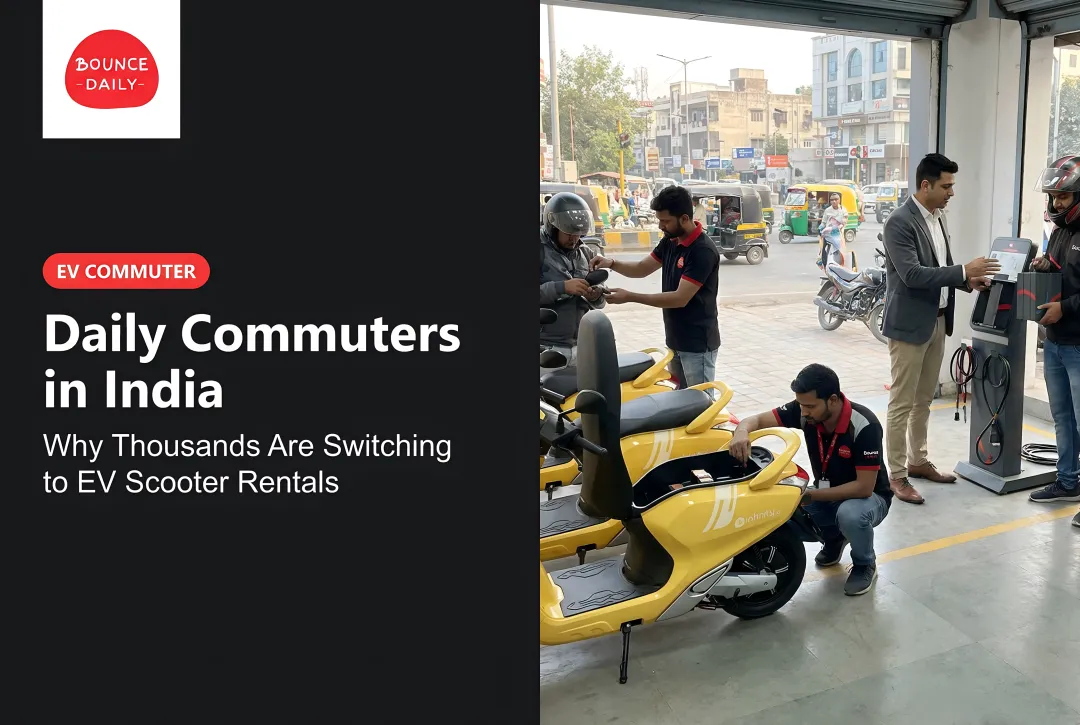
For franchise partners, this is a meaningful advantage. Bounce Daily manages maintenance, tracking, and uptime centrally, so hub operators can focus on customer relationships and local growth rather than chasing down mechanical problems. Operators with no automotive background can run a productive hub from day one.
Last-Mile Connectivity and Tier-2 City Expansion Are Opening New Markets
India's last-mile connectivity gap—the 2-3 km distance between metro stations or bus hubs and final destinations—remains unsolved in most cities. Hyderabad commuters face ₹100-120 costs for a 3 km ride, while shared autos frequently refuse short trips during peak hours. Bengaluru, Pune, and Mumbai exhibit identical patterns.
Bikes and scooters solve this at scale. They navigate congested roads faster than cars, park easily near transit hubs, and cost less per kilometre than app cabs. Two recent deployments show how quickly this is changing:
- Delhi deployed 1,500 electric autos across 150 metro stations to address last-mile demand directly
- Sun Mobility integrated battery-swapping stations at 19 Bengaluru metro stations, with plans to expand to all 69
Tier-2 Cities: The Next Growth Frontier
While Bengaluru, Mumbai, Delhi, and Hyderabad dominate current rental activity, Tier-2 cities like Jaipur, Lucknow, Indore, Surat, and Coimbatore are emerging as high-potential markets. Several factors make these markets attractive for rental operators:
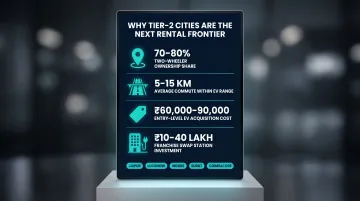
- Two-wheelers make up 70-80% of vehicle ownership in Tier-2 cities—far higher than in metros
- Average commute distances of 5-15 km sit well within EV range of 60-100 km per charge
- Entry-level electric scooters priced at ₹60,000-90,000 keep acquisition costs manageable
- Franchise models requiring ₹10-40 lakh for swap stations lower the barrier for local operators
Yulu's six partner-led cities alongside four company-operated hubs show the franchise model works at scale. Bounce Daily's planned expansion into NCR, Hyderabad, Chennai, and Mumbai follows the same partner-enabled approach.
What's Driving the Bike and Scooter Rental Boom in India
Government Policy and Incentives
Central schemes:
- PM e-Drive allocates ₹10,900 crore for EV adoption across two-wheelers, three-wheelers, buses, and trucks, extended through July 31, 2026
- FAME II (concluded) provided ₹15,000/kWh subsidies, up to 40% of vehicle cost
State-level policies:
- Delhi (Draft 2026-2030): ₹10,000/kWh subsidy, maximum ₹30,000 per vehicle (price cap ₹2.25 lakh)
- Maharashtra (2025-2030): Up to ₹10,000 per two-wheeler, 100% road tax exemption, and 50% fleet electrification mandate by 2030 for aggregators
- Karnataka (2025-2030): 25% capital subsidy for charging and swapping infrastructure, though road tax exemptions were rolled back
Maharashtra's 50% aggregator fleet mandate directly impacts rental operators serving delivery platforms, creating regulatory push alongside subsidy pull.
Urbanization and Traffic Congestion
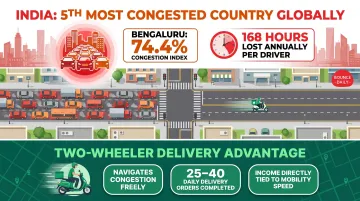
India ranked 5th most congested country globally in 2025, with an average congestion level of 37.4%. Bengaluru leads domestically at 74.4% congestion — costing residents 168 hours annually in lost time.
That pressure only grows. India is projected to have seven megacities by 2030, with cities generating 70% of GDP and urban populations nearly doubling by 2050.
In gridlocked metros, two-wheelers deliver time savings that cars cannot match. For delivery partners whose income depends on completing 25-40 orders daily, a scooter's ability to navigate congestion translates to earnings.
Rising Fuel Prices and Cost Sensitivity
Petrol prices hovering around ₹103.50/litre in Mumbai make fuel a significant operational expense for petrol bike users. For cost-sensitive gig workers operating on thin margins, the ₹2.00-2.50/km fuel cost versus ₹0.15-0.35/km electric cost isn't marginal—it's decisive.
Competitive Market Dynamics
Multiple funded players are re-entering or scaling operations. Bounce Daily relaunched in April 2025 with USD 5 million from Accel, B Capital, and Qualcomm Ventures. Yulu has reached $30 million ARR and EBITDA profitability.
Both milestones signal that unit economics in this segment are working — which means more hubs, better pricing, and wider city coverage for riders choosing rentals over ownership.
How These Trends Are Reshaping the Industry—and What Comes Next
Operational and Business Impact
The shift to EV fleets changes unit economics in measurable ways. Lower fuel and maintenance costs improve gross margins, but upfront acquisition costs require new financing models. Battery-as-a-Service addresses this by shifting battery ownership off operator balance sheets, enabling asset-light expansion.
Managed fleet services are emerging as a clear competitive advantage. Bounce Daily handles maintenance, tracking, and uptime for franchise partners — and provides marketing support and rider leads on top of that. Operators focus on local customer relationships rather than technical operations, lowering the entry barrier for non-automotive entrepreneurs.
Future Signals to Watch
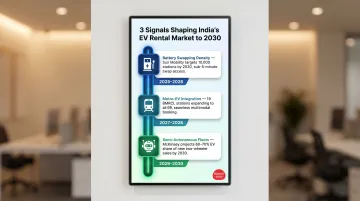
Three developments will shape where this market heads next:
- Battery swapping density: Sun Mobility targets 10,000 stations by 2030. Sub-5-minute swap access across city zones is the deciding factor for EV rental viability in new markets.
- Metro-EV integration: Sun Mobility's 19 BMRCL metro station deployments — expanding to all 69 stations — point toward multimodal trip planning where metro apps book last-mile EV rentals seamlessly.
- Semi-autonomous fleets: Gurugram's sidewalk robot and AI drone pilots are early experiments. McKinsey projects EVs will represent 60–70% of new two-wheeler sales by 2030, laying the groundwork for semi-autonomous fleet deployment within 3–5 years.
Workforce and Market Signal
These forward-looking signals rest on a foundation already taking shape today. Daily rental platforms create two streams of economic opportunity: formal income for gig workers and asset-light business models for franchise entrepreneurs. That combination should attract sustained policy support — Union Budget 2025-26's gig worker formalization is one early signal — alongside continued private investment.
Conclusion
India's bike and scooter rental market in 2026 sits at an inflection point. Electric vehicle adoption, gig economy demand, digital platform maturity, and government tailwinds aren't isolated trends — they reinforce each other, accelerating growth in ways no single factor could achieve alone.
Operators covering 800 million kilometres annually, processing 1.4 million monthly battery swaps, and supporting 20+ million deliveries confirm that this market has moved well past experimentation into scaled execution.
Those who move now stand to capture the largest share of a market scaling from USD 380 million in 2024 toward USD 1+ billion by 2030. The priorities are clear:
- Build EV-first fleets before petrol operators are forced to retrofit
- Target delivery partner segments with fast, simple digital onboarding
- Expand into Tier-2 cities through franchise models before competitors establish density
The early-mover window is narrowing. The structural drivers are not.
Frequently Asked Questions
What is the projected size of the bike and scooter rental market in India in 2026?
India's bike and scooter rental market reached USD 380.9 million in 2024 and is projected to grow at 19.8% CAGR to exceed USD 1.1 billion by 2030, per Grand View Research. Mordor Intelligence forecasts a parallel figure of USD 1.06 billion by 2030 at 18.15% CAGR — both sources put the market well past the USD 1 billion mark by 2030.
Which cities in India have the highest demand for electric scooter rentals?
Bengaluru, Mumbai, Delhi, Hyderabad, and Chennai represent current high-density rental markets, driven by severe traffic congestion, large gig workforces, and established delivery platform operations. Tier-2 cities including Pune, Jaipur, Lucknow, Indore, and Coimbatore are emerging as fast-growing secondary markets as operators expand beyond metros.
How is the gig economy driving growth in India's scooter rental market?
23.5 million gig workers projected by 2029-30 — up from 10 million in 2024-25 — create sustained demand for affordable two-wheeler access. Most delivery partners lack the capital to purchase vehicles, so daily or weekly EV rentals are their primary mobility option, keeping quick commerce platforms operational at scale.
What government schemes are supporting EV two-wheeler rentals in India?
PM e-Drive allocates ₹10,900 crore for EV adoption, extended through July 2026. State incentives add further push: Delhi offers ₹10,000/kWh (max ₹30,000), Maharashtra mandates 50% aggregator fleet electrification by 2030, and Karnataka provides a 25% capital subsidy for swapping infrastructure — all reducing fleet acquisition costs for rental operators.
Do you need a driving license to rent an electric scooter in India?
For low-speed electric scooters (up to 25 km/h, maximum 250 watts motor power), driving licence assistance (available for a nominal ₹200-₹230 fee) is available at our hub - visit us or check our app to know more. High-speed variants (above 25 km/h) require a valid driving license (LMV or MCWOG), registration, and mandatory helmet use.
What is the difference between pay-as-you-go and subscription scooter rental models in India?
Pay-as-you-go charges per ride or per hour with no commitment — best suited for occasional use. Subscription and daily rental models offer fixed daily or weekly rates with unlimited usage, which gig workers prefer for predictable costs and continuous vehicle access throughout the day.