This article is for aspiring bike rental entrepreneurs, franchise investors, and existing operators who want a clear-eyed answer to the profitability question — not optimistic projections, but realistic numbers, genuine margin benchmarks, and the specific factors that separate profitable operators from those breaking even.
We'll cover the profitability formula, the variables that move the needle most, cost structures that catch operators off-guard, and why the EV scooter segment in India — particularly targeting gig workers — represents one of the strongest rental economics available in 2026.
Key Takeaways
- The global bike and scooter rental market is valued at USD 5.53 billion in 2025, growing at 15% CAGR through 2030
- India's rental market is growing faster at 19% CAGR, with EV propulsion as the fastest-growing segment
- Occupancy rate is the single biggest profitability lever — the difference between 40% and 80% utilisation can double your revenue on the same fleet
- EV scooters for gig workers deliver higher utilisation, near-zero fuel costs, and year-round demand vs. tourist-dependent models
- Bounce Daily's FOCO program cuts startup risk — fleet management, maintenance, and rider acquisition are all handled for you
Is the Bike Rental Business Profitable in 2026?
The short answer is yes — with conditions. The market fundamentals are strong, but profitability depends heavily on your operational model.
According to Mordor Intelligence, the global bike and scooter rental market is valued at USD 5.53 billion in 2025 and is projected to reach USD 11.19 billion by 2030 at a 15.14% CAGR. That's steady, compounding growth backed by structural demand shifts.
The demand drivers are structural, not cyclical:
- Urban congestion makes two-wheelers faster and cheaper than cars for short trips
- Tourism recovery sustains leisure rental demand in high-footfall destinations
- Eco-conscious commuting is shifting daily transportation choices toward lighter vehicles
- The gig economy creates a permanent base of daily rental customers — delivery workers who need a vehicle for every shift
India's Specific Opportunity
India's bike and scooter rental market generated USD 312.1 million in 2023 and is projected to reach USD 1,106.8 million by 2030 — a 19% CAGR that outpaces the global average. The electric propulsion segment is growing fastest within that figure.
The workforce driving that growth tells its own story. According to NITI Aayog, India had 7.7 million gig workers in 2020-21, with projections reaching 23.5 million by 2029-30. These workers need a reliable scooter every single day — a demand pattern that seasonal tourist markets simply can't replicate.
Cities like Bengaluru illustrate the opportunity concretely:
- Year-round weather eliminates the seasonality that hurts tourist-dependent rental operators
- Dense delivery networks from Swiggy, Zomato, and Blinkit generate consistent daily rental demand
- A large gig workforce creates high fleet utilisation without relying on walk-in or tourist traffic
How to Calculate Bike Rental Business Profitability
Before you can improve margins, you need to understand what drives them.
The core profit formula:
Net Profit = (Fleet Size × Daily Rate × Occupancy Rate × Operating Days) − (Maintenance + OPEX + Staff + Rent + Insurance)
Most operators focus on fleet size and daily rate. The variable they underestimate most — occupancy rate — moves the outcome more than either.
Occupancy Rate: The Most Critical Variable
Occupancy rate — the percentage of your fleet that's rented on any given day — has more impact on profitability than almost any other factor.
Consider a 20-scooter fleet at ₹400/day average rental rate, operating 365 days:
| Occupancy Rate | Daily Rentals | Annual Revenue |
|---|---|---|
| 40% | 8 units | ₹11.68 lakh |
| 60% | 12 units | ₹17.52 lakh |
| 80% | 16 units | ₹23.36 lakh |
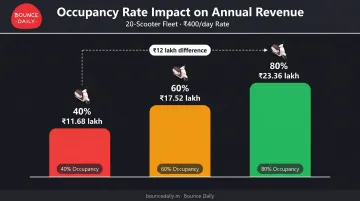
The difference between 40% and 80% occupancy on the same fleet is nearly ₹12 lakh annually — without adding a single vehicle or changing your pricing.
Typical occupancy ranges by season:
- Off-peak: 35–45% (tourist markets hit hardest here)
- Shoulder season: 60–75%
- Peak season: 85–95%
Gig worker-focused models compress this seasonal swing significantly. Delivery riders need scooters year-round regardless of weather or holidays. Urban EV rental operations targeting this segment consistently maintain higher average utilisation than leisure-dependent businesses.
Gross Margin vs. Net Margin: What to Track
Track both — they measure different things.
Gross margin = Revenue minus direct costs (maintenance, battery costs, variable servicing). Bike rental businesses typically achieve strong gross margins because each additional rental has very low incremental cost: the scooter is already bought, insured, and parked.
Net margin = What's left after all fixed overhead: rent, staff salaries, software, insurance, marketing, and taxes.
A simplified Year 1 P&L for a 15-unit EV scooter fleet at 60% average occupancy looks like this:
| Line Item | Amount (₹/year) |
|---|---|
| Gross rental revenue | 19,71,000 |
| Less: Direct maintenance | (2,50,000) |
| Gross Profit | 17,21,000 |
| Less: Rent/hub costs | (3,00,000) |
| Less: Staff | (2,40,000) |
| Less: Insurance & software | (1,20,000) |
| Less: Marketing | (60,000) |
| EBITDA | 10,01,000 |
| Less: Depreciation/tax | (2,00,000) |
| Net Profit | ~8,00,000 |
Note: These are illustrative figures for planning purposes. Actual results vary by location, fleet type, and utilisation.
Year 2 improves as revenue scales while most fixed costs hold flat.
Key Revenue Drivers That Determine Profit
Getting the revenue side right matters as much as managing costs.
Pricing Structure
Daily rate decisions directly cap your revenue ceiling. Pricing too low is the most common mistake first-time operators make — it's almost impossible to recover margin through volume alone.
Sample rate structure for India urban market:
| Vehicle Type | Hourly | Daily | Weekly |
|---|---|---|---|
| Standard pedal bike | ₹30–50 | ₹150–250 | ₹800–1,200 |
| E-cycle / e-bike | ₹60–90 | ₹300–450 | ₹1,600–2,500 |
| Low-speed EV scooter | ₹80–120 | ₹350–500 | ₹1,800–3,000 |
| High-speed EV scooter | ₹100–150 | ₹450–650 | ₹2,200–3,800 |
Indicative ranges based on urban Indian markets. Exact pricing varies by operator, city, and demand segment.
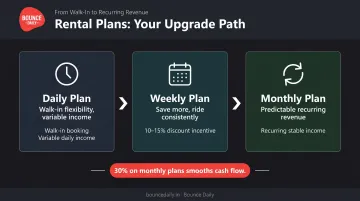
Weekly rates typically carry a 10–15% discount versus the equivalent daily rate — enough to incentivise longer commitments without compressing margin.
Fleet Type and Mix
Fleet composition is a direct margin decision. EV scooters command higher daily rates than standard pedal bikes, and their per-km operating costs are substantially lower once fuel savings are factored in.
Match your fleet to your customer:
- Gig workers and commuters → high-speed EV scooters on daily/weekly plans
- Students and first-time riders → low-speed EV scooters (no licence required in India for sub-25 km/h vehicles)
- Tourists and leisure riders → comfort bikes or e-bikes with flexible hourly/daily options
Mismatching fleet to customer is a utilisation killer. A fleet of mountain bikes in a flat urban delivery corridor will sit idle regardless of pricing.
Subscriptions and Ancillary Revenue
Most operators underuse two revenue levers that directly improve cash flow.
Subscription plans (weekly/monthly) convert variable walk-in customers into predictable recurring income. A 15-unit fleet with even 30% of customers on monthly plans smooths cash flow and cuts the cost of constant re-acquisition.
Plan upgrades are the second lever. Nudging a daily renter onto a weekly plan — or a weekly renter onto a monthly plan — increases revenue per customer without adding fleet units. Operators running tiered plan structures (daily → weekly → monthly) with a clear price-per-day incentive consistently see higher average tenure and better asset utilisation.
Major Costs That Impact Your Bottom Line
Revenue projections mean nothing without an honest cost structure.
Fleet Acquisition
The largest upfront investment. Indicative Indian market pricing:
- Standard pedal bikes: ₹6,000–15,000 per unit (consumer grade); fleet-grade higher
- E-cycles: ₹28,000–45,000 per unit
- EV scooters (low-speed): ₹45,000–70,000 per unit
- EV scooters (high-speed): ₹80,000–1,30,000 per unit
EV scooters have higher acquisition costs but significantly lower per-km operating costs. The economics improve substantially at high utilisation.
Maintenance: The Hidden Profit Killer
Maintenance is the most consistently underestimated ongoing cost. Every day a scooter is off the road is lost revenue, and aging fleets only compound that problem.
Key principles:
- Budget 8–12% of fleet acquisition value annually for maintenance (higher for heavy-use delivery fleets)
- EV scooters have significantly fewer mechanical components than petrol vehicles — no engine oil, no fuel system, fewer moving parts
- Preventive maintenance schedules (monthly checks vs. reactive repairs) can cut downtime and parts costs
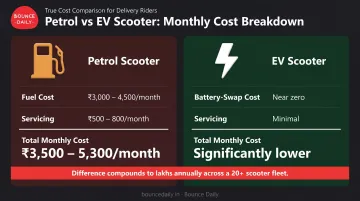
The EV cost advantage is concrete. Petrol scooters used by delivery riders typically incur ₹500–800/month in servicing costs per vehicle, on top of ₹3,000–4,500 in fuel.
EV rental models that include maintenance in the rental fee — like Bounce Daily's — absorb both costs centrally, removing them from the rider entirely.
Fixed Overhead
Fixed costs hit regardless of how many scooters you rent today:
| Cost Category | Estimated Monthly Range (small fleet) |
|---|---|
| Hub/premises rent | ₹15,000–50,000 |
| Staff (1–2 people) | ₹20,000–40,000 |
| Insurance (fleet + liability) | ₹8,000–20,000 |
| Software/tracking | ₹3,000–8,000 |
These costs are largely fixed. In slow months, they don't shrink — which means every idle scooter directly erodes your margin.
How EV Scooters Are Reshaping Rental Profitability in India
For fleet operators in India, the shift to EV rental is primarily an economic decision — and the numbers make a clear case.
The Operating Cost Advantage
Petrol scooters running 50–80 km/day for delivery work cost ₹3,000–4,500 monthly in fuel alone. EV scooters on battery-swap infrastructure reduce that fuel component to near zero. For fleet operators running 20+ scooters at high daily utilisation, that difference compounds to lakhs annually.
The swappable battery model — as used by Bounce Daily across its Bengaluru hub network — eliminates charging downtime entirely. Riders swap a depleted battery for a full one in minutes, keeping vehicles in revenue service through 8–12 hour delivery shifts without interruption.
The Gig Economy Demand Base
India's quick commerce sector is projected to reach USD 5.5 billion by 2025, with same-day delivery growing at 20–25% CAGR toward USD 15 billion by 2030. That growth requires a massive, expanding base of delivery riders who need vehicles every working day.
This is the structural demand advantage that sets urban EV rental economics apart from tourist-market rental. Delivery riders on Swiggy, Zomato, Blinkit, Zepto, BigBasket, and Amazon routes generate predictable, year-round utilisation rather than seasonal spikes.
Bounce Daily delivery partner Karanbir Das put it directly: "Way more cost-effective than petrol bikes, and I've never faced any issues with the battery." That reliability — not just cost savings — keeps gig workers renting rather than switching back.
The Franchise Model as a Lower-Risk Path
That consistent rider demand is exactly what makes the franchise model attractive. For investors who want exposure to EV rental profitability without building operational infrastructure from scratch, the franchise model reduces execution risk directly.
Bounce Daily's FOCO (Franchise Owned Company Operated) model illustrates the structure: the franchise partner provides capital and a hub location; Bounce handles vehicle maintenance, GPS tracking, insurance, battery-swap infrastructure, and supplies verified rider leads directly to the hub. Partners earn recurring monthly rental revenue without running a workshop or building their own rider acquisition pipeline.
Bounce Daily franchise partners get four core advantages:
- Fast digital onboarding so hubs start earning sooner, with no lengthy paperwork
- Maintenance and uptime managed entirely by Bounce, not the partner
- A steady pipeline of verified delivery riders supplied directly to the hub
- Ongoing training, marketing creatives, and operational guidance from day one
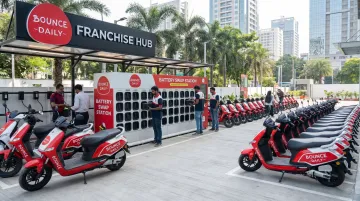
For operators looking to enter the space in 2026, this model removes the two hardest parts of the bike rental business: fleet maintenance complexity and customer acquisition.
Frequently Asked Questions
How much does it cost to rent a bike per week?
Weekly rates in India vary by vehicle type. Standard city bikes typically run ₹800–1,200/week, while e-cycles range from ₹1,600–2,500/week and EV scooters command ₹2,000–3,800/week depending on speed and range. Most operators offer a 10–15% discount for weekly bookings versus the equivalent daily rate.
Is a bike rental business profitable in India?
Yes, particularly in urban markets with EV scooters targeting gig workers. Year-round daily utilisation from delivery riders creates more predictable revenue than seasonal tourist models. Net margins typically improve from Year 2 as revenue scales over stable fixed costs.
What is the profit margin on a bike rental business?
Gross margins run 60–75% because per-rental variable costs are low. Net margins for well-run operations land at 15–30%, driven by utilisation rate, fleet type, and overhead — with Year 1 margins lower and improving from Year 2 as revenue scales over stable fixed costs.
How much does it cost to start a bike rental business?
A 10-unit pedal-bike fleet requires roughly ₹3–5 lakh in fleet acquisition. A 10-unit EV scooter fleet starts at ₹8–13 lakh for fleet alone, plus hub setup and working capital — higher upfront, but lower fuel and maintenance costs improve long-term economics.
What type of bike or scooter is most profitable to rent?
EV scooters targeting daily commuters and gig workers offer the highest per-rental revenue and lowest per-km operating cost in urban high-utilisation scenarios. Standard pedal bikes perform better in tourist or leisure markets with lower daily rate expectations and lighter usage patterns.
How do I increase profitability in a bike rental business?
Five levers move the needle most:
- Push occupancy above 65% through subscription plans and local partnerships
- Introduce weekly and monthly tiers to lock in recurring revenue
- Add ancillary revenue streams beyond base rentals
- Run preventive maintenance schedules to cut unplanned downtime
- Target high-utilisation segments like delivery riders, not just walk-in traffic