Introduction
Gig workers driving 150-250 km daily face a stark reality: every minute their vehicle sits idle directly erodes their income. For rental businesses serving India's gig economy, this operational truth transforms fleet management from a back-office function into the core revenue engine. India's gig workforce reached 7.7 million workers in FY21 and is projected to reach 23.5 million by FY30, while platforms like Swiggy and Zomato have committed to 100% EV delivery fleets by 2030. Yet India's charger-to-EV ratio stands at just 1:235 versus a global benchmark of 1:6-20, with 18% of public chargers non-functional.
That combination — surging demand, platform EV mandates, and a fractured charging network — makes rental fleet management fundamentally different from corporate fleet operations. Internal fleets run predictable routes with trained drivers. Rental operators manage rotating end-users, unpredictable charging behaviour, rapid rider turnover, and the pressure to generate revenue from every vehicle, every day.
A purpose-built system connecting vehicle acquisition, rider verification, battery management, and utilization tracking is what separates a profitable rental operation from one that bleeds cash on downtime.
TLDR:
- Profitable EV rental fleets run vehicle setup, rider onboarding, battery management, and revenue tracking as one integrated system
- Rotating riders with unpredictable behaviour require automated controls and session-based tracking that corporate fleet tools aren't built for
- Battery swapping cuts 4-6 hour charging cycles to minutes — Battery Smart hit 100 million swaps by December 2025
- India's 1:235 charger-to-EV ratio forces rental operators to rely on depot charging and swap networks, not public infrastructure
- Managed fleet partnerships let franchise hub operators focus on riders while central teams handle maintenance, tracking, and uptime
What Is EV Fleet Management for Rental Businesses?
EV fleet management is the process of overseeing all aspects of electric vehicle operations — acquisition, charging infrastructure, maintenance, and rider management — adapted specifically for businesses that rent EVs to external users rather than deploying them internally. In this context, the fleet operator isn't managing employees driving company routes; they're managing a rotation of gig workers, delivery partners, and commuters who rent vehicles by the shift, day, or week.
That distinction reshapes every operational function. A corporate fleet schedules maintenance around predictable mileage and tracks fuel cards for known drivers. A rental operator, by contrast, must:
- Verify rider identity in real-time before each session
- Track battery state-of-charge across dozens of rentals per vehicle per week
- Reconcile revenue by individual rental period, not by driver or route
A delivery partner renting a scooter at 6 AM for a 10-hour shift introduces variables that don't exist in traditional fleet management: unknown charging habits, inconsistent handling, and unpredictable battery drain patterns.
Large logistics companies pioneered EV fleet management at scale, but rental operators face a sharper version of the same urgency. A corporate fleet can absorb one vehicle's downtime across 50 others; a 10-vehicle rental hub loses 10% of daily revenue the moment one scooter sits uncharged.
The India Electric Two-Wheeler Rental Market was valued at USD 100 million in 2025 and is projected to reach USD 478.54 million by 2034 at 19% CAGR, fueled by aggregator platform requirements and rising demand from delivery workers. For rental operators in this market, fleet management directly determines whether each vehicle earns or drains money.
Why Rental Businesses Need a Dedicated EV Fleet Management Approach
A rental EV fleet presents operational complexity that internal fleets don't face. Each vehicle may serve three to five different riders daily, meaning battery charge levels, wear patterns, and vehicle location shift unpredictably throughout the day. A gig worker renting for one shift may return a scooter with 5% battery, park it incorrectly, or skip safety checks entirely. This variability makes manual oversight impossible beyond tiny fleets.
Uptime is revenue. A rental business earns only when vehicles are on the road. An unplanned breakdown costs the daily rental fee; a vehicle sitting uncharged because the previous rider drained it costs the next booking. At commercial gig usage rates of 100 km/day, batteries degrade 7% within the first year and reach warranty thresholds in approximately 4.5 years. Without active battery health management, replacement costs (35–45% of vehicle value) arrive years earlier than expected, destroying unit economics.
Compliance requirements are equally demanding. Under Indian Central Motor Vehicles Rules, every rental operator must confirm three things before handing over a high-speed scooter:
- Valid driving license and eligibility verification per rider
- Registration and insurance documentation on file
- Session-level data linking each rider to the vehicle during their shift
Digital KYC via Aadhaar makes this process take seconds rather than days. Bounce Daily's instant verification system using Aadhaar and license upload compresses onboarding while maintaining full compliance — and creates the audit trail needed if an incident occurs.
State-level mandates sharpen that urgency. Delhi's fleet electrification policy requires 100% EV transition by April 2030, with non-compliance fines of INR 25,000 to INR 1,00,000. Karnataka and Maharashtra have similar targets.
Rental operators supplying delivery platforms face pressure from both directions — regulatory deadlines and platform commitments like Swiggy's 100% EV goal. Managing this transition across hundreds of vehicles without systematic fleet tools means missed deadlines and lost contracts.
How EV Fleet Management Works End-to-End for Rental Businesses
EV rental fleet management isn't a single tool or dashboard — it's a connected sequence of decisions and systems running from vehicle sourcing through post-rental reset. Each stage feeds data into the next, directly determining whether vehicles earn revenue or sit idle.
Step 1: Vehicle Acquisition and Fleet Setup
The process begins by selecting EV variants matched to intended use cases. Delivery-grade requirements typically demand scooters capable of 70-100 km range with top speeds above 25 km/h, triggering full licensing requirements. Operators must balance range, speed, and regulatory classification. Bounce Daily offers two variants:
| Variant | Top Speed | Range | License Required |
|---|---|---|---|
| High Speed | 55 km/h | 70 km | Yes |
| Low Speed | 25 km/h | 85 km | No (16+ age only) |
The High Speed model suits longer delivery routes; the Low Speed model covers shorter urban runs without licensing barriers.
Physical infrastructure includes depot charging stations or battery swap kiosks. Given India's 1:235 charger-to-EV ratio and 18% public charger non-functional rate, relying on public infrastructure guarantees downtime. Battery swapping eliminates 4-6 hour plug-in charging cycles, with manual swaps completed in under 3 minutes. SUN Mobility operates 630+ stations supporting 25,000+ EVs, while Battery Smart crossed 100 million cumulative swaps by December 2025.Digital setup involves configuring fleet management software to track each vehicle's ID, telematics module, and maintenance schedule before the first rental. Bounce Daily centralizes this setup for franchise partners, handling vehicle tracking and uptime management so operators focus on local hub operations rather than backend configuration.
Step 2: Rider Onboarding and Verification
Onboarding in a rental context is a fleet management function, not just customer service. Every new rider introduces risk: unverified identity, unknown driving history, and potential non-compliance with licensing rules. Digital onboarding tools using Aadhaar OKYC enable verification within seconds versus days for manual processes, eliminating friction that would otherwise slow down new rentals.
For high-speed variants, license verification is mandatory. Bounce Daily's app requires riders to upload Aadhaar and driving license for instant verification before accessing 55 km/h scooters. Low-speed variants (capped at 25 km/h) require only age verification (16+) while maintaining regulatory compliance. For riders seeking driving licence assistance (available for a nominal ₹200-₹230 fee), our hub team can help — visit us or check our app to know more.
Beyond legal compliance, onboarding protects vehicle health. Riders unfamiliar with EVs may fully deplete batteries — damaging long-term capacity — or return vehicles to incorrect hubs.
Best-practice rental operators address this upfront: brief riders on battery swap locations, acceptable state-of-charge return thresholds, and vehicle handling. These small briefings meaningfully reduce wear across high-utilization fleets.
Step 3: Active Fleet Monitoring and Charging Management
Once vehicles enter service, real-time telematics give operators visibility into every active rental: GPS location, state-of-charge (SOC), speed data, and usage patterns. The India fleet telematics market is projected to grow from USD 1.68 billion in 2025 to USD 4 billion by 2032 at 13.2% CAGR, reflecting rising adoption across commercial fleets.
Charging management prevents revenue loss. Low-SOC alerts notify operators when a vehicle approaches critical battery levels, enabling proactive intervention. Geofenced charging zones or swap stations guide riders to nearby infrastructure. Battery Smart's 70% market share in India's swap infrastructure means rental operators can direct riders to dense networks in cities like Delhi NCR (332 stations) and Bengaluru (259 stations).
Bounce Daily's swappable battery technology on both scooter variants eliminates plug-in waiting periods. Riders swap depleted batteries for charged ones at hubs in under 3 minutes, resuming deliveries immediately. Centralized fleet tracking monitors which batteries are in circulation, when they were last charged, and which hubs need restocking — without burdening individual franchise operators.
Step 4: Maintenance and Battery Health Management
Predictive maintenance prevents breakdowns that cascade into lost bookings. Telematics flag vehicles approaching service intervals based on actual mileage and usage intensity, not arbitrary calendar schedules. Given commercial gig usage of 100 km/day, EV two-wheelers retain approximately 93% battery capacity after 25,000 km (roughly eight months of gig work).
Battery health management directly impacts unit economics. Manufacturers recommend maintaining lithium-ion batteries within 20-80% SOC range to maximize cycle life. Deep discharges below 40% and prolonged time above 80% accelerate degradation. Bounce Daily's swappable battery model shifts lifecycle management from rider to hub, but operators must still rotate batteries through optimal charging cycles and monitor capacity fade across the fleet.
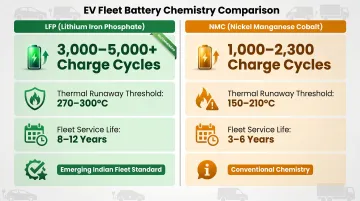
LFP (lithium iron phosphate) batteries are emerging as the fleet standard in India, offering 3,000-5,000+ charge cycles versus 1,000-2,300 for NMC chemistry, with thermal runaway onset at 270-300°C versus 150-210°C for NMC.
This chemistry advantage translates to 8-12 year service life in fleet use versus 3-6 years for NMC — a meaningful difference for operators calculating total cost of ownership. Bounce Daily's vehicles meet European market-compliant certification standards, reflecting a baseline commitment to battery safety and longevity.
Routine charger inspections prevent infrastructure downtime. With 18% of India's public chargers non-functional, depot charging reliability becomes a competitive advantage. Bounce Daily centralizes maintenance for franchise partners, handling vehicle upkeep and tracking to ensure seamless operations without requiring partners to source OEM parts or technician access independently.
Step 5: Revenue Tracking and Fleet Utilization Optimization
The final layer of fleet management tracks which vehicles generate revenue and which sit idle. Per-vehicle utilization rates, daily rental sessions, and revenue per unit expose underperformers. A scooter averaging one rental per day in a market where peers average three signals a problem: wrong hub location, poor vehicle condition, or mismatched variant for local demand.
Data-driven decisions flow from this visibility. Operators can redistribute vehicles from low-demand hubs to high-demand areas, adjust pricing for slow-moving units, or retire aging vehicles before maintenance costs exceed rental income. Bounce Daily supports franchise partners with a steady flow of verified rider leads and centralized fleet oversight — reducing the data burden on individual operators while keeping hub-level performance visible through the platform.
Key Components of an End-to-End EV Rental Fleet Management Solution
A complete solution integrates multiple subsystems. Gaps in any component create vulnerabilities across the entire operation.
Telematics and GPS tracking provide real-time visibility into vehicle location, SOC, speed, and usage patterns. Every other fleet function depends on this data layer — without it, operators can't locate missing vehicles, verify rider claims, or intervene before a battery runs out mid-shift.
Charging infrastructure management includes depot chargers, battery swap kiosks, and energy load balancing to avoid peak electricity rates. Battery-as-a-Service (BaaS) models reduce upfront vehicle costs by 30-40% by decoupling battery ownership. Bounce Daily's swappable battery infrastructure on both scooter variants supports continuous operations, with hubs managing battery rotation and charging centrally rather than relying on riders to find public chargers.
Digital rider management platforms handle onboarding, instant verification, booking, session tracking, and dispute resolution. This is where rental fleet management diverges most sharply from corporate tools. Systems built for employed drivers lack session-based billing, rotating user access controls, and per-rental accountability. Rental operators end up filling those gaps manually or patching in third-party integrations.
Maintenance and service workflows include scheduled inspections, breakdown response, and OEM partnerships. In Bounce Daily's managed model, the company centralizes fleet maintenance, tracking, and uptime for franchise partners, reducing the operational burden on local hub operators who may lack technical expertise or supplier relationships.
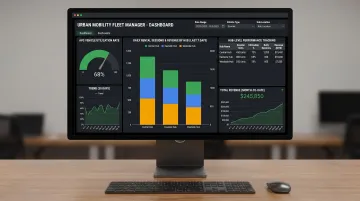
Reporting and analytics dashboards consolidate data across all components:
- Revenue per vehicle and utilization rates
- Battery degradation trends and charger uptime
- Inputs for fleet expansion, variant mix, and pricing adjustments
- Vehicle retirement timelines based on performance history
Before selecting a fleet platform, verify which metrics are accessible and how frequently the data refreshes — reporting gaps compound quickly at scale.
Key Factors That Affect EV Fleet Management in Rental Operations
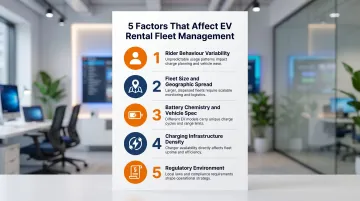
Fleet management configuration in rental operations depends on five variables — and getting them wrong costs uptime, compliance, and margins:
- Rider behaviour variability: Renters have inconsistent charging habits and driving styles. Operators cannot rely on trained behaviour and must build controls — geofencing, SOC alerts, usage caps — into the system itself.
- Fleet size and geographic spread: Larger fleets distributed across multiple hubs require centralized software management. Single-location operators may manage with lighter tools, but the same core processes apply.
- Battery chemistry and vehicle spec: LFP batteries (3,000–5,000+ cycles) handle high-cycle rental use far better than NMC (1,000–2,300 cycles). Swappable battery designs go further, eliminating charging downtime entirely.
- Charging infrastructure density: Public charging remains unreliable across most Indian cities — Delhi recorded just 1 charger per 153 EVs as of April 2024. Operators must fill that gap with depot charging or swap infrastructure.
- Regulatory environment: Speed category thresholds (25 km/h), rider data privacy rules, and state EV mandates all affect system setup. Delhi, Karnataka, Maharashtra, and Madhya Pradesh carry non-compliance penalties up to INR 1,00,000.
Common Misconceptions About EV Fleet Management for Rental Businesses
Misconception 1: "Any fleet management software will work." Most general fleet tools are built for corporate driver fleets, not rotating rental users. They lack rider verification workflows, session-based billing, and per-rental utilization tracking. Rental operators who try to adapt corporate tools end up managing gaps manually — spreadsheets for rider ID, separate payment reconciliation, no automated SOC alerts.
Purpose-built or integrated systems designed for rental use cases eliminate these workarounds entirely.
Misconception 2: "EVs need less management because they have fewer moving parts." EVs do require less mechanical maintenance — no oil changes, fewer brake replacements. But they introduce a different layer of management complexity that operators often underestimate:
- Monitor state-of-charge (SOC) in real time to prevent mid-shift breakdowns
- Schedule charging around peak electricity tariffs to control costs
- Maintain batteries within the 20–80% range to reduce degradation
- Manage thermal stress specific to Indian summer operating conditions
India's 18% public charger non-functional rate means fleet operators can't rely on public infrastructure — they need to manage their own charging uptime. Batteries constitute 35–45% of EV total cost, and commercial gig usage can hit warranty degradation thresholds in 4.5 years instead of 8+. Active battery lifecycle management is essential to preserving the total cost of ownership (TCO) advantage.
Misconception 3: "A franchise partner can manage the fleet independently without central support." EV rental fleet management covers a lot of ground that most franchise operators aren't equipped to handle independently — software integration, charging infrastructure, battery lifecycle tracking, compliance across vehicle variants, and OEM parts sourcing.
Centralized models, where the franchisor manages vehicle maintenance, tracking, and uptime (as Bounce Daily does), allow franchise partners to focus on what they do best: local customer acquisition and hub operations. This division of labour lowers the barrier to entry and ensures consistent fleet performance across locations.
Frequently Asked Questions
What is EV fleet management?
EV fleet management is the process of overseeing all aspects of electric vehicle operations: charging, maintenance, driver or rider management, and performance tracking — to keep a fleet running efficiently and profitably. It covers both hardware (vehicles, chargers, telematics) and software systems (dashboards, analytics, scheduling).
What is EV fleet management software?
EV fleet management software is a digital platform that centralizes monitoring and control of fleet vehicles. It covers real-time telematics, charging schedules, battery health, rider or driver data, and reporting, replacing manual tracking with automated, data-driven oversight.
What is the role of a fleet manager in an EV rental business?
In a rental business, the fleet manager ensures vehicle availability, charging readiness, maintenance scheduling, rider accountability, and utilization optimization. Their core goal is to maximize revenue per vehicle per day with minimal downtime, balancing operational efficiency with rider experience.
What are the 5 pillars of fleet management?
The five core pillars are: vehicle acquisition and lifecycle management, maintenance and safety, driver or rider management, fuel or energy management, and data reporting and compliance. EV rental fleets must address all five with tools adapted to rotating end-users rather than permanent employees.
How is managing an EV rental fleet different from managing a corporate fleet?
A rental fleet serves multiple rotating users per vehicle rather than assigned employees, requiring digital onboarding, session-based tracking, and automated usage controls. Corporate fleets assume consistent trained drivers with planned routes and centrally managed charging, allowing more predictable operational planning.
What should a rental business look for in an end-to-end EV fleet management solution?
Key criteria include rider verification and onboarding capability (such as digital ID verification via Aadhar or equivalent), real-time telematics, charging and battery management tools, maintenance workflow integration, and a reporting dashboard. Ideally, these functions are unified in one platform or delivered through a managed fleet partnership that centralizes complexity.