Introduction
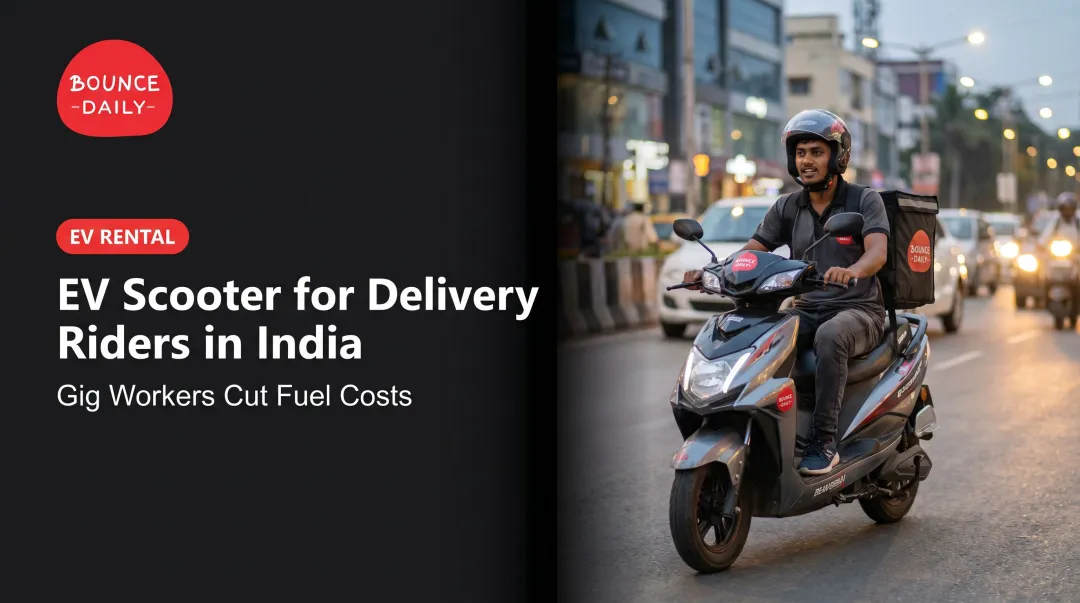
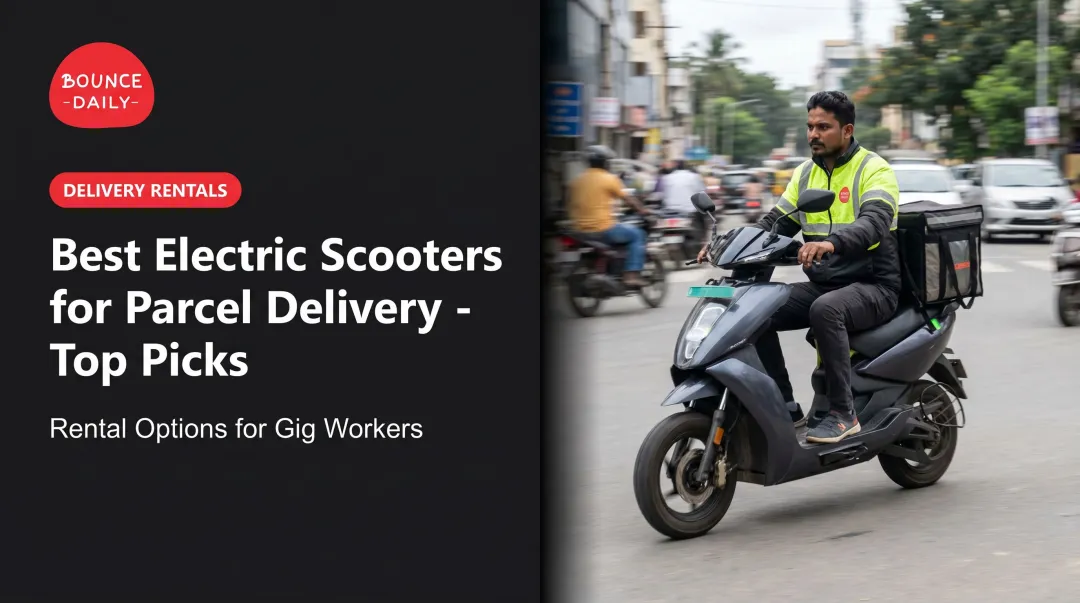
India's gig delivery economy runs on two wheels. Millions of riders powering Zomato, Swiggy, Blinkit, and Zepto deliveries clock 70–100 km daily — and a significant chunk of their earnings goes straight to the petrol pump.
The math is brutal. A typical petrol scooter rider spends ₹3,000–4,500/month on fuel alone — and that's before servicing, insurance, and repairs push the real cost to ₹4,500–6,500 monthly. Factor in the ₹80,000–1,20,000 purchase price or ₹2,500–3,500 in monthly EMI, and owning a petrol scooter starts looking like a losing proposition.
Electric scooters cut that cost significantly. Running on ₹500–800/month in electricity, with no EMI and no maintenance bills, an EV rental can save a delivery rider ₹3,000–4,000 every month — money that stays in their pocket instead of going to the pump.
This guide breaks down the best electric scooters for delivery work in India, the key specs that matter for daily riders, and how to get on the road — without the upfront cost or ownership headaches.
Key Takeaways
- Running a petrol 125cc scooter costs roughly ₹2.36/km; an electric scooter costs approximately ₹0.25/km — a saving of over ₹2 on every kilometre driven
- Look for range per charge, load capacity, charging flexibility, and service network when picking a delivery scooter
- Top picks: Ather 450S, TVS iQube ST, Bajaj Chetak C3501 for buyers; Bounce Daily for riders who want to skip ownership costs entirely
- Bounce Daily (Bengaluru) bundles battery swaps, insurance, and maintenance into one rental plan — no EMI, no repair bills
Why Electric Scooters Work for Delivery in India
Urban delivery work is one of the strongest use cases for electric two-wheelers. Short stop-and-go routes, predictable daily distances, and constant pressure to cut operating costs make a compelling case for switching to electric.
According to Redseer Strategy Consulting, hyperlocal deliveries in India grew 39% year-on-year over the past three years, with the gig delivery workforce growing at roughly 21% annually. That's millions of additional riders entering a sector where vehicle running costs directly eat into take-home pay.
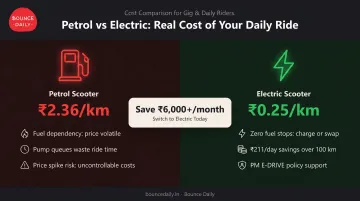
The cost difference is concrete. Based on current Bengaluru petrol prices (₹110.93/litre) and a Honda Activa 125's mileage of 47 kmpl, a petrol scooter costs ₹2.36/km to run. The average electric scooter runs at approximately ₹0.25/km. Over 100 km of daily delivery distance, that's a saving of ₹211 every single day.
Beyond cost, EVs offer:
- Easier navigation through city traffic due to compact form factor
- Zero fuel dependency — no pump queues, no price spikes
- Policy tailwinds from the PM E-DRIVE scheme — ₹10,900 crore earmarked to support ~24.79 lakh electric two-wheelers
With a growing range of Indian-brand options on the market, the key is identifying which scooter holds up across a full 8–10 hour delivery shift — range, load capacity, and running cost included.
Top Electric Scooters for Delivery in India
These picks were selected on range for urban delivery shifts, load handling, build durability, and real-world rider suitability for gig work.
Ather 450S
Ather Energy's 450S is a strong choice for delivery riders who prioritise daily reliability and fast turnaround. The Bengaluru-based brand's Ather Grid fast-charging network adds 30 km of range in just 10 minutes — a genuine advantage when mid-shift top-ups matter.
The 450S handles city traffic well with responsive braking and a build quality designed for daily urban riding. Its higher starting price is offset by lower long-term maintenance costs and performance that clearly outpaces budget alternatives.
| Spec | Detail |
|---|---|
| IDC Range per Charge | 122 km / 161 km (variant-dependent) |
| Fast Charge (Ather Grid) | 30 km added in 10 minutes |
| Starting Ex-Showroom Price | ₹1,35,999 |
Best for: Delivery riders who need fast charging turnaround and consistent daily performance.
TVS iQube ST (5.3 kWh)
The TVS iQube ST's biggest advantage for delivery workers isn't just its specs — it's the pan-India TVS service network. For riders outside Bengaluru or in Tier 2 cities, proximity to authorised service centres is often more valuable than raw performance numbers.
The 5.3 kWh variant delivers 212 km of IDC-rated range and came back with 100 km in real-world Sport-mode testing per BikeWale's long-term review. Its IP67 water and dust resistance and 32-litre under-seat storage add practical delivery utility.
| Spec | Detail |
|---|---|
| IDC Range per Charge | 212 km |
| Load Carrying Capacity | 130 kg (iQube family) |
| Ex-Showroom Price (range) | ₹1,13,244 – ₹1,72,307 across variants |
Best for: Riders who want maximum range and need after-sales coverage beyond metro cities.
Bajaj Chetak C3501
The Chetak revival has built a strong reputation among daily riders for durability rather than outright performance. Its metal body construction and IP67-certified water and dust resistance (confirmed on the official Chetak C3501 product page) make it one of the most weather-ready options on this list. For delivery workers riding through monsoon season six days a week, that matters.
Bajaj's extensive service network is a further advantage for riders in cities where Ather or Ola coverage is limited.
| Spec | Detail |
|---|---|
| IDC Range per Charge | 153 km |
| Key Delivery Feature | IP67 weatherproofing + metal body construction |
| Ex-Showroom Price (Bengaluru) | ₹1,41,305 |
Best for: Riders who prioritise durability and all-weather reliability over performance.
Bounce Daily — Best for Riders Who Don't Want to Buy
Bounce Daily, by Bounce Infinity, is an electric scooter rental service relaunched in April 2025 specifically for gig and delivery workers in Bengaluru. Unlike every other option on this list, you don't buy a scooter: you rent one by the day, week, or month.
Two variants are available:
| Feature | High Speed Variant | Low Speed Variant |
|---|---|---|
| Top Speed | 55 km/h | 25 km/h |
| Range | 70 km | 85 km |
| Battery | Chargeable + Swappable | Swappable |
| Driving License | Required | Not required |
The rental fee covers everything: insurance, maintenance, GPS tracking, breakdown recovery, and unlimited battery swaps at Bounce hubs. Riders replace ₹4,500–6,500 in monthly petrol-era costs with one predictable payment.
Net monthly savings typically range from ₹1,000–2,500.
Delivery partner Karanbir Das, who has been using the service for over a year, puts it directly: "Way more cost-effective than petrol bikes, and I've never faced any issues with the battery."
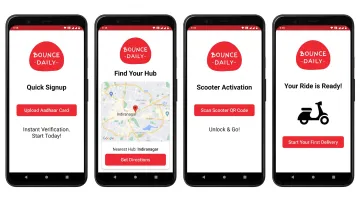
Onboarding is fully digital via the Bounce Daily Android app (Google Play Store). Upload Aadhaar (and DL for the High Speed variant), locate your nearest hub, pay, and pick up. Same-day activation. The fleet has now logged 30M+ kilometres driven and avoided 10,000+ tonnes of CO₂ to date.
Current availability: Bengaluru. Multi-city expansion planned.
Best for: New gig workers, riders without the capital for EMI, and anyone who wants zero maintenance headaches.
A Note on the Ola S1 Air
The Ola S1 Air was one of the most affordable mainstream EVs for delivery use — last recorded at ₹89,999 with a 151 km ARAI-rated range and 6 kW max power. However, it was marked discontinued by both ZigWheels and BikeWale as of January 2026. If you're considering Ola Electric, check the current lineup (the S1 X Gen 3 is the active entry-level model) before making any purchase decisions.
Key Features to Look For in a Delivery Electric Scooter
Range and Charging Flexibility
A full delivery shift in an Indian city typically covers 60–100 km. Koan Advisory pegs the average at 100 km/day for delivery riders. That means claimed range figures aren't the right benchmark — real-world range under load is.
Key considerations:
- Target 80+ km real-world range as a baseline for full-shift coverage
- Models with swappable batteries (like Bounce Daily's fleet) eliminate charging downtime entirely
- For purchased scooters, fast-charging access (Ather Grid, TVS charging points) reduces mid-shift wait times
Motor Power and Load Capacity
Delivery bags, insulated carriers, and a fully-laden rider add significant weight. On Bengaluru's flyovers and inclined roads, underpowered motors slow down noticeably.
- Verify the carrying capacity rating — the TVS iQube family supports 130 kg
- Mid-range motors (3–6 kW) handle urban gradients well for most delivery configurations
- Avoid entry-level low-speed EVs for high-load all-day delivery shifts
Build Quality and Weather Resistance
Indian delivery routes combine potholes, monsoon rain, and stop-and-go traffic for 6–8 hours a day. Build quality directly affects running costs over a 12–24 month lifespan.
- IP67-rated protection (Chetak C3501, TVS iQube ST) handles monsoon conditions without electrical damage
- Metal-frame construction (Chetak) holds up better than plastic-heavy builds over 18–24 months of daily use
- Pneumatic tyres absorb road imperfections better than solid variants
After-Sales Service Network
For a delivery rider, a breakdown means lost shifts on top of the repair bill. Before buying:
- Check the nearest authorised service centre to your delivery zone
- TVS and Bajaj have the deepest Tier 2 and Tier 3 city coverage
- Managed fleet services like Bounce Daily remove this consideration entirely — Bounce handles breakdown recovery centrally
Buy vs. Rent: Cost Comparison
Service network coverage is one factor in the ownership decision. The financials are the other — and the gap between buying and renting is wider than most riders expect.
| Cost Factor | Petrol Scooter (Own) | Electric Scooter (Buy) | Bounce Daily (Rent) |
|---|---|---|---|
| Upfront Cost | ₹80,000–1,20,000 | ₹1,13,000–1,72,000 | ₹0 |
| Monthly Fuel/Running | ₹3,000–4,500 | ~₹300–500 | Included in rental |
| Maintenance | ₹500–800/month | Lower but self-managed | Included |
| Insurance | ₹150–300/month | Self-arranged | Included |
| Breakdown Risk | High | Moderate | Managed by Bounce |
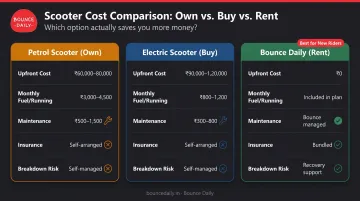
Buying suits riders with stable income and the capital for EMI. For new gig workers or anyone without upfront capital, renting is the more practical starting point — no ownership costs, no maintenance to manage during a 10-hour shift.
How We Chose These Scooters
These recommendations weren't based on spec sheets alone. The evaluation weighted real-world delivery suitability across four criteria:
- Range under load (not just ARAI claims)
- After-sales infrastructure in Indian cities
- Total cost per km
- Feedback from active delivery workers
Two mistakes delivery workers commonly make when choosing a scooter:
- Trusting claimed range figures — ARAI and IDC ranges are tested under ideal conditions. Real-world range under delivery load, city traffic, and summer heat typically runs 20–35% lower than the claimed number.
- Ignoring after-sales coverage — A high claimed range is irrelevant if the nearest service centre is 40 km away and a breakdown costs you two days of income.
The Bounce Daily rental option was included specifically because a significant segment of gig workers — particularly those new to the sector or without vehicle capital — are better served by a managed fleet than by any owned scooter.
Conclusion
The right electric scooter for delivery work depends on three things: your daily km requirement, whether you can absorb the upfront ownership cost, and the service support available in your city.
For riders covering 80–100 km daily who want to own their vehicle, the Ather 450S and TVS iQube ST offer the best combination of real-world range and reliability. The Bajaj Chetak C3501 wins on durability for riders who ride through rain-heavy routes year-round.
For delivery partners in Bengaluru who want to start earning immediately — without EMI, insurance hassles, or repair bills — Bounce Daily's rental model removes every friction point that comes with ownership. Here's what that looks like in practice:
- Same-day digital onboarding via the Bounce Daily app
- Swappable batteries so range anxiety doesn't cut into your earnings
- Maintenance, GPS tracking, insurance, and breakdown recovery handled by Bounce
- No vehicle purchase, no EMI, no upfront capital required
Download the Bounce Daily app on Android, upload your Aadhaar (and DL for the High Speed variant), and you can be on a scooter the same day.
Frequently Asked Questions
Which electric scooter is best for delivery jobs in India?
For buyers, the Ather 450S and TVS iQube ST are strong choices — both offer real-world range suitable for full delivery shifts and reliable service networks. For riders who want to avoid upfront costs, Bounce Daily's rental service in Bengaluru handles maintenance and insurance in one predictable fee.
Is an electric scooter good for delivery work?
Yes. Electric scooters cost approximately ₹0.25/km to run versus ₹2.36/km for a petrol 125cc — savings of ₹150–211 per day across 70–100 km. No fuel stops and lower maintenance frequency make EVs practical for full delivery shifts.
Do I need a driving license to ride an electric scooter for delivery in India?
Under the Central Motor Vehicles Rules, scooters below 0.25 kW and 25 km/h require no driving license or registration. High-speed delivery scooters (above 25 km/h) need a valid two-wheeler DL. Bounce Daily's Low Speed variant qualifies under the no-DL category, with Aadhaar-only onboarding.
How much range do I need from an electric scooter for a delivery shift?
Target at least 70–80 km real-world range for a standard urban delivery shift. Delivery riders average around 100 km/day, so scooters with swappable batteries are particularly useful for back-to-back shifts without waiting on a charge.
Should I buy or rent an electric scooter for delivery work?
Buying works if you have stable income and can manage EMI (₹2,500–3,500/month) plus insurance and maintenance. Renting via Bounce Daily is the better starting point for new gig workers — zero upfront cost, everything included in the rental fee, and same-day activation. Net monthly savings versus petrol ownership run ₹1,000–2,500.
How much cheaper is an electric scooter to run compared to a petrol bike for delivery?
At current Bengaluru petrol prices (₹110.93/litre), a petrol 125cc scooter costs approximately ₹2.36/km. An electric scooter costs roughly ₹0.25/km. Over 100 km of daily delivery distance, that's a saving of ₹211/day — or over ₹6,000/month in fuel costs alone.