Electric scooters have emerged as a genuinely practical answer — not just because they're cheaper than autos or cabs, but because they fit the actual shape of student life. No fuel queues, no EMI on a vehicle you'll leave behind when you graduate, and for low-speed models, no driving licence required.
This guide covers everything a student in India needs to know: the legal rules, what features actually matter for Indian roads, and whether buying or renting makes more financial sense.
Key Takeaways
- Low-speed e-scooters (≤25 km/h, motor ≤250W) need no driving licence, registration, or insurance under Indian law — making them genuinely accessible for most students
- Prioritise 40–60 km real-world range, IPX4+ weather resistance, and solid suspension for Indian roads
- Electric two-wheelers cost ₹1.48/km vs ₹2.46/km for petrol two-wheelers — ownership pays off for daily commuters
- Renting suits students in a city for 1–3 years, with no upfront cost and zero maintenance responsibility
- Always check your college's campus rules before riding, as policies vary by institution
Why Electric Scooters Make Sense for Indian Students
The Cost Argument Is Solid
A 2025 study by CEEW puts the total cost of ownership for electric two-wheelers at ₹1.48/km, compared to ₹2.46/km for petrol two-wheelers (accounting for financing, fuel, maintenance, insurance, and resale). For a student covering 15–20 km daily, that difference adds up fast.
Students relying on autos or ride-hailing typically spend ₹2,000–3,000 per month on daily commutes. An e-scooter (owned or rented) can meaningfully undercut that while eliminating the unpredictability of surge pricing.
Portability That Actually Works on Campus
One underrated advantage: foldable or compact e-scooters can go where petrol bikes cannot. Students in PGs or hostels without dedicated parking can store lightweight models indoors — a room corner, under a loft bed, or a corridor shelf. That's a real edge at campuses where two-wheeler parking fills up by 8 AM.
The Environmental Case
The practical case is clear — but context matters. According to IQAir's 2024 World Air Quality Report, India ranked 5th most polluted country globally, with key air quality figures including:
- National average PM2.5: 50.6 µg/m³ — ten times the WHO guideline of 5 µg/m³
- Bengaluru: 28.4 µg/m³
- Delhi: 91.6 µg/m³
Choosing a zero-emission vehicle is a small but real contribution. The government has backed this direction through successive schemes — FAME II (which ran until March 2024) and EMPS 2024. The current PM E-DRIVE scheme, notified in September 2024, commits ₹10,900 crore to support approximately 24.79 lakh electric two-wheelers.
India's Electric Scooter Laws: What Students Must Know
Most students only look up the rules after getting stopped. Here's what you need to know before that happens.
The Two-Tier Classification
Indian law under the Central Motor Vehicles Rules creates a clear split:
| Category | Speed | Motor Power | Licence Needed? | Registration? | Insurance? |
|---|---|---|---|---|---|
| Low-speed e-scooter | ≤25 km/h | ≤250W | No | No | No |
| High-speed e-scooter | >25 km/h or >250W | Any | Yes (DL) | Yes | Yes |
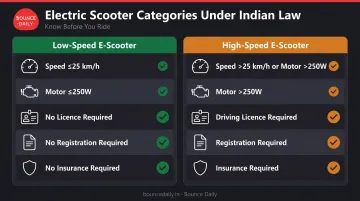
The low-speed exemption comes from notification G.S.R. 589(E) dated 16 September 2005, which classifies such vehicles as not being "motor vehicles" under the CMVR. Verify the current Gazette notification before making any legal decisions, as regulations can be updated.
Age Requirements
- High-speed scooters require a minimum age of 18 years and a valid two-wheeler driving licence, per Section 4 of the Motor Vehicles Act, 1988
- Low-speed scooters have no formal minimum age under central law — but individual states and college campuses can impose their own restrictions. No central rule does not mean no rules
Helmets and Traffic Violations
Section 129 of the Motor Vehicles Act mandates helmets for all regulated two-wheeler riders. For low-speed scooters, enforcement varies — but wear one anyway. The fine is minor; the head injury isn't.
Key fines to be aware of:
- Delhi: ₹1,000 for helmet violations; court challan for riding on footpaths
- Bengaluru: ₹500 for no helmet; ₹500 for triple riding
Riding on pavements is both illegal and dangerous — regardless of scooter speed class.
Campus Rules
Some colleges prohibit two-wheelers on campus entirely, while others have designated e-scooter zones. Check with your institution's administration before buying or renting — campus bans apply to e-scooters too, and enforcement is often stricter than on public roads.
Key Features to Look for in a Student Electric Scooter
Range: Don't Trust the Certified Number
Most student commutes run 5–20 km one way. A scooter claiming 150 km IDC range sounds ideal — until you ride it in Bengaluru traffic.
The Ola S1 Air illustrates this well: its certified range is 151 km, but real-world figures drop to roughly 125 km in Eco mode, 100 km in Normal, and 87 km in Sport mode. Similarly, the TVS iQube range varies from 94 km to 212 km IDC depending on battery variant — but IDC figures are measured in controlled conditions.
Practical rule: Target a scooter with at least 40–60 km of usable real-world range for Indian urban conditions. Anything less creates range anxiety on longer days.
Suspension and Tyres
Campus roads and surrounding streets in India are rarely smooth — and that's the reality you'll ride through daily. Look for:
- Front and rear suspension to absorb speed breakers and potholes
- Wider tyres (10 inches or more) for stability on uneven surfaces
- Tubeless tyres to avoid stranded flats in tier-2 city conditions
Water Resistance
Monsoon is not optional in India. The IPX rating tells you what a scooter can handle:
- IPX4: Protected against water splashes from any direction — minimum acceptable
- IPX5: Withstands low-pressure water jets — better for heavy rain
- IPX6: Handles powerful water jets — strong all-weather choice
Electrical damage from water ingress isn't covered under basic warranties — repairs can run ₹5,000–₹15,000 out of pocket.
Fixed vs. Swappable Batteries
- Fixed (chargeable) batteries: Plug in overnight at your hostel or PG. Convenient if you have a power socket nearby and consistent charging access
- Swappable batteries: Exchange a depleted battery for a charged one at a swap station in minutes — no waiting for a charge cycle. Ideal for students who don't have reliable home charging access
Swappable networks are growing but remain city-specific. SUN Mobility operates 630+ active swap stations across 18+ cities, and Gogoro launched in Delhi and Goa in 2023, with Mumbai and Pune planned.
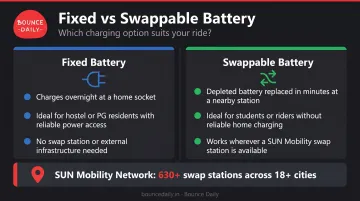
Coverage varies significantly by area. Check what's available near your campus before committing to a swap-dependent model.
Buying vs. Renting: Which Makes More Sense for Students?
The Case for Buying
Entry-level and mid-range options currently available in India:
- TVS iQube 2.2 kWh: Starting ₹94,434 | 94 km IDC | 75 km/h
- TVS iQube 3.1 kWh: Starting ₹1,00,000 | 123 km IDC | 82 km/h
- Ola S1 X: Starting ₹69,999 (high-speed, DL required)
All high-speed models require a licence, registration, and insurance. On EMI (typically 20% down, 80% financed), a ₹94,000 scooter runs roughly ₹1,800–2,200/month in EMI alone, before charging costs and servicing.
Buying makes financial sense if you have a daily commute for 3+ years in the same city and have access to charging. After breaking even, the ₹1.48/km running cost is hard to beat long-term.
The Case for Renting
Students in a city for 1–3 years can sidestep the largest financial risks of ownership by renting:
- No upfront capital outlay (₹70,000–1,20,000+)
- No depreciation loss when you leave the city
- No servicing, insurance, or breakdown costs
- Flexibility to scale up or down between semesters
Bounce Daily for Bengaluru Students
Bounce Daily's Low Speed variant (25 km/h, 85 km range) is built for Bengaluru students — it requires only Aadhaar verification, no driving licence, and onboarding is completed digitally through the Bounce Daily Android app in minutes.
Every rental plan includes maintenance, GPS tracking, insurance, and battery-swap access at Bounce hubs. Students pay nothing separately for servicing or breakdowns. A refundable security deposit is required; exact rental rates are disclosed in-app at plan selection.
The fleet has covered 30M+ kilometres and avoided 10,000+ tonnes of CO₂ — numbers that reflect a service running at genuine operational scale, not a pilot.
Compared to ₹2,000–3,000/month on autos and ride-hailing, the monthly rental is designed to come in below that with no surprises.
The service is currently Bengaluru-only, with multi-city expansion planned.
Quick Comparison
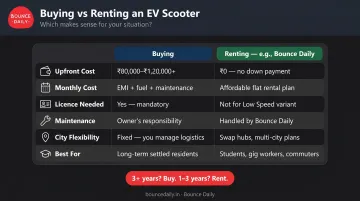
| Factor | Buying | Renting (e.g., Bounce Daily) |
|---|---|---|
| Upfront cost | ₹70,000–1,58,000+ | Refundable deposit only |
| Monthly cost | EMI + charging + maintenance | Single plan fee, all-in |
| Licence needed | Yes (high-speed) | No (Low Speed variant) |
| Maintenance | Your responsibility | Managed by provider |
| City flexibility | Tied to your asset | Stop/start any time |
| Best for | 3+ year daily commuters | 1–3 year students, irregular riders |
Practical Tips for Riding in Indian Cities
Charge to 80–90%, not 100% every day. Consistently charging lithium-ion cells to full voltage accelerates degradation. For a typical 10–15 km daily campus commute, a partial charge is sufficient and extends battery lifespan.
Use physical locks in addition to digital ones. Dense urban areas near campuses and markets are higher-risk for theft. A disc brake lock or chain lock deters theft beyond any built-in immobiliser.
Ride defensively — Indian traffic rewards caution, not confidence:
- Stay in the leftmost lane and avoid riding between large vehicles
- Slow down significantly at uncontrolled intersections
- Give autos and buses extra space — they don't always signal
- Never ride on pavements — it's illegal and carries real fines in both Delhi and Bengaluru
Frequently Asked Questions
Which electric scooter is best for students?
It depends on your commute distance and budget. For short campus routes, a low-speed scooter (no licence required) is the most practical and affordable choice. If you don't want the cost of ownership — EMI, insurance, maintenance — renting a scooter through a service like Bounce Daily gives you a ready-to-ride option without the upfront commitment.
Can a 13-year-old have an electric scooter?
Low-speed e-scooters (≤25 km/h) don't require a driving licence under Indian central law, and there's no formal national minimum age. That said, individual states, local authorities, and campus rules may impose age restrictions. Parents should verify the rules in their specific city before proceeding.
Do students need a driving licence to ride an electric scooter in India?
Not always. Low-speed e-scooters (≤25 km/h, ≤250W motor) are exempt from licence, registration, and insurance requirements under central law. High-speed models — anything faster or more powerful — are classified as motor vehicles and require a valid two-wheeler licence, registration, and at minimum third-party insurance.
Is renting an electric scooter better than buying for students in India?
Renting suits students who are in a city for 1–3 years, have irregular commute needs, or want to avoid upfront capital costs and maintenance. Buying makes more financial sense only for students with consistent daily commutes over three or more years in the same city.
How much does it cost to charge an electric scooter in India?
For a typical 2–3 kWh battery at India's approximate residential tariff of ₹6–8 per kWh, a full charge costs roughly ₹12–24 — before charger losses, slab rates, and fixed charges. Actual cost varies by state and DISCOM. For context, BESCOM (Bengaluru) and MAHADISCOM (Maharashtra) each publish current tariff schedules on their official websites.
Are electric scooters allowed on Indian college campuses?
Policies vary significantly. Some campuses have designated two-wheeler parking for e-scooters; others restrict all motorised vehicles beyond the gate. Check with your college administration before purchasing or renting — it's a quick conversation that can save you a real inconvenience later.