That's why the shift to EV scooters isn't primarily an environmental story. It's a financial one.
This guide covers everything a delivery rider needs to know before making the switch: which features actually matter for delivery work, a real cost breakdown against petrol bikes, how swappable vs chargeable batteries affect your shift, licensing rules, and whether renting or buying makes more sense at your stage.
Key Takeaways
- Delivery riders on petrol bikes typically spend ₹3,000–4,500/month on fuel alone — EV scooters cut this drastically
- Swiggy's EV fleet grew 7x in FY2024-25; EV delivery is already mainstream, not experimental
- Prioritise range, battery type, and payload capacity over top speed when choosing a delivery scooter
- Low-speed EVs (under 25 km/h) don't require a driving licence in India — a major accessibility advantage
- For most new delivery riders, renting makes more sense than buying — no upfront cost, no maintenance burden, and you can start the same day
Why Delivery Riders in India Are Switching to EV Scooters
India's gig delivery workforce is enormous and still growing. Zomato reported 480,000 average monthly active delivery partners in Q3 FY25, while Swiggy's delivery partner base expanded 31.3% year-on-year to reach 515,000 average monthly transacting partners in FY2024-25. Factor in Amazon, Blinkit, Zepto, Flipkart, and Shadowfax, and over a million riders are on Indian roads every single day.
These riders share a common financial squeeze: fuel costs eat into already thin per-order margins. At ₹100–110 per litre with typical mileage of 40–45 km/l, covering 80 km a day costs roughly ₹175–220 in petrol.
That adds up to ₹4,500–5,500 per month — before servicing, insurance, or repairs.
Platforms Are Already Moving to EV
The numbers make clear this isn't a fringe trend:
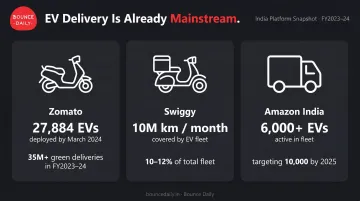
- Zomato's EV delivery fleet reached 27,884 vehicles by March 2024 — roughly double what it was a year earlier — and the company completed over 35 million green deliveries using electric two-wheelers in FY2023-24
- Swiggy's EV partners cover 10 million km per month, with EVs now representing 10–12% of its fleet as of August 2025
- Amazon India had 6,000+ EVs in its delivery fleet by August 2023, on track for 10,000 by 2025
Beyond savings, EV scooters suit Indian city riding naturally. They're compact enough for narrow lanes, produce no exhaust fumes during a 10-hour shift, and eliminate the mental load of fuel stops mid-route. For quick-commerce riders (Blinkit orders are typically delivered within 3 km), the short stop-and-go pattern is exactly what EV motors handle most efficiently.
Policy tailwinds are accelerating the shift too. Two schemes directly benefit riders and buyers:
- PM E-DRIVE scheme (October 2024 – March 2026): ₹5,000/kWh incentive on electric two-wheelers in FY2024-25
- Karnataka Clean Mobility Policy 2025-30: 100% exemption on road tax and registration charges for EVs
What to Look for in an EV Scooter for Delivery Work
Not every EV scooter is built for 8–10 hour delivery shifts. Here's what separates a practical delivery vehicle from one that will let you down mid-shift.
Battery Range and Charging Flexibility
A delivery rider covering 70–100 km per shift needs a scooter that can match that distance reliably in real urban traffic — with frequent starts, stops, and loaded bags — not just under ideal test conditions.
Two battery models exist:
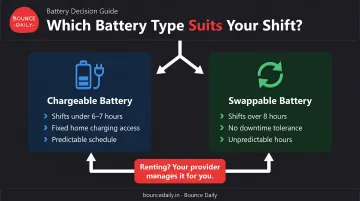
- Chargeable batteries — charged overnight at home or at a hub; best for riders with predictable shift hours and reliable charging access
- Swappable batteries — exchanged at a swap station in minutes; best for long or double shifts where waiting for a charge isn't an option
Bounce Daily's High Speed variant (55 km/h, 70 km range) supports both chargeable and swappable batteries. The Low Speed variant (25 km/h, 85 km range) is swappable only. For most delivery riders, swappable wins: it mirrors the time efficiency of a petrol stop with zero tailpipe emissions.
Build Quality for Indian Roads
Potholes, flooded underpasses, speed breakers every 200 metres — Indian roads punish poorly built scooters hard. Suspension quality, weather-resistant components, and durable tyres aren't optional extras; they're income protection.
A breakdown mid-shift costs more than repair time:
- Lost orders and cancelled deliveries
- Rating drops on Swiggy, Zomato, or Blinkit
- Potential towing or recovery charges
Bounce Daily delivery partner Goutam Behera puts it simply: "The build quality is top-notch and it runs smoothly every single day. Truly a reliable ride." That kind of consistent reliability, shift after shift, is what delivery work demands.
Cargo Capacity and Safety Features
Cargo capacity matters more than most riders realise until a wobbly bag costs them a delivery. Make sure your scooter can carry a standard insulated box or delivery bag without compromising balance — a stable rear platform or underseat storage is worth checking before you commit.
On safety, the non-negotiables for delivery riders are:
- Front and rear braking systems with short stopping distance
- LED headlights for night shifts (early mornings and late evenings are high-order periods)
- Indicators and brake lights visible in traffic
- GPS tracking (also useful for platform accountability)
Speed and Performance
The speed class you choose affects both your licence requirements and your delivery zone. High-speed EVs (above 25 km/h) require a valid two-wheeler DL and vehicle registration. Low-speed EVs, under 25 km/h with a motor below 250W, are exempt from both under Indian regulations — no DL, no registration needed.
For hyperlocal delivery in dense neighbourhoods, 25 km/h is often sufficient. For multi-zone shifts or longer cross-city routes, the high-speed variant's 55 km/h capability makes a genuine difference.
Petrol Bike vs EV Scooter: Real Cost Breakdown for Indian Delivery Riders
Let's put actual numbers to the comparison for a delivery rider covering 80 km/day across 26 working days per month.
Monthly Fuel Cost
| Vehicle | Daily Distance | Daily Fuel/Energy Cost | Monthly Cost (26 days) |
|---|---|---|---|
| Petrol bike | 80 km | ₹176–220/day (₹100–110/l, 40–45 km/l) | ₹4,576–5,720 |
| EV scooter | 80 km | Battery swap included in rental plans | Included in rental |
For riders who own their EV, electricity via BESCOM domestic tariffs (₹4.50/unit for first 100 units) means charging a typical 2–3 kWh scooter battery costs ₹9–14 per charge — roughly ₹250–365 per month at one charge per day.
Maintenance Costs
Petrol bikes require regular oil changes, spark plugs, air filter replacements, clutch adjustments, and more. A realistic monthly maintenance budget runs ₹500–800, with occasional repairs averaging ₹500–1,000 more.
EV scooters have significantly fewer moving parts — no oil, no spark plugs, no clutch. Servicing costs drop significantly, particularly when the vehicle is managed by a rental provider who handles all maintenance centrally.
Total Monthly Cost Comparison
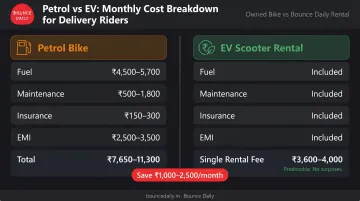
| Cost Component | Petrol Bike (owned) | EV Scooter (Bounce Daily rental) |
|---|---|---|
| Fuel/energy | ₹4,500–5,700 | Included |
| Maintenance/servicing | ₹500–1,800 | Included |
| Insurance (monthly) | ₹150–300 | Included |
| EMI or upfront cost | ₹2,500–3,500/month | ₹0 |
| Estimated total | ₹7,650–11,300 | One predictable rental fee |
According to Bounce Daily's cost model, delivery riders typically save ₹1,000–2,500 per month after switching, improving daily take-home by ₹200–400 per shift. A CEEW study cited by the Economic Times found electric two-wheelers cost just ₹1.48/km to operate compared to ₹2.46/km for petrol — a 40% per-kilometre reduction.
Karanbir Das, who has used Bounce Daily for over a year, confirms the gap: "Way more cost-effective than petrol bikes, and I've never faced any issues with the battery."
Swappable vs Chargeable Batteries: What Works Better for Long Delivery Shifts?
The battery question is practical, not technical. Your shift pattern determines the right answer.
Chargeable batteries suit riders who:
- Work predictable 6–7 hour shifts
- Have access to a charging point at home or a base hub
- Don't need to extend a shift unexpectedly
Swappable batteries suit riders who:
- Work 10+ hour shifts or double shifts
- Can't afford downtime waiting for a charge
- Want the fastest possible battery refresh mid-shift
For delivery work, swappable almost always wins. A 30–45 minute charge stop mid-shift loses orders, drops your ranking on platform algorithms, and costs more in lost earnings than the convenience is worth. The swap infrastructure in India has also reached real scale — SUN Mobility reports over 1 million swaps per month across 620+ swap points nationally.
If you're renting from Bounce Daily, the decision is largely made for you. The swap process takes just a few minutes — comparable to filling petrol at a pump — with unlimited swaps included in rental plans across the Bengaluru hub network. No separate swap fee, no per-swap charge. The High Speed variant supports both chargeable and swappable; the Low Speed variant runs on swappable only.
Simple decision framework:
- Shift under 6–7 hours + fixed home base → chargeable works fine
- Shift over 8 hours or unpredictable hours → swappable is the smarter call
- Renting from a provider who manages battery logistics → the decision is made for you
Licence and Road Rules Every Delivery Rider Should Know
India's regulations distinguish clearly between two classes of electric scooter:
| Feature | Low-Speed EV | High-Speed EV |
|---|---|---|
| Speed | Under 25 km/h | Above 25 km/h |
| Motor power | Under 250W | Above 250W |
| Driving licence | Not required | Required |
| Registration | Not required | Required |
| Bounce Daily variant | Low Speed (85 km range) | High Speed (70 km range) |
Platform requirements can override the low-speed exemption — so don't assume the no-DL rule applies to your delivery work. Blinkit, for example, explicitly requires a valid driving licence, RC, and insurance certificate regardless of vehicle speed class. Always check your platform's onboarding requirements before you sign up.
Bounce Daily's onboarding requirements by variant:
- Low Speed variant — Aadhaar card only (no DL, no RC required)
- High Speed variant — Aadhaar card plus a valid two-wheeler DL
- No licence yet? — DL support is available at Bounce Daily hubs for Low Speed riders who want help with the licence process
One more compliance box to check: third-party insurance is mandatory in India for all EVs, including low-speed variants. Every Bounce Daily rental plan includes it.
Should You Rent or Buy an EV Scooter for Delivery?
The case for buying:
- Full ownership, no ongoing rental cost
- Freedom to use anytime, any shift length
- Makes financial sense over 3+ years of steady delivery work
The reality of buying:
- Decent EV scooters cost ₹80,000–1,50,000+ upfront
- You bear all maintenance, repair, and battery replacement costs
- Battery degradation over time reduces range and resale value
- Capital tied up could be used elsewhere
The case for renting:
- Zero upfront capital required
- Maintenance, insurance, GPS tracking, and breakdown recovery all included
- Same-day onboarding — start earning the same day you sign up
- No EMI pressure if delivery income drops
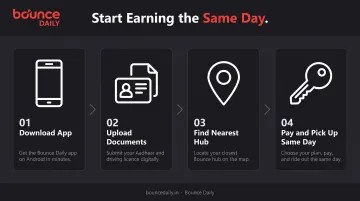
Bounce Daily's rental model addresses exactly these financial pressure points. Getting started takes four steps:
- Download the Bounce Daily Android app
- Upload your Aadhaar (plus DL for High Speed scooters)
- Locate the nearest hub
- Pay and pick up — same day
Bounce manages the entire fleet centrally: maintenance, battery swaps, insurance, anti-theft, and breakdown recovery are all handled for you.
For new delivery riders or those in their first 12–18 months of gig work, renting almost always wins on financial flexibility alone. The monthly savings from not paying EMIs or maintenance costs offset the rental fee, leaving more of each shift's earnings in your pocket.
Experienced riders with stable, long-term delivery income may find ownership worthwhile after two or more years — but even then, the rent-first approach lets you test your income stability before committing ₹1 lakh or more.
Frequently Asked Questions
Which EV scooter is best for delivery?
The best delivery scooter covers a full shift's distance, handles Indian roads reliably, and keeps running costs low. For riders in Bengaluru, Bounce Daily's rental service — swappable batteries, included maintenance, and same-day onboarding — removes the biggest barriers to getting started without any upfront cost.
Can you use an EV scooter for delivery?
Yes. Modern EV scooters comfortably cover the 70–100 km a typical delivery shift requires, either on a single charge or through a quick battery swap. Swiggy, Zomato, and other major platforms already have tens of thousands of EV riders on their networks.
Do I need a driving licence to ride an EV scooter for delivery in India?
Low-speed EVs (under 25 km/h, motor under 250W) don't require a DL under Indian motor vehicle rules. However, platforms like Blinkit require a licence regardless of vehicle class. Check your platform's requirements before selecting a scooter variant.
How much can a delivery rider save per month by switching to an EV scooter?
Based on 80 km/day at current petrol prices, a delivery rider typically spends ₹4,500–5,700/month on fuel alone. Switching to a Bounce Daily rental — which includes battery, maintenance, and insurance — typically saves ₹1,000–2,500/month net, with daily take-home improving by ₹200–400 per shift.
Is renting an EV scooter better than buying for delivery riders?
For most gig workers, yes. Renting eliminates upfront capital, offloads maintenance and insurance, and lets you start earning immediately. Buying only makes sense once you've confirmed long-term commitment to delivery work and have stable income to absorb ownership costs.