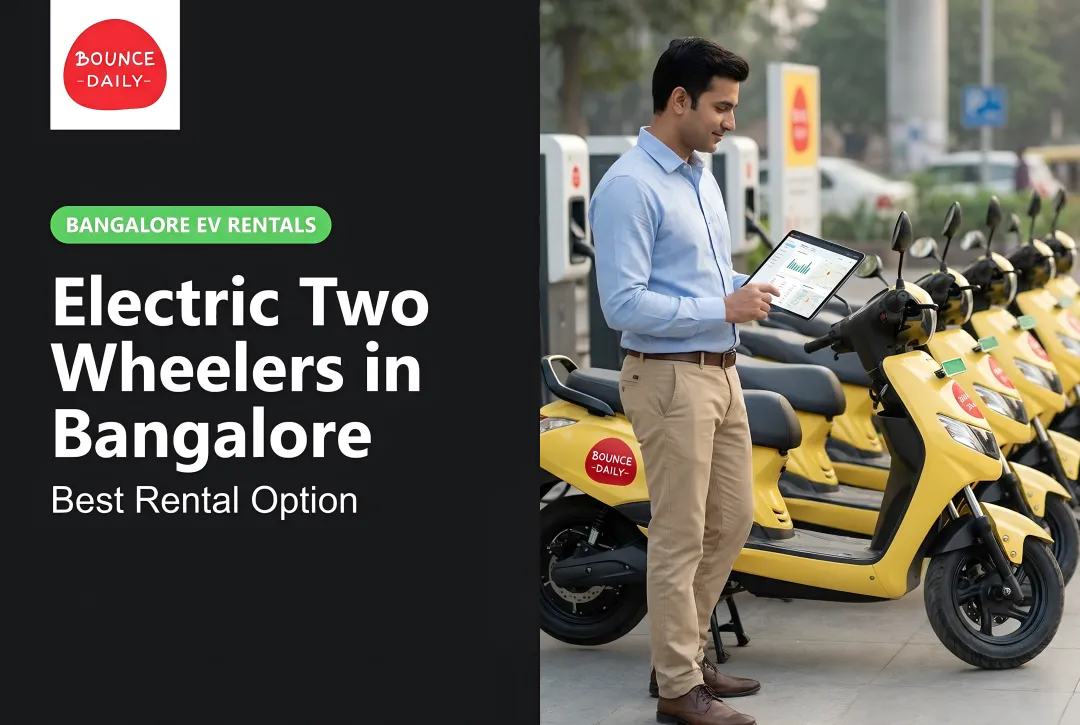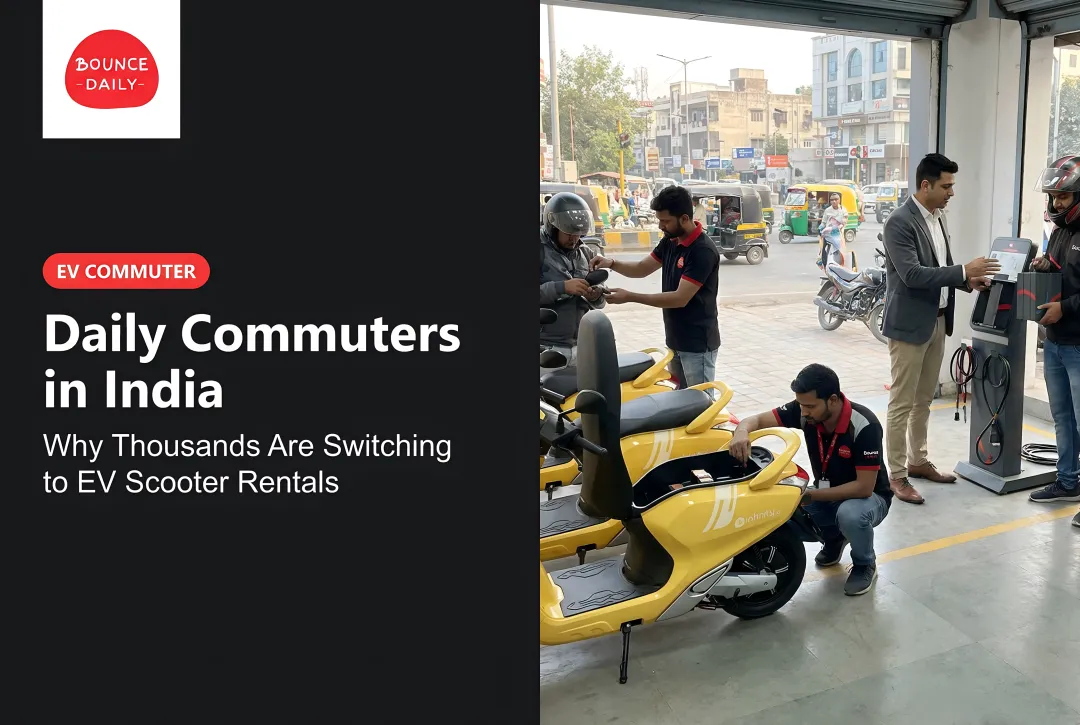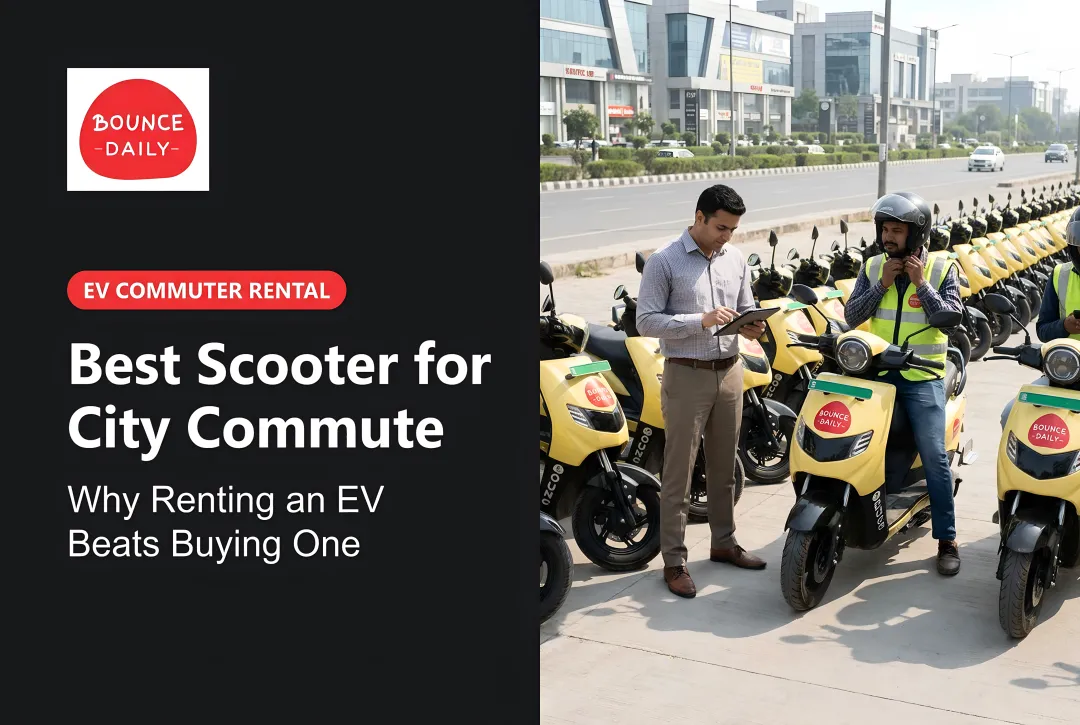
Electric scooters get talked about mostly in environmental terms. But for Bangalore riders — especially delivery partners working with Swiggy, Zomato, Blinkit, and similar platforms — the real argument is simpler: renting an EV scooter costs less, demands less, and keeps you earning more consistently than owning a petrol bike.
This article breaks down exactly how those advantages play out in practice.
Key Takeaways
- Renting eliminates upfront ownership costs — no EMI, no depreciation, no insurance paperwork
- Electricity runs at roughly ₹0.17–0.30/km versus ₹0.80–1.20/km on petrol, directly improving take-home income
- All maintenance, servicing, and breakdown recovery is handled by the rental provider
- Zero-emission riding cuts your carbon footprint and keeps you compliant with delivery platform EV mandates
- Aadhaar-based digital onboarding means you can be riding the same day you sign up
What Is Electric Scooter Rental?
Electric scooter rental is straightforward: you pay a daily, weekly, or monthly fee to ride a maintained, insured, road-ready EV — without purchasing, financing, or servicing it yourself.
Ownership means owning every problem too: service appointments, repair bills, days off the road. With a rental, those responsibilities stay with the provider.
For Bangalore riders, that trade-off is especially practical. Stop-start city traffic, dense delivery zones, and the financial reality of gig work all favour a rental-first approach. Bounce Daily (the EV rental service from Bounce Infinity) is built around exactly this use case: same-day digital onboarding, swappable batteries at hub locations, and fully managed fleet maintenance. Riders focus on covering kilometres, not managing vehicles.
Key Benefits of Renting Electric Scooters in Bangalore
The benefits below aren't theoretical. They map directly to the costs and friction points Bangalore riders deal with daily: fuel spend, maintenance downtime, upfront capital, and regulatory direction.
Lower Running Costs, Higher Take-Home Income
The core financial case comes down to one number: per-kilometre cost.
Using BESCOM's 2024 EV tariff and ICCT's energy consumption data for electric scooters, electricity costs work out to approximately ₹0.17–0.30/km, depending on whether you're charging at a dedicated EV rate (₹4.50/kWh), domestic rate (₹5.90/kWh), or commercial rate (₹8.00/kWh).
A 2025 Economic Times report put total operating costs at ₹1.48/km for electric two-wheelers versus ₹2.46/km for petrol two-wheelers — a gap of nearly ₹1 per kilometre across all costs.
For delivery riders, that gap compounds fast:
- A typical Swiggy or Zomato rider on a petrol scooter spends ₹3,000–4,500/month on fuel alone
- Add ₹500–800 in regular servicing, ₹150–300 in insurance, and occasional ₹500–1,000 in breakdown repairs
- Total monthly petrol scooter operating cost: approximately ₹4,500–6,500/month, plus EMI of ₹2,500–3,500 if the bike is financed
Bounce Daily's rental model replaces that entire cost structure with one predictable fee covering electricity (via battery swap), maintenance, insurance, and GPS. Based on the company's own cost modelling, validated by delivery partner Karanbir Das, riders see monthly savings of ₹1,000–2,500 and daily take-home improvements of ₹200–400 per shift — no extra orders required.
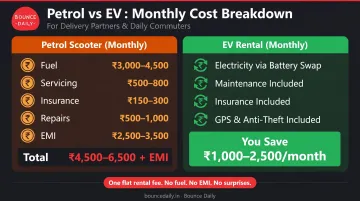
When this matters most: High-volume delivery days, long urban runs, and any period when petrol prices spike — because your electricity cost stays flat.
Zero Maintenance Burden, Zero Downtime
Owning a petrol bike means owning its maintenance calendar. Oil changes, tyre wear, brake pads, unexpected repairs — each costs money and, more critically for gig workers, time off the road.
When you rent, that burden shifts entirely to the provider.
Bounce Daily handles all of the following centrally, at no cost to the rider:
- Vehicle maintenance and servicing
- Battery health monitoring and replacement
- GPS tracking and anti-theft systems
- Insurance and breakdown coverage
- Roadside support if a vehicle has an issue mid-shift
The battery swap setup is especially useful for delivery riders. Instead of waiting hours for a charge or losing half a day at a service centre, riders swap to a fresh battery at a Bounce hub in minutes. Swaps are unlimited and included in every plan.
IDinsight's research on India's delivery gig workforce found that fuel and maintenance expenses consume 32% of gross earnings for delivery drivers working more than eight hours daily — against a gross average of ₹27,814/month. For workers already operating on thin per-order margins, shifting those variable costs to a flat rental is a meaningful income stabiliser.
Delivery partner Goutam Behera puts it plainly: the scooter has "top-notch build quality" and "runs smoothly every single day." Karanbir Das, who has used Bounce for over a year, says he has "never faced any issues with the battery."
When this matters most: Peak periods — festival seasons, weekend surges — when a breakdown on a personal vehicle means losing an entire day's income with no backup.
Eco-Friendly Riding That's Future-Proof for Bangalore
For Bangalore riders, the more pressing reason to go electric is regulatory and commercial direction — the emissions case just adds to it.
ICCT data shows lifecycle emissions of 60.9 gCO₂e/km for a petrol scooter versus 37.5 gCO₂e/km for an electric scooter, a 38% reduction. Bounce Daily's fleet has collectively avoided 10,000+ tonnes of CO₂ across 30M+ kilometres driven.
The policy direction reinforces this shift. Karnataka's Clean Mobility Policy 2025–30 targets 25–30% EV penetration for two-wheelers and three-wheelers, and the central PM E-DRIVE scheme (running until March 2026) has allocated ₹1,772 crore to support around 24.79 lakh electric two-wheelers.
Platform mandates are already in motion:
- Zomato has committed to 100% EV adoption by 2030, expected to influence at least 160,000 two-wheelers
- Swiggy's FY25 BRSR states a target to transition to a 100% EV delivery fleet by 2030
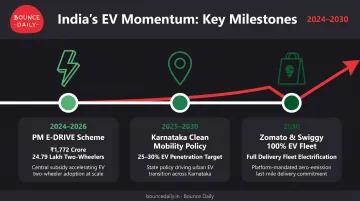
Riders who are already on electric rental fleets are ahead of that transition, not scrambling to catch up when it arrives.
What Happens When You Ignore These Benefits
Staying on a petrol bike isn't a neutral choice. Every month you delay the switch is another month of compounding costs with no way out.
The Financial Drain
- Ongoing petrol spend tied to price volatility you can't control
- Monthly servicing costs that increase as the bike ages
- ₹80,000–1,20,000 in capital locked in a depreciating asset (IDV depreciation commonly reaches 50% by years 4–5)
- EMI payments running ₹2,500–3,500/month if the bike was financed
The Day-to-Day Operational Risk
- A breakdown with no backup vehicle means a lost shift, with no compensation
- Service centre visits during peak earning periods — weekends, festivals — directly reduce monthly income
- No continuity if the bike is stolen or damaged
The Longer-Term Platform Risk
- Both Zomato and Swiggy have published 2030 EV-fleet commitments
- Riders on petrol bikes will face growing pressure as platforms and city regulations move toward electric-only delivery fleets
Waiting to switch doesn't avoid the transition cost. It just delays it while the petrol bills keep running.
How to Get the Most Out of Your Electric Scooter Rental in Bangalore
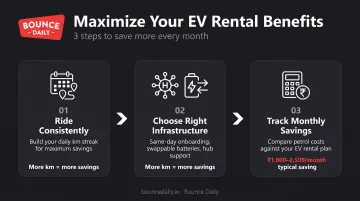
Use it consistently across your working week. The cost-per-day savings on electricity add up the more kilometres you cover — sporadic use cuts into that advantage.
Choose a provider with the right infrastructure. Look for same-day digital onboarding, swappable batteries, and hub-based breakdown support. Bounce Daily covers all three: Aadhaar-based KYC through the Android app, swappable and chargeable battery options, and hub operations that keep you on the road without waiting on a service centre.
Track your monthly savings. Compare your current fuel and maintenance spend against your rental cost. For most delivery riders, the difference runs ₹1,000–2,500/month — a concrete number that makes earnings planning much easier.
Conclusion
Renting an electric scooter in Bangalore is a measurable financial and operational decision, not just an environmental one. Every month on a rented EV scooter is a month without fuel price volatility, without repair bills, and without unplanned downtime eating into your earnings.
For gig and delivery workers, the benefits are direct and stackable:
- Lower per-kilometre costs raise net income on the same order volumes
- Zero maintenance burden keeps you earning through peak periods
- Platform EV alignment means you're already positioned for where delivery work is heading
Frequently Asked Questions
What are the benefits of electric scooters?
Electric scooters produce zero tailpipe emissions, cost roughly ₹0.17–0.30/km to run versus over ₹1.38/km for petrol, and require minimal mechanical maintenance. For Bangalore riders, that translates to lower daily fuel spend and fewer service disruptions.
How much does 1 km cost in an electric scooter?
Using BESCOM's 2024 tariff and ICCT's energy data, electricity costs work out to approximately ₹0.17–0.30/km for an electric scooter. A petrol scooter running at 60 km/L on ICCT's ₹83/L baseline costs ₹1.38/km in fuel alone , and current Bengaluru petrol prices push that figure higher still.
Is a driving licence required to rent an electric scooter in Bangalore?
Under CMVR Rule 126, scooters with a top speed at or below 25 km/h don't require a driving licence. High-speed variants (above 25 km/h) do require a valid two-wheeler DL. Bounce Daily's Low Speed variant covers licence-free riders with Aadhaar-only onboarding.
Can I use a rented electric scooter for Swiggy, Zomato, or Blinkit deliveries?
Yes. Rented electric scooters are compatible with gig delivery work in Bangalore. Bounce Daily specifically targets delivery partners across Swiggy, Zomato, Blinkit, Zepto, Amazon, Flipkart, and other platforms, with daily and monthly rental plans designed around full-shift delivery usage.
Is renting an electric scooter cheaper than owning a petrol bike in Bangalore?
For most delivery riders, yes. Petrol scooter ownership costs ₹4,500–6,500/month in running costs plus EMI, with no capital required upfront. A Bounce Daily rental bundles battery swaps, maintenance, insurance, and GPS into one flat fee, typically saving riders ₹1,000–2,500/month.
How does battery charging or swapping work with rented electric scooters?
Bounce Daily riders can swap depleted batteries for fully charged ones at Bounce hubs across Bengaluru in a few minutes , with no charge cycle wait. The High Speed variant also supports plug-in charging as a backup. Swaps are unlimited and included in every rental plan, so riders are never stranded mid-shift due to a low battery.