 2026](https://file-host.link/website/bouncedaily-p2ce8h/assets/refined-images/1780918464576000_fe47b938a33a4a3db1979fb1d09285c3/360.webp)
The shift from petrol bikes to electric scooters is accelerating. Lower running costs (roughly ₹0.25/km vs ₹1–1.5/km for petrol), zero emissions, and easier city navigation are pushing more gig workers to make the switch. India's electric two-wheeler sales hit 11.49 lakh units in FY2024-25 — up 21% year-on-year — signalling mainstream adoption, not a niche trend.
This guide covers the best electric scooters for food delivery in India in 2026, evaluated on real-world range, reliability, total cost of use, and features that matter specifically to delivery riders.
Key Takeaways
- Electric scooters cut running costs by 4–6x vs. petrol bikes — saving delivery riders ₹3,000–4,500/month in fuel alone
- Minimum 70–100 km real-world range is the practical threshold for full-day delivery shifts
- Top 2026 picks span both rental and ownership models — the right choice depends on budget and city
- Zero upfront cost? Bounce Daily rentals are the fastest way to start earning on electric
Why Electric Scooters Make Sense for Food Delivery
Urban food delivery is one of the most demanding use cases for any vehicle — stop-and-go traffic, frequent parking, multiple drops per hour, and 8–12 hour shifts. Electric scooters suit this environment well for three reasons.
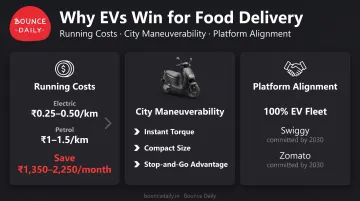
- Running costs drop significantly. According to BikeDekho, a 100cc petrol motorcycle costs ₹1–1.5/km to run. Electric scooters average ₹0.25–0.50/km. For a rider covering 60 km/day, that's a saving of roughly ₹45–75 per day (₹1,350–2,250/month before maintenance).
- City maneuverability beats top speed. In stop-and-go traffic, a scooter's compact size and instant torque matter more than outright speed. High-speed EVs (45–90+ km/h) cover wider delivery zones; low-speed models (up to 25 km/h) work well for dense hyperlocal routes.
- Platform alignment creates real advantages. Swiggy has committed to a 100% electric delivery fleet by 2030 and already works with 50+ EV partners. Zomato made the same commitment. Riders who switch to EVs now gain better platform support as that infrastructure matures.
India's quick-commerce sector — Blinkit, Zepto, Instamart — grew 150% year-on-year in the first five months of 2025. That volume growth makes the vehicle decision more consequential, not less.
Best Electric Scooters for Food Delivery in India (2026)
Selections below are based on real-world delivery suitability: daily range, charging convenience, motor reliability, total cost of use, and adoption among delivery riders across India's major platforms.
Bounce Daily (Rental)
Bounce Daily is an EV rental service built specifically for gig workers, re-launched in April 2025 by Bounce Infinity with a focus on food delivery and e-commerce partners. Currently active in Bengaluru with multi-city expansion planned, it serves riders working with Swiggy, Zomato, Blinkit, Zepto, BigBasket, and others.
Two variants are available:
| Feature | High Speed Variant | Low Speed Variant |
|---|---|---|
| Top Speed | 55 km/h | 25 km/h |
| Range | 70 km per charge | 85 km per charge |
| DL Required | Yes (two-wheeler DL) | No |
| Battery Options | Chargeable + swappable | Swappable |
| Onboarding | Aadhaar + DL, same-day | Aadhaar only, same-day |
Why delivery riders choose Bounce Daily:
- No upfront vehicle purchase, no EMI — one predictable rental fee
- Fleet maintenance, insurance, GPS tracking, and breakdown recovery are all included
- Battery swap infrastructure at Bounce hubs eliminates charging downtime mid-shift
- Digital onboarding via the Bounce Daily Android app — riders can be on the road the same day
- The Low Speed variant is legally rideable without a driving licence under Indian motor vehicle rules
Rider Karanbir Das, who has used the service for over a year, calls it "way more cost-effective than petrol bikes" with zero battery issues. The platform has logged 30M+ kilometres driven and helped avoid 10,000+ tonnes of CO₂ across its fleet.
For riders spending ₹3,000–4,500/month on petrol plus ₹500–1,000 on servicing, switching to Bounce Daily typically improves daily take-home by ₹200–400 per shift.
Ola S1 Series
Ola Electric's S1 range is among the most widely used high-performance scooters by Swiggy, Zomato, and Blinkit delivery partners in metro cities. The current lineup includes multiple variants, with the S1 X+ Gen 3 being the most accessible for owned-fleet delivery use.
Built-in navigation and high top speeds make it a capable option for riders covering wide delivery zones across metro areas.
| Feature | Details |
|---|---|
| Motor Power | Up to 11 kW (varies by variant) |
| Top Speed | Up to 125 km/h (S1 X+ 5.2 kWh) |
| Range | 242 km ARAI certified (S1 X+ 5.2 kWh) |
| Ownership Model | Purchase only |
Heads up: Ola's lineup was updated significantly for 2025–26. Confirm current variant specs and real-world range on Ola's official site before purchasing — certified range typically differs from city stop-and-go range.
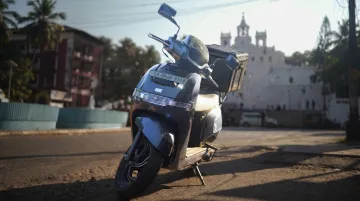
TVS iQube (2.2 kWh)
The TVS iQube is the most straightforwardly documented owned scooter in this category, with specs confirmed directly from TVS's official product pages. It's a strong choice for riders who want a trusted brand, fast charging, and enough range for a full delivery shift.
| Feature | Details |
|---|---|
| Motor Power | 4.4 kW peak (BLDC hub motor) |
| Top Speed | 75 km/h |
| Range | 94 km IDC per charge |
| Battery | 2.2 kWh |
| Charging Time | ~2 hours 45 minutes |
The 2h 45min charging time is a genuine advantage — riders can top up during a lunch break rather than losing hours to charging. TVS's service network across India also reduces downtime risk compared to newer brands with thinner dealership coverage.
Yulu Wynn
Yulu Wynn is a compact low-speed electric moped built for hyperlocal urban deliveries. At 250W and 25 km/h, it falls under India's low-speed EV category, which means no driving licence or registration required under CMVR rules.
| Feature | Details |
|---|---|
| Motor Power | 250W |
| Top Speed | 25 km/h |
| Range | Up to 68 km per charge |
| Battery | 0.98 kWh with swap capability |
| Model | Available for retail purchase + rental ecosystem |
Best fit for: Short-radius hyperlocal delivery runs in dense city zones where speed limits and congestion cap real-world speeds anyway. The battery swap capability keeps downtime minimal.
Not ideal for: Riders covering 50+ km/day across wider city zones, where the 68 km range and 25 km/h cap become operational constraints.
Key Features to Evaluate Before Choosing
Battery Range and Charging Flexibility
A minimum 70–100 km real-world range is the practical threshold for full-day delivery shifts. Manufacturer-certified ranges are measured under ideal conditions — city stop-and-go traffic cuts actual range by 20–30%.
How you recharge matters just as much as how far you go. Battery swap infrastructure (like Bounce Daily's hub network or Yulu's swap stations) eliminates charging downtime entirely. Fast charging under 3 hours matters when riders need a mid-shift top-up.
Motor Power and Load Handling
Motor wattage determines acceleration, hill-climbing ability, and stability under load. Delivery riders carrying insulated bags and multiple orders need:
- 250W minimum for flat urban hyperlocal routes
- 1 kW+ for stable city performance with loads
- 4 kW+ for hilly routes or longer delivery zones
Motor specs set the baseline — but what you pay to keep the scooter running determines whether it actually works for your earnings.
Total Cost of Use
The purchase price is just the starting point. Factor in:
- Monthly fuel cost (petrol) vs. monthly rental or electricity cost
- Servicing frequency and average repair bills
- Battery replacement timeline (typically 3–5 years for lithium-ion)
- Whether a rental model removes all maintenance variables entirely
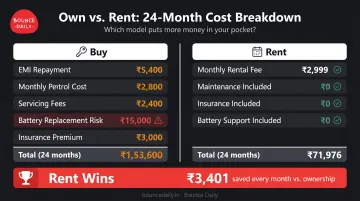
A ₹1.2 lakh scooter purchase with EMI + petrol + servicing often costs more over 24 months than a monthly rental plan that bundles maintenance, insurance, and battery support — which is exactly the calculation Bounce Daily is built around.
Regulatory Compliance
Under MoRTH G.S.R. 291(E):
- Low-speed EVs (up to 25 km/h, 250W): No driving licence or registration required
- High-speed EVs (above 25 km/h): Valid DL and vehicle registration required
Verify what your delivery platform requires before selecting a model. Some platforms may have vehicle eligibility criteria beyond base regulatory requirements.
How We Chose These Scooters
This list prioritises real-world delivery performance over spec-sheet numbers. Common mistakes riders make:
- Focusing on top speed (mostly irrelevant in city traffic under 40 km/h)
- Trusting certified range without accounting for city stop-and-go conditions
- Ignoring total cost of use in favour of the lowest purchase price
Instead, each scooter was assessed against criteria that actually affect your daily earnings:
- Daily operational range under realistic city conditions
- Charging time and infrastructure availability in Indian cities
- Regulatory compliance for delivery platforms
- Total cost of use including maintenance, fuel savings, and battery lifecycle
- Verified adoption by delivery partners across Swiggy, Zomato, Blinkit, and Zepto
Both ownership and rental models are included — the right choice depends on the rider's finances, city, and delivery platform. A Bengaluru rider doing 80+ km/day on Zomato has different needs than someone doing short Blinkit runs in a tier-2 city.
Conclusion
The best electric scooter for food delivery in 2026 comes down to three things: your budget (ownership vs. rental), your daily delivery distance, and the city and platform you work with — whether that's Swiggy, Zomato, Blinkit, or any other.
Run those numbers before committing. Calculate your actual daily kilometre needs and true total monthly cost — a higher-range scooter or a rental with bundled maintenance can generate more take-home earnings than the cheapest upfront option.
For delivery partners in Bengaluru looking to start earning without upfront vehicle investment, Bounce Daily's rental model offers same-day onboarding, swappable batteries, and maintenance handled entirely by Bounce. Download the Bounce Daily app from the Google Play Store to check plans and get on the road today.
Frequently Asked Questions
Which is the best scooter for Swiggy delivery?
Swiggy works with multiple EV providers, and commonly used options include Ola S1 variants, TVS iQube, and Bounce Daily rentals. Bounce Daily's same-day onboarding makes it the fastest option for riders starting without a vehicle — check the Bounce Daily app for current plan availability in your city.
Can I use an electric bike for Swiggy delivery?
Yes, Swiggy accepts electric two-wheelers. High-speed EVs (above 25 km/h) require a valid driving licence and registration, while low-speed EVs (up to 25 km/h) have simpler compliance requirements under Indian motor vehicle rules. Check Swiggy's Delivery Partner app for current vehicle eligibility, as platform rules can change independently of MoRTH regulations.
Is it better to buy or rent an electric scooter for food delivery?
Buying suits riders with stable long-term income who want to build equity in a vehicle. Renting — through services like Bounce Daily — is the better fit for riders starting out, since EMI, maintenance, and insurance are all bundled into a single daily or monthly fee with no upfront capital required.
How much range do I need for food delivery?
Full-day delivery shifts need at least 70–100 km real-world range per charge. Stop-and-go city traffic typically cuts manufacturer-certified figures by 20–30%, so target scooters rated 100+ km certified range to comfortably clear that threshold.
Do I need a driving licence for an electric scooter used in delivery?
Under current MoRTH rules, low-speed EVs (up to 25 km/h, 250W) need no driving licence or registration; high-speed EVs require both. Platform eligibility rules can be stricter than the regulatory baseline — confirm directly with your delivery app before onboarding.
How much can I save by switching from petrol to electric for delivery?
Electric scooters run at approximately ₹0.25–0.50/km vs ₹1–1.5/km for a 100cc petrol motorcycle. For a rider covering 60 km/day, that's a monthly fuel saving of ₹1,350–2,250 — before accounting for reduced servicing costs. Bounce Daily riders typically improve daily take-home earnings by ₹200–400 per shift after switching from petrol.