Introduction: The Delivery Gig Economy Boom in India
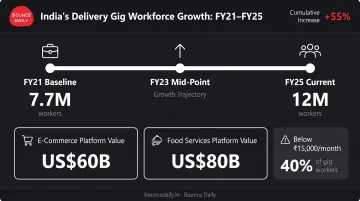
India's gig workforce has exploded from 7.7 million in FY21 to 12 million in FY25, a 55% cumulative increase. More Indians are picking delivery work for flexible schedules, weekly payouts, and low entry barriers.
With e-commerce projected at US$60 billion in 2024 and food services at US$80 billion the same year, platforms like Zomato, Swiggy, Zepto, and Blinkit offer immediate income: no degree required, just a smartphone and a two-wheeler.
Yet the Economic Survey 2025-26 reveals about 40% of gig workers earn below ₹15,000/month. Platform choice and cost control decide whether you clear that bar—or stay stuck under it. This guide breaks down the highest-paying delivery roles, real net pay, and where costs eat earnings.
Key Takeaways
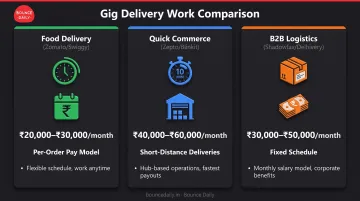
- Quick commerce (Zepto, Blinkit) ads claim up to ₹60,000/month; B2B logistics pays ₹30,000–₹50,000 full-time
- Food and quick-commerce apps usually pay weekly; multi-apping cuts idle time and lifts order volume
- Full-time riders net about ₹18,761/month at 62 hours/week after fuel and maintenance
- Vehicle costs take 32% of gross pay; EV rentals like Bounce Daily can save ₹1,000–₹2,500/month
- Onboarding averages 3–7 days; you need Aadhaar, a licence (for some vehicles), smartphone, and bank account
Top Food Delivery Platforms in India
Three platforms dominate food and quick-commerce delivery pay in India. Here’s how each structures rider earnings.
Zomato
Zomato runs one of India’s largest delivery networks, with flexible hours and weekly bank transfers. Official partner documentation confirms accident and medical insurance, plus instant withdrawal in the partner app.
Earnings hinge on completed orders, city demand, and peak-hour surge pricing. Zomato has not published detailed per-order rates or average monthly income.
Earning structure:
- Distance-based pay per delivery
- Surge pricing during lunch (12 PM–2 PM) and dinner (7 PM–10 PM) rushes
- Quest bonuses for hitting daily or weekly delivery targets
- Performance incentives tied to ratings and on-time delivery
Partners can cover breakfast, lunch, and dinner slots and pull earnings between weekly payouts through instant withdrawal.
Swiggy
Swiggy advertises up to ₹30,000/month for delivery partners, with pay varying by city and order volume. Riders work as paid partners, not employees, and earn per completed delivery. Onboarding usually takes about 24 hours, with weekly direct bank transfers.
Key earning features:
- Per-delivery pay with no fixed hourly commitment
- Weekend incentives when order volumes peak
- Long-distance bonuses beyond standard city zones
- Performance rewards for high acceptance and completion rates
Riders log in when demand is high and switch off in slow periods—useful if you juggle more than one platform.
Swiggy Instamart
Swiggy Instamart handles grocery and essentials in quick commerce. Specific rider-pay figures are not public.
Industry reports suggest quick-commerce riders earn more than food-delivery riders, driven by higher order values and shorter trips inside 2–3 km micro-zones.
Instamart advantages:
- Higher order values mean better per-delivery pay
- Shorter distances cut fuel cost and vehicle wear
- Frequent surge pricing in metros like Bengaluru, Mumbai, and Delhi
- Steady grocery demand, less seasonal than restaurant food
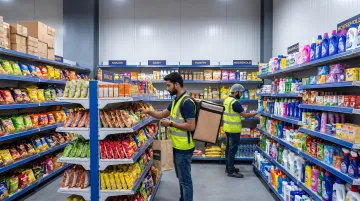
Instamart dispatches from dark stores (small local warehouses), so pickups are faster and delivery zones stay tighter than restaurant food runs.
Quick Commerce Delivery Jobs: The 10-Minute Delivery Revolution
Quick-commerce apps pack more short trips into each hour, which is why their top advertised pay often beats standard food delivery. Here’s how the main 10-minute platforms compare on earnings, incentives, and day-to-day work.
Zepto
Zepto promises up to ₹60,000/month for delivery partners, the highest advertised ceiling among quick-commerce platforms. Its hub-based model clusters orders within hyperlocal zones, enabling riders to complete more deliveries per hour.
Zepto's unique model:
- Hub-based operations with guaranteed hourly rates in select cities
- Daily incentives for completing delivery targets
- Insurance coverage up to ₹10 lakh for rider and family
- Hiring drives across 40+ hubs in metro and tier-2 cities
- Short-distance rides (typically under 2 km) reduce fuel burn
Zepto requires Aadhaar and PAN for onboarding, with flexible hours allowing riders to choose high-demand slots. The 10-minute delivery promise creates tight delivery windows but also consistent order flow.
Blinkit (formerly Grofers)
Blinkit offers up to ₹50,000/month plus a joining bonus up to ₹4,000. The platform uses a per-packet pay model with weight and distance incentives, rewarding riders for handling heavier groceries and longer routes.
Blinkit earning structure:
- Base per-packet rate for every order completed
- Weight incentives for bulk grocery deliveries
- Distance bonuses for deliveries beyond the standard micro-zone
- Multi-order clustering from one hub to raise earnings per trip
- Flexible slots with weekly bank transfers
Blinkit’s micro-fulfillment centers support fast pickups, and riders often run 2–3 orders per trip, which cuts idle time.
BigBasket BB Now
BigBasket advertises up to ₹50,000/month with referral bonuses up to ₹5,000, claiming riders can start earning within one hour of onboarding. The platform focuses on grocery fulfillment with predictable order patterns.
BigBasket advantages:
- Quick onboarding with app-based verification and training
- Grocery-focused model creates consistent daily demand
- Referral bonuses for bringing new riders onto the platform
- Fairwork India 2024 noted a local minimum-wage-after-costs policy, unique among major platforms
The grocery focus means fewer late-night shifts compared to food delivery, with peak demand during morning and evening shopping hours.
Dunzo
Platform status: As of January 2025, Dunzo's app and website went offline following operational difficulties. While Dunzo pioneered hyperlocal delivery in India, the platform is currently near shutdown and should not be considered for new delivery partner onboarding.
E-Commerce & Logistics Platforms
E-commerce and logistics work pays differently from food or quick-commerce gigs. You will see block rates, monthly salaries, and B2B routes that trade pure flexibility for steadier income.
Amazon Flex India
Amazon Flex uses a block-based system: partners pick shifts of 2–8 hours. Official rates are ₹120–₹140/hour, with location and duration setting the exact figure. Each block lists pickup point, length, and an estimated range that mixes a guaranteed minimum with possible extras.
Requirements and benefits:
- Own vehicle (two-wheeler or three-wheeler) required
- Background check mandatory for all partners
- Flexible supplemental or part-time work; blocks are not guaranteed
- Twice-weekly payouts; partners choose payment days
- Openings in tier-2 cities with Amazon fulfillment centers
Amazon Flex fits riders who want predictable hourly pay over per-delivery swings. Block supply still rises and falls with seasonal demand.
Flipkart & Delivery Partners
Glassdoor data from 110 submitted salaries puts Flipkart Delivery Executives at about ₹17,000/month, with a reported range of ₹11,927–₹74,450. Flipkart hires directly and through third-party logistics (3PL) partners, so two pay models sit side by side.
Employment model differences:
- Direct employees get a fixed monthly salary, provident fund, health insurance, and leave—more security, less control over hours
- 3PL contractors earn per delivery completed, keep more schedule freedom, and forgo PF or medical cover
Pick the model that matches your priority. Direct roles usually need full-day availability; 3PL work is easier to stack with other apps.
Shadowfax, Delhivery & B2B Logistics
If stability matters more than multi-apping, B2B logistics is the next step up the pay ladder. These platforms move business and bulk e-commerce loads and often post higher base rates. Shadowfax delivery associates earn ₹2.1–₹2.5 lakh/year across 196 reported salaries, or roughly ₹17,500–₹21,000/month.
Why B2B logistics often pays more:
- Larger package volumes and commercial vehicle handling
- Longer routes with multiple drops in one shift
- Daytime business windows (9 AM–6 PM) cut night work
- Full-time roles with fixed monthly salaries
- PF and medical benefits on some contracts
Delhivery and other 3PL aggregators follow similar structures. These jobs suit riders who want a steady monthly number more than gig flexibility, and many still pair daytime B2B shifts with evening food or grocery blocks when the schedule allows.
Specialized High-Paying Delivery Niches
Some delivery niches pay more because of stricter handling rules, tighter timelines, and higher trust requirements. Medical logistics and high-value goods are two of the strongest options for experienced riders.
Medical & Pharmaceutical Delivery
Medical courier work (moving lab samples, prescription medicines, and equipment) pays more because deliveries are time-critical and tightly controlled. Exact nationwide pay data is limited, but these roles typically require:
- Background verification and a clean record
- Cold-chain handling for temperature-sensitive samples
- Compliance with pharmaceutical transport rules
- Strict delivery windows (lab samples often must arrive within hours)
That reliability bar is why pay runs higher. Most openings are in metro cities with dense hospital and diagnostic networks.
Luxury Goods & High-Value Deliveries
Delivering electronics, jewellery, and premium food orders (gourmet catering, high-end restaurants) can mean higher earnings, with extra requirements:
- Comprehensive background checks
- Handling training to prevent damage
- Enhanced insurance for high-value items
- Strong customer service and professional presentation
Amazon Flex requires background checks for all partners, a baseline that gets stricter for luxury-goods delivery. These gigs suit experienced riders with clean records and strong customer-facing skills.
Part-Time vs Full-Time Earnings Breakdown
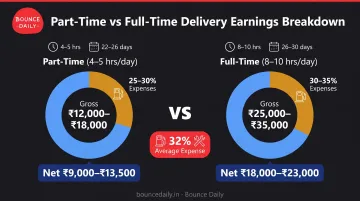
IDinsight's study of 2,547 urban delivery riders found average net monthly earnings of ₹18,761 at 62 hours/week, or about ₹75.3 net per hour after expenses.
Full-time riders (8+ hours/day) averaged ₹27,814 gross/month, but work expenses consumed 32% of earnings. Fuel and maintenance were the largest drains—so cutting fuel cost (for example with an EV) is one of the clearest ways to protect net pay.
Monthly earnings framework:
| Work Type | Hours/Day | Days/Week | Gross/Month | Expenses | Net/Month |
|---|---|---|---|---|---|
| Part-time | 4–5 | 5–6 | ₹12,000–₹18,000 | 25%–30% | ₹9,000–₹13,500 |
| Full-time | 8–10 | 6–7 | ₹25,000–₹35,000 | 30%–35% | ₹18,000–₹23,000 |
Advantages and trade-offs:
Part-time (4–5 hours/day):
- Ideal for students, second jobs, or testing gig work before committing
- Focus on peak hours (lunch/dinner) maximizes per-hour earnings
- Lower vehicle wear reduces maintenance costs
- Limited income potential; harder to hit platform incentive thresholds
Going full-time changes the math on bonuses, ratings, and costs:
Full-time (8–10 hours/day):
- Unlocks platform bonuses and quest targets that need high order volume
- Consistent daily routine builds ratings and platform standing
- Higher absolute income, with higher fuel, maintenance, and fatigue
- More exposure to income dips in slow seasons
City-wise variations:
Hours matter, but so does where you ride. Metro cities (Delhi, Mumbai, Bengaluru, Hyderabad) bring higher order density and more surge pricing, along with higher living costs and heavier traffic. Swiggy notes that earnings vary by city and order volume; Amazon notes that location affects delivery availability and estimated pay.
Tier-2 cities usually mean lower absolute earnings, but also less competition and lower fuel spend from shorter trips. Precise city-by-city salary data is thin, so real-time platform earnings estimates beat generalized figures.
Maximizing Your Delivery Income: Smart Strategies
Multi-Apping Across Platforms
Working simultaneously on Zomato and Swiggy, or combining food delivery with quick commerce (Blinkit or Zepto), reduces idle time. IDinsight found delivery riders average 1.69 earning sources, with part-time workers diversifying more. Multi-apping requires:
- Juggling order acceptance across apps without conflicts
- Strategic order selection: prioritize shorter distances and higher pay
- Managing acceptance rates on each platform to avoid penalties
- Ensuring delivery windows don't overlap
Most platforms allow multi-apping legally, but riders must avoid accepting simultaneous orders with conflicting pickup or drop-off times.
Peak-Hour Timing Strategies
Surge pricing and order volume spike during:
- Lunch rush: 12 PM–2 PM weekdays
- Dinner rush: 7 PM–10 PM daily, extending to 11 PM weekends
- Weekend evenings: Friday–Sunday 6 PM–11 PM
- Festival seasons: Diwali, Holi, New Year's Eve drive 40%–60% volume increases
Positioning yourself near high-demand zones (office districts at lunch, residential areas at dinner) cuts wait times. Avoid logging in during 3 PM–5 PM dead zones unless working quick-commerce platforms with consistent grocery demand.
Vehicle Cost Optimization
Fuel and maintenance are the primary components of the 32% expense share for full-time riders. Petrol scooters cost approximately ₹4,500–₹6,500/month to operate:
- Fuel: ₹3,000–₹4,500 (50–80 km/day at ₹100–₹110/L, 40–45 km/L mileage)
- Servicing, oil, brake pads, tyres: ₹500–₹800
- Insurance: ₹150–₹300/month allocation
- Breakdown repairs: ₹500–₹1,000
ICCT's July 2026 Delhi benchmark shows electric scooters cost ₹2.7/km versus ₹4.5/km for petrol, a 40% saving.
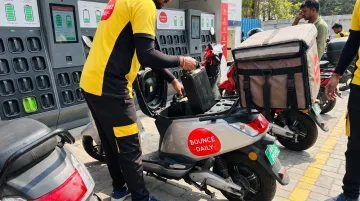
For delivery partners in Bengaluru, Bounce Daily offers High Speed (55 km/h, 70 km range) and Low Speed (25 km/h, 85 km range) EV scooter rentals built for gig work. Plans bundle:
- Unlimited battery swaps at Bounce hubs
- Maintenance, insurance, and GPS tracking
- No ₹80,000–₹1,20,000 upfront vehicle purchase
Riders typically drop ₹3,000–₹4,500/month in fuel and net ₹1,000–₹2,500 more than petrol ownership. That trims the 32% expense share and can add roughly ₹200–₹400 take-home per shift.
Requirements & Getting Started in Delivery Work
Most delivery platforms in India ask for the same core documents. Gather them before you apply so onboarding stays on track.
Essential documents and qualifications:
- Age 18+ (some platforms require 20+ for commercial three-wheelers)
- Driving licence: Two-wheeler DL for bikes/scooters; commercial DL for auto-rickshaws
- Smartphone: Android device with 4G connectivity, GPS, and camera
- Aadhaar card for identity verification
- PAN card for tax compliance (required by most platforms)
- Bank account with active debit card or UPI for payouts
- Vehicle documents: Registration certificate (RC), insurance, pollution certificate
If you do not have a scooter or licence yet, Bounce Daily rents insured EV scooters with maintenance included, and Low Speed riders can get hub-based driving licence assistance for ₹200–₹230.
Typical onboarding process:
- Apply in the app: Download the platform app (Zomato, Swiggy, Blinkit, etc.) and complete your profile
- Upload documents: Submit Aadhaar, DL, RC, PAN, and bank details digitally
- Clear verification: Platforms check criminal records and address proof (usually 2–5 days)
- Complete training: Online modules on safety, customer service, and app navigation (usually 1–2 hours)
- Activate and go live: After approval and first login you can accept orders; Swiggy advertises 24-hour onboarding, while most platforms activate within 3–7 days
A few platforms spell out extras on top of that baseline:
- Blinkit: age 18+, own two-wheeler, Android phone, DL, RC, vehicle insurance, PAN, address proof, and bank account
- Amazon Flex: background checks, 18+ for two-wheelers, 20+ for commercial three-wheelers
Once approved, you can log in and start accepting orders immediately.
Frequently Asked Questions
What is the highest paying delivery job?
Quick commerce platforms like Zepto (up to ₹60,000/month) and Blinkit (up to ₹50,000/month) advertise the highest ceilings. B2B logistics roles with Shadowfax or Delhivery typically offer ₹30,000–₹50,000/month. These are maximums—actual pay depends on city, hours, and order volume.
Is it worth becoming a delivery driver?
Delivery work offers flexibility, fast onboarding, and income with no formal qualifications. Riders still carry vehicle costs, income swings, 8–10-hour physical shifts, and no PF or medical benefits. It suits schedule control or side income more than long-term job security.
Do I need my own vehicle for delivery jobs?
Most platforms require ownership or rental of a two-wheeler. Some support bicycle delivery in select high-density areas like college campuses or dense urban cores. For riders without vehicles, rental services like Bounce Daily provide EV scooter access with maintenance, insurance, and battery swaps included, eliminating the ₹80,000–₹1,20,000 upfront purchase cost.
Which delivery apps pay weekly in India?
Zomato, Swiggy, Blinkit, and Amazon Flex all offer weekly payouts. Zomato additionally provides daily or instant withdrawal options through its delivery-partner app. Amazon Flex allows partners to choose payment days, enabling weekend or holiday transfers with proper bank details.
Can I work for multiple delivery platforms simultaneously?
Yes, multi-apping is legal and commonly practiced. Riders juggle Zomato, Swiggy, Blinkit, and others to reduce idle time and increase order volume. The challenge is managing acceptance rates on each platform and avoiding overlapping delivery windows that cause delays or cancellations.
What are the hidden costs of delivery work?
Full-time riders often see 32% of gross earnings go to work expenses—mainly fuel (₹3,000–₹5,000/month), maintenance, insurance, and data. Personal vehicles also lose resale value faster. EV rentals can cut fuel costs and shift maintenance to the provider.