Introduction
FOCO model EV rental franchises have moved from a niche investment idea to a mainstream conversation in Indian cities over the past year. India's gig workforce is expanding quickly, and electric two-wheeler adoption is rising with it. Investors, in parallel, want asset-backed income that does not need daily management.
Many first-time entrepreneurs struggle with the capital load of traditional EV dealerships and the daily grind of fully hands-on FOFO (franchise-owned, franchise-operated) setups. FOCO is winning attention because you still own a physical fleet asset, while day-to-day operations sit with the company and returns follow a structured model instead of unpredictable retail margins.
Interest is broad. HNIs and family offices are testing the category as a new asset class. Salaried professionals treat it as a side investment, and franchise seekers want a managed business rather than another full-time job.
This guide explains what a FOCO EV rental franchise actually involves and how it compares with other models. You will also get a practical lens for vetting a partner before you commit capital.
Key Takeaways
- FOCO means Franchise Owned, Company Operated — you own the fleet, the company runs it
- Built for investors seeking semi-passive, asset-backed income, not hands-on management
- Small-fleet entry typically starts in the low-lakh range (₹), varying by program
- Payouts are monthly, tied to fleet utilization, and never fully guaranteed
- Returns (often cited around 14–16% IRR) hinge on partner track record, rider pipelines, and contract terms
What Is the FOCO Model in EV Rental Franchising?
FOCO stands for Franchise Owned, Company Operated. In plain terms: you buy the electric scooters and they're registered in your name. The franchisor company then runs everything else: rider allocation, maintenance, charging or battery swaps, insurance, and your monthly payouts.
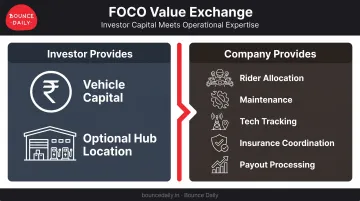
The value exchange is simple:
- You provide: capital for the vehicles (and sometimes a hub location)
- The company provides: operations, including riders, maintenance, tech tracking, insurance coordination, and payout processing
This is different from simply "investing" in a company. You're funding a specific, identifiable fleet, and your returns are tied to how well those particular vehicles get used, not to broader company performance.
FOCO vs FOFO vs Dealership — What's the Difference?
These three models sit on a spectrum from fully passive to fully hands-on. Here's how they stack up:
| Model | Capital & Ownership | Daily Involvement | How Returns Work |
|---|---|---|---|
| FOCO | Franchisee owns the fleet/assets; may include a security deposit | Low: company runs operations | Fixed revenue share or targeted ROI, paid periodically |
| FOFO | Franchisee owns the outlet and assets | High: franchisee hires staff, manages inventory and service | Profit-dependent; franchisor usually takes a royalty |
| Dealership | Dealer buys manufacturer inventory outright | High: dealer sets pricing, hours, and service independently | Resale/distribution margin; no franchise royalty typically applies |
FOCO sits between a passive financial investment and an active dealership. You put in capital and get a defined asset, but you hand off the operational grind to a team that already knows the market.
Why the FOCO Model Is Gaining Momentum in India's EV Rental Space
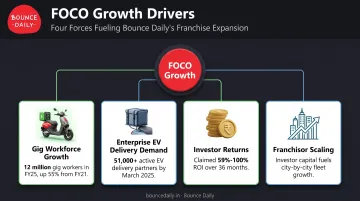
Four structural shifts are pushing FOCO from a curiosity to a serious asset class.
The gig workforce is expanding fast. India had 12.0 million gig workers in FY25, up from 7.7 million in FY21, a 55% jump in four years, according to IBEF's services industry data. Every one of these workers needs a vehicle, and increasingly, that vehicle is electric and rented rather than owned.
Enterprise demand for EV delivery fleets keeps climbing. Eternal (Zomato's parent) reported 51,000+ active EV-based delivery partners across Zomato and Blinkit as of March 2025, with a stated goal of 100% EV-based food delivery by 2030, per Eternal's investor relations impact page. Swiggy has a similar 2030 target for its delivery fleet.
This is why FOCO operators can promise structured payouts: the underlying demand from riders working for these platforms isn't going anywhere soon.
The investor pitch is asset ownership plus structured income. Zypp Electric, one of the more visible FOCO operators, told ETAuto it deployed 500 EVs worth roughly ₹2.5 crore under its FOCO model by September 2025, with claimed returns of 59%–100% over a 36-month payout period. Those headline numbers draw investor attention. As we'll cover below, these figures are operator-stated, not independently audited.
For franchisors, FOCO is a scaling tool. Instead of raising debt or equity to buy vehicles, companies use investor capital to expand fleets city by city. It's faster, and it spreads risk across many smaller investors rather than concentrating it on the balance sheet.
When the FOCO Model Makes Sense — and When It Doesn't
FOCO works well under specific conditions. It falls apart under others.
Favourable conditions:
- High delivery-partner density in your target city
- A partner with a verifiable rider pipeline and real enterprise contracts
- Reliable charging or battery-swap infrastructure already in place
Unfavourable conditions:
- New or unverified operators with no operating history
- Weak local gig-economy demand
- Poor or non-existent charging/swap infrastructure
- Expectations of guaranteed returns with zero performance risk
Key risk to flag: Payouts depend on actual fleet utilization and the stability of gig-economy demand — not a fixed guarantee. Before committing capital, verify vehicle ownership documentation, insurance coverage, and buyback or exit terms in writing. Marketing pages often show best-case ROI scenarios; your contract should show the actual mechanics.
How the FOCO Model Works — From Investment to Payout
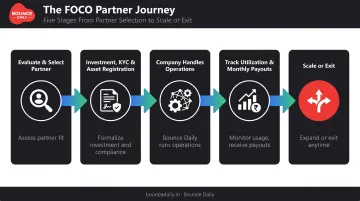
The process breaks into five distinct stages. Rushing partner selection or skipping documentation checks is, by far, the most common early mistake investors make.
Step 1 — Evaluate and Select a FOCO Franchise Partner
Before shortlisting anyone, check:
- Existing fleet size and city presence
- Verifiable enterprise tie-ups (not just logos on a website)
- Rider onboarding process and pipeline strength
Investment tiers vary widely across operators:
| Operator | Entry point | Fleet size |
|---|---|---|
| Zypp Electric | ~₹4.5 lakh (calculator ~₹41,000/scooter) | 10 scooters |
| GBG EV | ~₹3.8 lakh + GST | 5 EVs |
| BLive | ~₹30 lakh | 30–40 vehicles |
Compare these against your available capital and risk appetite. Bounce Daily also runs a FOCO-style hub-operator program with company-managed fleets; confirm current package terms directly before you commit.
Step 2 — Complete Investment, KYC, and Asset Registration
Once you've picked a partner:
- Complete digital KYC and sign the investment agreement
- Confirm in writing that vehicles will be registered in your name
- Understand the exact fee structure: one-time investment, revenue share, hybrid, or another model
Don't assume documentation. Ask the operator directly how ownership transfer is proven, and get it in the contract, not just in a sales conversation.
Step 3 — Company Handles Rider Allocation and Fleet Operations
From here, the franchisor takes over. They typically handle:
- Verified rider allocation
- Maintenance and battery swaps
- Insurance arrangement
- IoT-based vehicle tracking
That handoff is why the model is called semi-passive: your role shrinks to occasional monitoring, not daily management.
Step 4 — Track Utilization and Receive Monthly Payouts
Payouts are typically disbursed monthly, tied directly to how much each vehicle is actually used. Zypp's public tenure structure runs 36 months; other operators use different time bases, so don't assume every provider follows the same schedule.
Use whatever dashboard or reporting tool your partner provides to check individual vehicle performance and confirm payout consistency month over month. If a partner can't show you utilization data on request, treat that as a warning sign.
Step 5 — Scale or Exit
Once your initial fleet shows stable utilization and consistent payouts, you can reinvest to expand. In parallel, review buyback or exit terms before you need them. Several operators mention buyback provisions after a lock-in period, but duration and pricing formulas often aren't published upfront. Get those terms in writing early.
Top FOCO Model EV Rental Franchise Providers in India
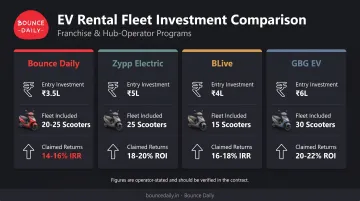
Several companies now run FOCO-style EV rental models, differing in fleet size, city coverage, and investment structure. Here's how the more visible ones compare.
Bounce Daily
Bounce Daily's FOCO hub-operator programme is built directly around India's gig-worker demand curve. Partners provide capital and a suitable hub location; Bounce Daily manages everything else through its FleetOS platform — fleet maintenance, GPS and anti-theft tracking, battery-swap operations, rider onboarding, and lead generation.
Key details:
- Rider pipeline: Bounce Task aggregates demand across Swiggy, Zomato, Blinkit, Zepto, BigBasket, and other platforms
- Onboarding: Quick digital sign-up with low documentation for partners
- Support: Training, hub operations guidance, and marketing creatives included
- Scale: 10,000+ EV scooters; ~3.3 crore kilometres processed per month
- Impact: 30M+ cumulative kilometres driven; 10,000+ tonnes of CO₂ avoided
- Returns: Stated target of 14–16% IRR
Active today in Bengaluru, with more Indian cities planned as hubs open. Exact investment tiers, fees, and payout tenure are shared during partner onboarding—ask for them directly when you evaluate this route.
Zypp Electric
Zypp's FOCO model launched in July 2025 and scaled quickly. The company told ETAuto it had deployed 500 EVs worth about ₹2.5 crore by September 2025.
Key details:
- Entry: Roughly ₹4.5 lakh for 10 scooters
- Returns: Claimed 59%–100% over 36 months, paid monthly
- Ownership & ops: Scooters registered in the investor's name; Zypp handles rider allocation, insurance, and IoT tracking
- Demand partners: Zomato, Zepto, Swiggy, and Blinkit
Zypp's public calculator also shows different figures (around ₹41,000 per scooter; 51% three-year ROI in one place and 90% elsewhere). Confirm exact numbers in your contract rather than relying on marketing copy.
BLive
BLive runs an end-to-end FOCO approach for last-mile delivery fleets, with B2B partnerships across Zepto, Blinkit, Swiggy, and Zomato. Packages run larger than most peers.
Key details:
- Entry: Around ₹30 lakh for 30–40 electric two-wheelers
- Yield: Monthly rental about ₹5,000–6,000 per vehicle; claimed break-even near two years
- Platform: Real-time GPS, utilization data, and earnings updates
- Returns caveat: Marketed 200% ROI depends on high fleet utilization
GBG EV
GBG EV sits at a lower entry point than most FOCO peers in this set.
Key details:
- Entry: Roughly ₹3.8 lakh plus GST for a 5-vehicle fleet
- Returns: Claimed ₹3,600 per EV per month; about 117% net ROI over four years
- Ownership & ops: Investors own the scooters; GBG leases to riders and runs insurance plus maintenance
- Buyback: Marketed after a lock-in, but public pages omit the exact duration—confirm before signing
Conclusion
The FOCO model offers a genuine middle path: real asset ownership without the daily grind of running a rental business yourself. It sits between fully passive investing and active dealership ownership.
Your returns will depend on partner selection, fleet utilization, and realistic expectations, not on assuming a guaranteed income stream. The advertised IRR or ROI figures from any operator are targets, not promises.
India's gig economy and electric two-wheeler adoption both show sustained, long-term growth. That's the tailwind making FOCO worth considering. Do the homework before you commit capital:
- Verify documentation
- Ask hard questions about payout history
- Read the exit terms carefully
Frequently Asked Questions
What is the FOCO model in EV rental franchising?
FOCO stands for Franchise Owned, Company Operated. The investor owns the EV scooters while the franchisor company manages riders, maintenance, and daily operations.
How much investment is required to start a FOCO EV rental franchise?
Small-fleet entry points typically fall around ₹3.8 lakh to ₹4.5 lakh, with costs scaling for larger fleets. Exact quotes vary by operator—Bounce Daily and others share figures during onboarding.
What returns can investors expect from a FOCO EV franchise?
Returns are usually paid monthly over a fixed tenure and often land around 14–16% IRR, depending on the operator. Payouts are tied to fleet utilization, not flat guarantees.
Is the FOCO model completely passive investment?
Not entirely. The company handles day-to-day operations, but investors should still monitor utilization reports, payout consistency, and partner performance regularly.
How is FOCO different from the FOFO model?
FOCO keeps the investor's role passive with the company running operations, while FOFO requires the franchisee to manage staff, inventory, and daily business tasks personally.
What risks should I know before investing in a FOCO EV franchise?
Key risks include dependency on gig-economy platform demand, utilization-linked (not guaranteed) payouts, and unverified operators. Always confirm ownership documents, insurance, and exit terms before investing.