Introduction
Picture a logistics manager juggling three spreadsheets, a shared Google Sheet nobody updates on time, and a WhatsApp group for driver check-ins — for a fleet of 800 vehicles. That's not a hypothetical. It's how many enterprises still operate.
The costs pile up fast:
- Unplanned breakdowns that sideline vehicles without warning
- Fuel leakage that shows up only when the invoice arrives
- Missed compliance deadlines and audit exposure
- No real-time visibility into where vehicles are
For large fleets, those gaps routinely erase 10–15% of operating budget through idle time, excess fuel, and reactive maintenance. Add gig and third-party delivery capacity into the mix, and the tracking problem multiplies.
This guide breaks down what enterprise fleet management means, the software components that matter most, how the top platforms compare, where electrification is heading, and how to pick a partner that won't outgrow its own product.
Key Takeaways
- Centralised platforms replace spreadsheets with real-time tracking, maintenance alerts, and compliance automation across large fleets
- Enterprise-ready platforms combine telematics, predictive maintenance, fuel analytics, and ERP/CRM integration
- Most enterprises recover their investment within 6–18 months
- Electrification and EV rental-as-a-service models are reshaping gig and last-mile fleet management
What Is Enterprise Fleet Management?
Enterprise fleet management is the centralised control, optimisation, and automation of large-scale vehicle and asset operations, typically run through software paired with telematics hardware. Instead of one dispatcher tracking trucks on a whiteboard, a single system captures location data, maintenance schedules, fuel spend, driver behaviour, and compliance status, all in one dashboard.
It's a different animal from the fleet tracking a small business uses. A five-van delivery company might get by with a basic GPS app. An enterprise running 2,000 vehicles across multiple states or countries needs:
- Multi-department visibility (finance, operations, HR, and compliance teams all pulling from the same data)
- Deeper integration with existing ERP and CRM systems
- Stricter, jurisdiction-specific compliance handling
- Analytics that scale with fleet size instead of breaking under the weight of it
Why It Matters for Enterprises
Manual tracking works fine at a small scale. Past a few dozen vehicles, it becomes the bottleneck itself. Spreadsheets can't flag an overdue oil change across 500 trucks or catch a driver logging more hours than legally allowed. Someone has to notice manually, and by the time they do, the damage is already done.
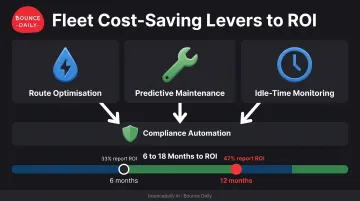
According to Verizon Connect's 2025 Fleet Technology Trends Report, 47% of GPS fleet-tracking users reported positive ROI within a year, and 33% saw it in under six months.
That survey drew on 543 fleet professionals in mid-2024, a fair signal that these systems earn their cost quickly for most operators.
Key Benefits & ROI
Three levers drive most of the savings:
- Route optimisation cuts fuel burn and driver hours by avoiding inefficient paths
- Predictive maintenance catches issues before they become breakdowns
- Idle-time monitoring flags wasted fuel from vehicles sitting with engines running
Compliance automation adds a second layer of savings. Digital driver working-hour logs and automated audit trails mean fewer violations and far less scrambling before an inspection. Enterprises that combine cost reduction with compliance automation typically see measurable payback within 6 to 18 months, depending on fleet size and rollout quality.
Key Components of Enterprise Fleet Management Software
Not every platform covers every function well. Here's what an enterprise-grade system needs.
Telematics & Real-Time GPS Tracking
Location data alone isn't enough. Modern telematics layers in idling patterns and driver-behaviour scoring, feeding smarter routing decisions and holding drivers accountable without manual spot-checks.
Preventive & Predictive Maintenance
Reactive repairs are expensive and disruptive. Geotab's Interstate Batteries case study found that shifting to telematics-driven maintenance scheduling cut maintenance costs by roughly 10% for that fleet. It's one case, not an industry average, but it shows how proactive scheduling reduces unplanned spend.
Fuel Management & Cost Analytics
Per-vehicle and per-trip fuel tracking, paired with fuel card integration, catches anomalies fast, such as a card used at odd hours or consumption that doesn't match mileage logged.
Driver Safety & Behaviour Monitoring
Scorecards and coaching modules based on harsh braking, speeding, and distraction events help lower accident rates and, over time, insurance premiums.
Compliance Automation
Digital logging and audit-ready reporting matter more as fleets cross borders or states. In India, that means AIS-140-compliant vehicle location tracking for covered public-service vehicles. In the US, it means aligning with FMCSA's ELD and hours-of-service rules.
A good system flags region-specific rules automatically instead of relying on someone remembering them.
Integration with ERP, CRM & HR Systems
Fleet data that stays siloed is only half useful. Syncing it with finance, dispatch, and HR tools gives leadership a single source of truth instead of three conflicting reports.
Top Enterprise Fleet Management Software Solutions
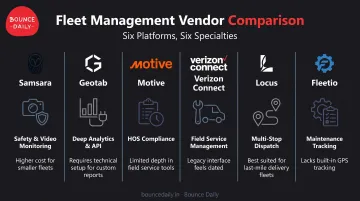
"Fleet management software" actually covers two distinct categories, and mixing them up leads to disappointed buyers:
- Telematics/GPS platforms — focused on vehicle tracking, safety, maintenance, and compliance
- Logistics orchestration platforms — focused on route planning and multi-stop dispatch at scale
Match your primary pain point to the category first. Then compare vendors within it.
Samsara
Removed identical "Best for" lockstep and varied entry rhythm across vendors; tightened limitation wording and cut extra em-dashes/filler.
Strong fit when fleet safety, video-based driver monitoring, and asset visibility matter most across large, mixed fleets. Samsara's telematics and compliance coverage is broad, spanning public works, transit, and utility operators. Complex multi-stop dispatch is outside its core design, so delivery-heavy teams often run a second tool beside it.
Geotab
Large fleets that want deep analytics and room to extend the platform usually shortlist Geotab first. The open marketplace and API access support custom integrations instead of locking you to one vendor roadmap. Budget for add-ons during evaluation, since some advanced capabilities sit outside the base package.
Motive
Trucking-heavy operations that put HOS compliance and driver safety first get the most from Motive. Compliance workflows and dashcam tools are a clear strength. Multi-stop delivery optimisation is a weaker area, which can limit retail or e-commerce fleets with complex routing.
Verizon Connect
Mid-market and growing enterprise fleets often pick Verizon Connect for GPS tracking and field service management. Tracking and reporting hold up well across standard use cases. If you run complex routing constraints, validate that workflow in a pilot before you sign; it is not the platform's strongest suit.
Locus
Enterprise retail, CPG, and 3PL teams running high-volume, multi-stop networks are the core Locus buyer. Constraint-aware dispatch and carrier orchestration stand out for last-mile complexity. It does not replace vehicle telematics or maintenance tracking, so most buyers pair it with a telematics platform.
Fleetio
Choose Fleetio when maintenance management and asset health tracking are the main gap. Work-order and service-history tools go deep enough to support TCO and replacement-cycle planning. Routing and dispatch are out of scope, so it will not solve delivery-optimisation problems on its own.
Before requesting demos, shortlist 2-3 vendors that match your single biggest constraint — safety, dispatch complexity, or maintenance — rather than trying to find one tool that does everything equally well.
Fleet Electrification & Emerging Trends in Enterprise Fleet Management
Electrification is no longer a pilot-program conversation. Tightening emission norms, rising fuel costs, and ESG reporting pressure are pushing enterprises toward EVs faster than most procurement cycles anticipated.
The IEA's Global EV Outlook 2024 projects electric medium and heavy truck sales growing more than 30-fold from roughly 54,000 in 2023, potentially exceeding 20% of sales by 2035 under current policy trajectories. In India, the same pressure shows up in last-mile two-wheelers that power food, grocery, and quick-commerce delivery.
AI and IoT are accelerating that transition. Telematics now feeds predictive maintenance models that flag component failures before they strand a vehicle. AI dispatch tools read live ops data and reroute around delays in real time. Those capabilities matter more when every hour of downtime hits SLA and fuel—or energy—budgets.
The Outsourced Last-Mile Shift
Enterprises with large gig or delivery workforces are increasingly outsourcing vehicle ownership instead of building an internal EV fleet from scratch.
Bounce Daily is a working example. Rather than buying and maintaining hundreds of electric scooters, a delivery-heavy enterprise can rely on Bounce Daily's franchise-partner hubs for a fully managed rider fleet:
- Instant Aadhaar-based digital verification — riders onboard and go rental-ready in minutes
- Swappable batteries — hub swaps in minutes support 8–12-hour gig shifts without charge downtime
- Centralized ops stack — maintenance, insurance, GPS tracking, and anti-theft handled at the hub
- Bounce Task rider pool — verified riders aggregated across food, grocery, and parcel demand in Bengaluru, Hyderabad, and Delhi NCR
For fleet leaders, the rental-as-a-service model converts vehicle capex and upkeep into a variable operating cost—and scales delivery capacity without adding assets to the balance sheet.
How to Choose the Right Enterprise Fleet Management Partner
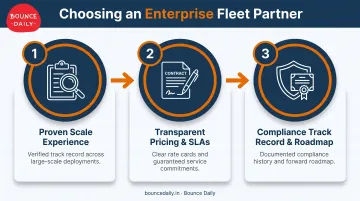
A vendor that works for 50 vehicles won't necessarily hold up at 5,000. Before committing, check these three areas closely.
- Proven scale experience. Ask for references from fleets similar in size to yours, not just logos on a website. Features that "scale" on paper often mean added latency or manual workarounds in practice.
- Transparent pricing and SLAs. Most enterprise fleet software is quote-based, priced around fleet size, module depth, and support tier. Insist on a full cost breakdown and a named point of contact for post-sale support, not a ticket queue.
- Compliance track record and roadmap. Look for relevant certifications such as ISO/IEC 27001 for data security, a documented history handling region-specific compliance rules, and a clear product roadmap for AI features and EV support.
Gartner's evaluation criteria for transportation management systems emphasise functionality, analytics depth, integration tooling, and use-case complexity, but Gartner publishes no universal SLA benchmark. That gap means the burden falls on you to validate uptime guarantees, data ownership terms, and API limits directly in the contract, not assume they're industry-standard.
Frequently Asked Questions
What is enterprise fleet management?
It's the centralised, software-driven control of large-scale vehicle operations, covering real-time tracking, maintenance, compliance, and cost optimisation across hundreds or thousands of assets.
What are the top enterprise fleet management software solutions?
Leading options split into telematics platforms (Samsara, Geotab, Motive, Verizon Connect) and orchestration platforms (Locus). The right pick depends on whether your core need is vehicle safety or delivery dispatch complexity.
What is the difference between enterprise fleet management and regular fleet management?
Enterprise systems handle far greater scale, deeper analytics, and cross-department integration with ERP, CRM, and HR tools, unlike basic GPS tracking used by small fleets.
How much does enterprise fleet management software cost?
Pricing is largely quote-based, driven by fleet size, feature depth, and support level. Always request a full cost breakdown covering hardware, software tiers, and integration work before signing.
How long does it take to see ROI from an enterprise fleet management system?
Most enterprises see measurable savings within 6 to 18 months, depending on fleet size and how smoothly the rollout goes. Many GPS-tracking users report positive ROI within a year.
Can enterprises with gig or delivery-based fleets benefit from fleet management tools?
Yes. Gig-heavy delivery operations benefit significantly, especially when paired with managed EV rental models like Bounce Daily that remove vehicle ownership and maintenance burden.