While traditional franchising requires franchisees to both invest and operate, FOCO offers a unique proposition: investors provide capital and own the outlet, but the parent company handles all daily operations—from staffing and inventory to customer service and compliance. This model appeals especially to working professionals, NRIs, real-estate owners, and retired individuals who want business ownership without the time demands of active management.
This guide breaks down exactly how the FOCO business model works from an investor's perspective, covering investment structure, returns, operational mechanics, risks, and key due-diligence considerations to help you evaluate whether a FOCO investment aligns with your financial goals.
Key Takeaways
- FOCO means investors own and fund the outlet while the company manages daily operations
- Returns typically arrive through revenue/profit-sharing agreements or fixed monthly payments
- Gaining traction across India in F&B, retail, EV fleets, diagnostics, and cloud kitchens
- Lower day-to-day involvement—if you diligence the operator’s track record and contract terms
- Choose brand partners with transparent reporting and proven unit economics
What Is the FOCO Business Model?
FOCO stands for Franchise Owned, Company Operated. The franchisee invests capital to own the business unit, while the franchisor runs day-to-day operations.
According to Franchise India's model comparison, that cover includes staff hiring and training, inventory management, quality control, customer service, and regulatory compliance.
FOCO lets people own a unit and earn returns without operational expertise, management skills, or daily involvement. It suits:
- Working professionals who cannot dedicate hours to business management
- NRIs seeking India-based investment opportunities
- Retired individuals looking for passive income streams
- Real-estate owners with suitable commercial locations
- Investors who want brand exposure without execution risk
What FOCO Is NOT
FOCO is easy to confuse with nearby models. Here is how it differs:
FOCO vs FOFO: In FOFO (Franchise Owned, Franchise Operated), the franchisee funds and runs the unit. You get full control, but you also need active management and operational skill.
FOCO vs COCO: In COCO (Company Owned, Company Operated), the brand owns and runs outlets itself. There is no franchisee seat for outside investors.
FOCO vs angel investing: A FOCO investor owns a specific outlet, holds contractual rights over it, and can see that unit’s performance directly—unlike a pure equity cheque into a company.
Why FOCO Remains Relevant
Brands use FOCO to expand without funding every outlet themselves. Investors get a proven brand and operating system instead of building a standalone business from scratch.
Deal structures differ. Some offer guaranteed monthly returns; others use profit shares, often 60-40 or 70-30 either way, depending on sector and brand strength.
Contracts usually run 5–10 years. India has no dedicated franchise statute, so rights come from the contract alone, per the International Franchise Association's India guide.
How the FOCO Model Works for Investors
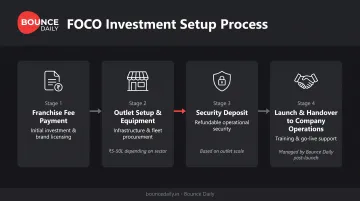
The FOCO investment journey follows a defined sequence from initial investment through ongoing returns, with investor and company responsibilities clearly split at each stage.
Initial Investment and Setup
The investor funds several components:
- Franchise fee: A one-time, non-refundable payment for brand rights and support
- Outlet setup costs: Interiors, equipment, signage, fixtures, and initial inventory
- Security deposit: Often refundable, typically equivalent to 2-3 months of expected revenue
These costs vary widely by industry and brand. Small EV scooter fleets often sit in the low-lakh range, while traditional retail or QSR outlets can run ₹15-50 lakh depending on format and location.
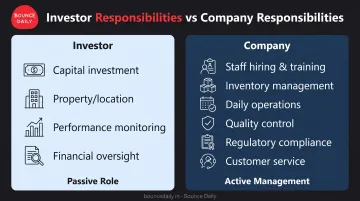
The company typically handles:
- Site selection or approval
- Design and layout to brand standards
- Equipment procurement and vendor tie-ups
- Pre-launch checks against brand and regulatory requirements
That split removes most pre-opening complexity from the investor.
Operational Management by Company
Once operational, the company takes complete charge:
- Hiring, training, and managing all staff
- Inventory procurement and management
- Daily operations, customer service, and quality control
- Compliance with local regulations—FSSAI for food businesses, Shop & Establishment Act, Fire NOC, and other sector-specific licenses
What this means for investors: zero involvement in day-to-day running. No staff management headaches, no operational decisions about suppliers or pricing, no customer complaints to handle. The investor's role becomes purely financial oversight and performance monitoring.
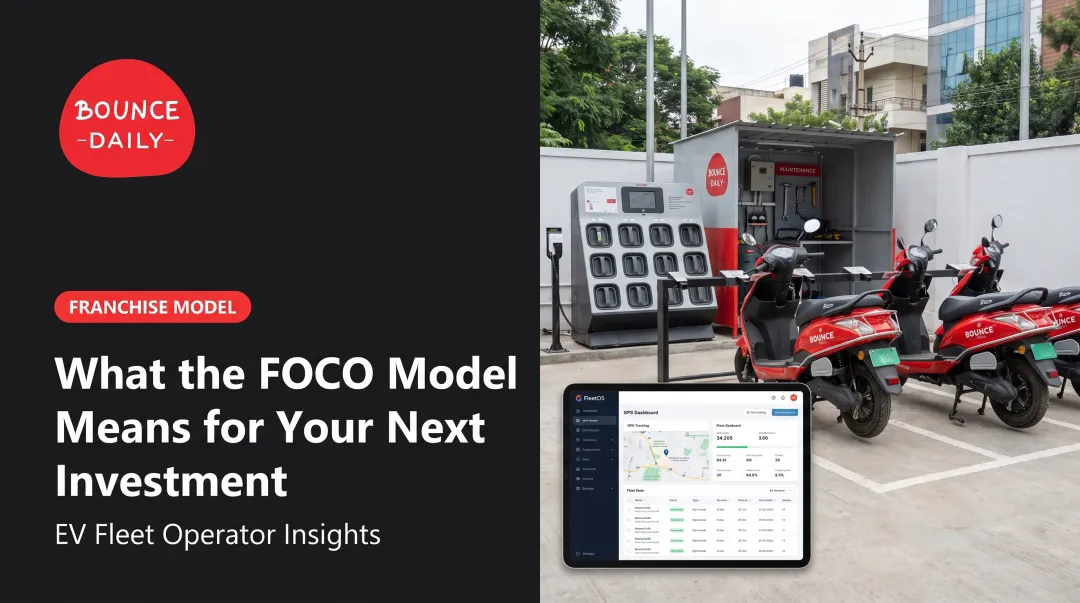
The company maintains control through standardised operating procedures, centralised supply chains, regular audits, brand-consistency checks, and performance monitoring systems. In the EV rental space, for example, companies like Bounce Daily manage vehicle maintenance, GPS tracking, rider onboarding, and battery-swap infrastructure centrally.
Revenue Sharing and Returns
Two common FOCO return structures exist:
1. Fixed Guaranteed Returns: The investor receives a predetermined monthly or quarterly amount regardless of outlet performance. This offers predictability but may cap upside during high-performance periods. These arrangements are less common and sometimes advertise 2-3% monthly returns (24-36% annually). Figures that high need extra scrutiny—more typical EV FOCO programmes benchmark closer to the mid-teens IRR (around 14-16%).
2. Revenue or Profit Sharing: The investor receives an agreed percentage of gross revenue or net profit. Common splits include:
- 20-40% of gross monthly revenue
- 40-60% of net monthly profit after operating expenses
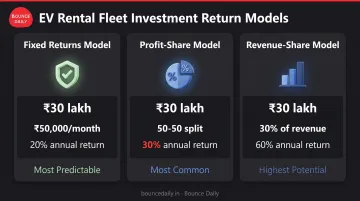
Example: If an outlet generates ₹5 lakh monthly revenue with a 30% net margin (₹1.5 lakh profit), a 50-50 profit share gives the investor ₹75,000/month, or ₹9 lakh annually. On a ₹30 lakh initial investment, this represents a 30% annual return.
Revenue-sharing arrangements usually include transparent reporting systems, monthly financial statements, defined payment schedules, and provisions for quarterly or annual performance reviews. The exact calculation methodology (what expenses are deducted before profit calculation, and who bears maintenance and equipment replacement) must be clear in the agreement.
Monitoring and Reporting
Quality FOCO brands provide investors with monitoring rights:
- Access to sales data and operational metrics
- Monthly P&L statements showing revenue, expenses, and profit distribution
- Audit rights to verify reported figures
- Real-time performance dashboards or mobile apps
In EV rental FOCO, that often means visibility into vehicle location, utilisation, and fleet status while the operator runs maintenance and hubs. Bounce Daily, for example, centrally manages GPS tracking, servicing, and battery-swap infrastructure so investors can track performance without running daily ops. How often you get reports, how detailed they are, and what you can audit still vary by brand—lock those terms in the agreement before you fund.
Financial Structure and Investor Returns in FOCO
FOCO deals bundle franchise fees, setup capital, and a revenue- or profit-share formula. Knowing each line item—and what gets deducted before you are paid—keeps return expectations grounded.
Typical Cost Components
- Franchise fee — One-time, non-refundable payment (often 10–20% of total investment) for brand rights, training, and support
- Setup costs — Interiors, equipment, signage, and fixtures; a cloud kitchen costs far less than a dine-in outlet
- Working capital — Initial inventory, first-month operating expenses, and a buffer for slow ramp-up
- Security deposit — Refundable hold, typically 2–3 months of expected revenue, returned if contract terms are met
Revenue-Sharing Formulas with Examples
Scenario 1 – Profit-Share Model:
- Monthly revenue: ₹5 lakh
- Operating expenses: ₹3.5 lakh (70% of revenue)
- Net profit: ₹1.5 lakh
- Investor share (50%): ₹75,000/month or ₹9 lakh/year
- On ₹30 lakh investment: 30% annual return
Scenario 2 – Revenue-Share Model:
- Monthly revenue: ₹5 lakh
- Investor share (30% of revenue): ₹1.5 lakh/month or ₹18 lakh/year
- On ₹30 lakh investment: 60% annual return (higher but rarer)
Scenario 3 – Fixed-Return Model:
- Monthly guaranteed payment: ₹50,000
- Annual return: ₹6 lakh
- On ₹30 lakh investment: 20% annual return (more predictable)
These figures are illustrative. Profit-share is net of operating costs; revenue-share is top-line and can look higher until expenses, fees, and shortfalls are factored in. Fixed returns trade upside for predictability.
ROI Timelines and Industry Benchmarks
Mapped against real timelines, most FOCO investments in India target 20–30% annual returns, with break-even often in 3–4 years. Brand strength, location, and how tightly the operator runs costs all move that window.
The India franchise market report pegs sector growth at 30–35% annually, though individual outlet results still vary widely.
In EV fleet FOCO, advertised numbers span a wide range: Zypp cites 90% ROI in three years (its own calculator shows about 51% over 3 years), Hala Mobility claims 25.1% IRR, and Bounce Daily’s hub-operator program advertises 14–16% IRR. Treat all of these as company projections—not verified investor outcomes.
Often-Hidden Costs and Considerations
- Management fees: Companies may charge 5-10% of monthly revenue for operational management
- Marketing contributions: Mandatory advertising fund contributions, often 2-5% of revenue
- Maintenance and renovation: Clarify who bears equipment replacement, outlet refresh, and repair costs
- Exit costs: Early termination penalties, buyback terms, transfer restrictions
Model every fee before you sign—a headline 30% return can compress to ~15% once management, marketing, and maintenance deductions apply.
FOCO vs FOFO and Other Franchise Models
| Dimension | FOCO | FOFO | COCO |
|---|---|---|---|
| Ownership | Franchisee owns outlet | Franchisee owns outlet | Company owns outlet |
| Operations | Company manages day-to-day operations | Franchisee manages operations | Company manages |
| Investor Involvement | Low; passive monitoring only | High; active daily management | No investor participation |
| Typical Investment | ₹5-50 lakh+ depending on sector | ₹5-50 lakh+ depending on sector | Not applicable |
| Expected Returns | 20-30% annually (varies widely) | 30-40% potential (higher risk) | Not applicable |
| Best Suited For | Passive investors, NRIs, working professionals | Entrepreneurs seeking control and higher upside | Brand-managed expansion |
FOCO vs FOFO: The Control Trade-Off
In FOFO, you both fund and operate, giving full control over hiring, pricing decisions, supplier choices, and customer experience. This can yield higher returns (potentially 30-40% annually) but requires significant time investment, management skills, and operational expertise. You bear direct execution risk but capture more upside.
FOCO offers passive ownership but limited control. You depend entirely on the company's operational capability, staff quality, and decision-making. Returns are typically capped at the contracted percentage, but you avoid the daily grind and can own multiple outlets without proportional time commitment.
FOCO vs COCO: The Investor Angle
COCO outlets are fully company-owned and operated. Brands use this model for flagship locations and strategically important markets, or when they fund expansion internally. Investors cannot participate in COCO, so FOCO is the passive route if you want brand-backed exposure without building operations yourself.
Advantages, Risks, and Key Considerations for FOCO Investors
FOCO investing can deliver passive returns with brand-backed operations, but you give up day-to-day control and depend entirely on the operator. Weigh both sides before you commit capital.
Advantages for Investors
- Passive income potential: Earn returns without operational involvement, management responsibilities, or daily time commitment.
- Established brand access: Use proven business models, customer recognition, and operational systems rather than building from zero.
- Company handles complexity: No hiring headaches, supplier negotiations, compliance filings, or inventory management.
- Lower risk than independent startups: Benefit from brand support, training, marketing, and centralized infrastructure.
- Scalability: Once comfortable with one FOCO outlet, experienced investors can own multiple units across locations, compounding returns without proportionally increasing time investment.
Risks and Challenges
- Complete operational dependence: You rely entirely on the company's execution capability, staff quality, and integrity. Poor management directly affects your returns with little recourse.
- Limited control: You cannot change suppliers, adjust pricing, modify offerings, or override operational decisions even if you disagree.
- Revenue-sharing disputes: Ambiguous contract terms can lead to disagreements over expense allocation, revenue calculation, or profit distribution.
- Company financial health risk: If the parent company faces liquidity issues, defaults, or bankruptcy, you risk your investment and returns.
- Exit complexity: Franchise agreements often restrict transfers, impose buyback conditions, or lack clear exit mechanisms, leaving capital locked in.
Red Flags Investors Should Watch
- Unrealistic guaranteed returns above 30-35% annually without clear unit economics
- Lack of transparency in financial reporting or reluctance to share existing franchisee data
- High franchisee churn rates indicating operational problems or unsustainable economics
- Vague contract terms on revenue calculation methodology, expense allocation, or payment schedules
- No existing FOCO outlets or refusal to connect you with current franchisees
- Pressure tactics demanding quick decisions without due diligence time
Key Considerations Before Investing
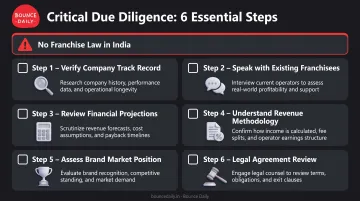
Conduct thorough due diligence:
- Verify the company's track record, years in operation, and expansion history
- Speak with existing FOCO franchisees about actual realized returns, payment consistency, and operational support quality
- Check for litigation, regulatory issues, or negative press
Understand exact revenue-sharing methodology:
- How is revenue defined—gross receipts or after certain deductions?
- What expenses are deducted before profit calculation?
- Who bears equipment replacement, major repairs, and renovation costs?
Review franchise agreement with legal counsel:
- Dispute resolution clauses—arbitration vs. litigation
- Termination conditions and notice periods
- Renewal terms and fee escalations
- Transfer and exit provisions
Assess brand market position:
- Is the sector growing or saturated in your target geography?
- How does this brand differentiate from competitors?
- What is the company's expansion trajectory and financial stability?
Evaluate location viability:
- Is the catchment area suitable for this business format?
- What is the competitive intensity?
- Are there regulatory or infrastructure constraints?
Seek professional validation:
- Have a chartered accountant review financial projections
- Get legal review of all agreements before signing
- Consider engaging a franchise consultant for complex deals
These steps matter even more in India, which has no franchise-specific law or mandatory disclosure requirements, according to the IFA's legal framework guide. Your protection depends entirely on contract strength and the company's integrity. Treat due diligence as your primary defence.
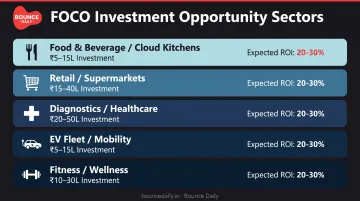
Industries and Real-World Examples of FOCO in India
FOCO is particularly popular in sectors where operational expertise and brand consistency are critical but capital requirements for rapid expansion are high.
Food & Beverage and Cloud Kitchens
Franchise India identifies QSR and casual dining as prominent FOCO formats. Cloud kitchens—delivery-only operations with shared infrastructure—are especially suited to FOCO because they combine lower real-estate costs with centralized kitchen management.
RedSeer valued India's food services market at approximately USD 80 billion in 2024 and forecast 10-11% CAGR through 2030, driven by online ordering and quick commerce. This demand growth creates opportunities for FOCO investors, though success depends on brand execution and unit-level economics, not just market size.
Retail and Supermarkets
Branded grocery stores, convenience retail, and supermarket formats use FOCO to expand without full capital burden. The investor funds store setup, while the company manages inventory, vendor relationships, pricing, staffing, and daily operations.
This works well in neighbourhood retail where local ownership perception matters but operational consistency is crucial.
Diagnostics and Healthcare Services
Diagnostic chains leverage FOCO to enter tier-2 and tier-3 cities rapidly. The company maintains quality control, technology integration, reporting standards, and regulatory compliance, while investors provide capital and suitable real estate. Healthcare's regulatory complexity makes company-managed operations particularly attractive to passive investors.
EV Fleet and Mobility
The electric vehicle rental sector has emerged as a high-growth FOCO opportunity. Companies such as Bounce Daily, Zypp, and Hala Mobility let investors own EV rental fleets while the operator runs daily operations—vehicle maintenance, rider onboarding, GPS tracking, battery swapping, and insurance.
Hala Mobility reported raising ₹30 crore in six months through its FOCO model in October 2025, deploying 2,400 EVs with plans for 6,000 total. The company advertises 25.1% IRR, though this remains a projection rather than verified realized returns.
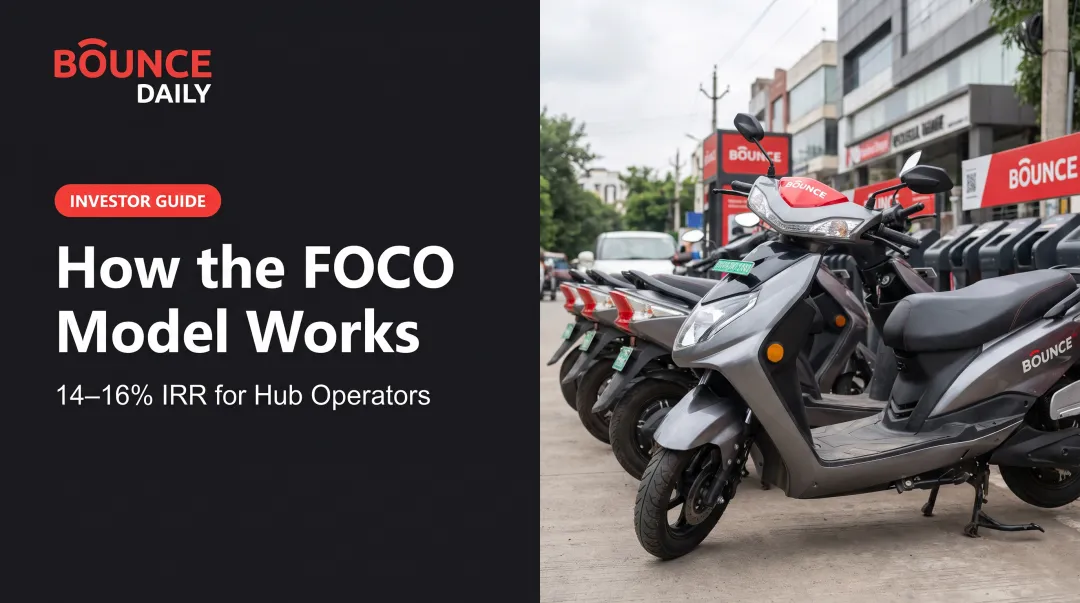
Bounce Daily runs a FOCO hub-operator program for delivery and gig-worker EV rentals. Investors provide capital and a hub location, with advertised targets of 14-16% IRR. The program operates in Bengaluru, with expansion planned across Indian cities.
Under the model, responsibilities typically split as follows:
- Investor: Capital and hub location
- Bounce Daily: Fleet operations, Bounce Task rider lead generation, digital onboarding, maintenance, GPS tracking, and battery infrastructure
Fitness and Wellness
Deloitte and HFA estimated India's fitness market at ₹16,200 crore in 2024, forecasting ₹37,700 crore by 2030 at 15% CAGR.
Fitness centres, yoga studios, and wellness chains use FOCO to scale while holding trainer quality, equipment standards, and brand experience steady. Those operations are intensive, and they drive customer retention.
Evaluating Sector Opportunities
High-growth sectors like cloud kitchens, EV mobility, and quick commerce offer attractive FOCO opportunities because they combine capital-light scaling for brands with passive ownership for investors. However, growth forecasts measure market size, not FOCO unit profitability.
Before committing capital, investors must:
- Verify actual unit-level economics, not just sector growth projections
- Assess whether the specific brand has operational capability and financial stability
- Understand competitive intensity—a growing market with 20 similar FOCO offerings dilutes opportunity
- Confirm the business model is proven with existing successful outlets, not just a new launch
Conclusion
The FOCO model gives investors a route to business ownership and returns without day-to-day operational involvement, pairing established brand systems with passive income potential. For the right profile (working professionals, NRIs, real-estate owners, or retirees seeking semi-passive income), FOCO can deliver solid risk-adjusted returns in growing sectors like F&B, retail, diagnostics, and EV mobility.
Success depends heavily on choosing the right brand partner. Protect your capital with clear expectations, strong contracts, and ongoing monitoring—and complete these checks before you sign:
- Speak with existing franchisees about real-world returns and support
- Verify the company’s track record and unit-level performance data
- Engage legal and financial advisors on the agreement
- Confirm full transparency in the revenue-sharing methodology
Given India's lack of franchise-specific regulation, your contract is your primary protection. Invest the time upfront to get it right, and FOCO can become a valuable component of a diversified income portfolio.
Frequently Asked Questions
What is the FOCO business model?
FOCO (Franchise Owned Company Operated) is a franchise structure where investors own the outlet by providing capital, while the parent company runs daily operations, staffing, inventory, and customer service. Investors earn income with minimal day-to-day involvement.
What is the profit margin for a FOCO business model franchise?
Profit margins vary by industry: F&B typically delivers 15-25% net margins, while retail can reach 20-35%. Investor returns usually follow revenue- or profit-share deals (often 20-40% of gross or 40-60% of net), with many brands targeting 20-30% annual ROI by brand and location.
What are the key differences between the FOCO and FOFO franchise models?
In FOFO, the franchisee owns and operates the business—full control and higher potential returns (often 30-40% annually), but active daily management is required. In FOCO, the company operates the outlet, so ownership stays more passive, with typical targets around 20-30% returns and limited operational control.
What is the typical investment required for a FOCO franchise in India?
FOCO investments range from ₹5 lakh to ₹50 lakh+ depending on brand, industry, and outlet size. Cloud kitchens and EV fleets typically require ₹5-15 lakhs, retail stores ₹15-40 lakhs, and hospitality or full-service formats ₹20-50 lakhs+, excluding working capital.
How do investors receive returns in the FOCO model?
Returns usually follow one of two structures: fixed monthly payouts (less common, often around 2-3% per month) or revenue/profit sharing (more common, 20-40% of revenue or 40-60% of profit). Payouts are typically monthly or quarterly against an agreed schedule and reporting pack.
What should investors verify before investing in a FOCO franchise?
Check the company's track record and operations strength, speak with existing franchisees about real returns and payment consistency, and review the agreement with legal counsel. Confirm how revenue and expenses are calculated, then assess brand position, competition, and location viability before you commit capital.