Introduction
Franchise Owned, Company Operated (FOCO for short) flips the usual franchise script. The investor funds the outlet or fleet; the brand runs it day-to-day. You put up the capital—without owning hiring, daily ops, or rider coordination.
Heading into 2026, this structure is spreading fast. Brands running EV rental hubs, cloud kitchens, and quick-commerce dark stores are betting that centralised operations beat franchisee-run inconsistency.
Why now? India's gig workforce is projected to cross 10 million workers in 2024-25 and climb toward 23.5 million by 2029-30, according to NITI Aayog projections cited by the Ministry of Labour and Employment. That demand is reshaping what "franchise investment" even means.
Below: where FOCO is gaining ground in 2026, sector by sector, and what to check before you commit capital.
Key Takeaways
- FOCO is expanding beyond food and retail into EV mobility, quick commerce, and wellness franchises
- Investors fund infrastructure; the company handles staffing, compliance, and daily operations
- Gig-economy growth and green mobility policy are creating new EV rental hub opportunities
- Centralised tech (POS, fleet tracking, digital KYC) is making multi-city FOCO management practical
- Run sector-specific research first: returns and risk vary sharply by category
Key Trends Shaping the FOCO Franchise Model in India in 2026
Indian consumers and gig workers are pushing brands toward organised, tech-enabled service delivery. That pressure is why FOCO is no longer just a food-and-retail story: it's showing up in mobility, wellness, and logistics too.
EV Mobility & Gig Rental FOCO Models
Electric two-wheeler rental is one of the clearest FOCO fits in India right now. The logic is simple: franchise partners invest in the fleet or hub, while the company manages riders, charging, and maintenance centrally.
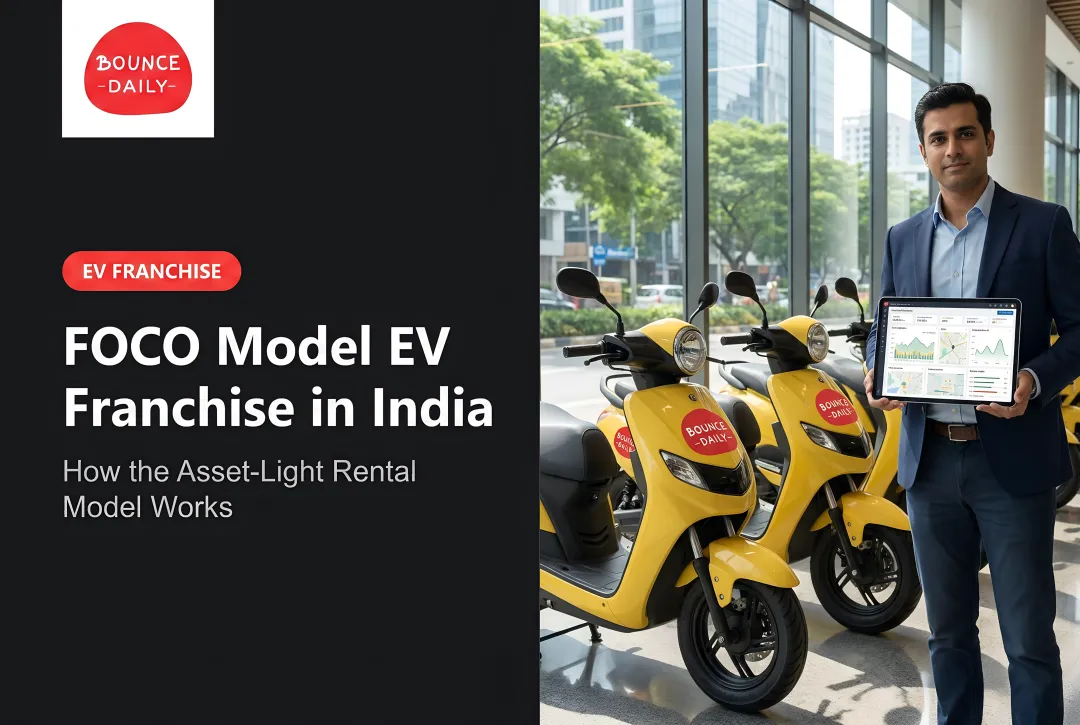
Bounce Daily, the EV rental brand under Bounce Infinity, runs exactly this structure. Partners fund the hub location and the rental fleet — that's their capital commitment. Bounce then operates:
- Fleet maintenance, uptime, and GPS tracking
- Insurance and breakdown coverage on every rental
- Battery-swap infrastructure and charging operations
- Rider verification, KYC, and onboarding through the Bounce Daily app
- Training, marketing creatives, and a steady flow of verified rider leads
The program advertises an estimated 14-16% IRR to hub-operator investors, run through Bounce's FleetOS platform, the same stack behind 30M+ kilometres driven to date.
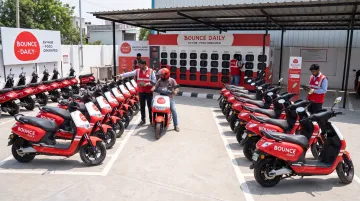
Why is this category growing? Two forces are converging. First, India's e-commerce and food-delivery gig workforce keeps expanding. NITI Aayog's earlier baseline put it at 7.7 million workers, a figure now projected to more than triple by 2030.
Second, delivery partners need low-cost, zero-emission transport that doesn't eat into thin per-order margins. A petrol bike's fuel cost adds up fast across an 8-12 hour shift; an EV rental with unlimited battery swaps doesn't carry that burden.
Riders get variant choice too: a 55 km/h High Speed scooter for licensed multi-zone delivery work, or a 25 km/h Low Speed option (no licence required, with hub-based licence assistance for a nominal fee) suited to students and hyperlocal riders.
Cloud Kitchen & Quick-Service Food FOCO Franchises
Cloud kitchens were early adopters of the operate-for-you model, and the logic hasn't changed: investors fund the kitchen infrastructure while the brand controls recipes, cooking staff, and delivery logistics.
Curefoods is a documented example of this centralised approach, operating roughly 340 locations across cloud kitchens, QSRs, and restaurant formats in India. That's a company-operated footprint, proof that centralised food-brand management scales well past a single city.
The market opportunity backs this up. India's cloud kitchen sector was valued at ₹9,747 crore (roughly $1.13 billion) in 2024 and is forecast to reach ₹24,498 crore by 2030, a 16.7% CAGR, according to IBEF. Online food delivery demand is climbing alongside it — Swiggy reported Q4 FY25 food-delivery gross order value up 17.6% year-on-year, with monthly transacting users rising 17%.
That kind of order volume punishes inconsistency. A franchisee tweaking a recipe or understaffing a dinner rush can tank a brand's rating overnight. Centralised kitchen operations protect against exactly that.
Quick Commerce & Dark Store Retail Expansion
Ten-minute grocery delivery doesn't tolerate slow decision-making, and that's pushing quick-commerce brands toward company-run dark stores rather than franchisee-managed outlets. Under this version of FOCO, investors fund the outlet while the company runs inventory, staffing, and fulfilment.
The scale here is already substantial:
| Metric | Figure | Source |
|---|---|---|
| Sub-30-minute q-commerce share of e-grocery orders | Over two-thirds | Bain, 2025 |
| Projected annual growth through 2030 | 40%+ | Bain, 2025 |
| Swiggy Instamart active dark stores | 1,102 across 128 cities | Swiggy, Q2 FY26 |
According to Bain's 2025 India shopping report, quick commerce now runs a two-speed model: select products delivered in under 15 minutes, broader assortments within an hour. Hitting that window at scale requires standardised stock placement and trained staff, not franchisee discretion.
Swiggy's own dark-store network grew from 1,021 stores at FY25 year-end to 1,102 just a couple of quarters later. That pace of expansion only works when the operating company controls the rollout directly.
Wellness, Salon & Personal Care FOCO Franchises
Hair, skin, and spa services depend entirely on trained hands. A single bad haircut travels fast on social media. That's why salon and wellness brands are leaning on FOCO to keep service quality and staff training consistent across outlets.
Lakme Salon offers the clearest documented example. Under its FOCO structure, the investor funds initial outlet setup, while the company handles interiors, daily operations, staffing, and promotion — the investor earns a fixed percentage of turnover in return. Lakme now runs 500+ salons across 215 cities, with Tier 2 and Tier 3 markets flagged as a key growth driver.
Industry executives estimate the premium salon segment is growing 10-15% annually, with the organised market approaching ₹15,000 crore. Rising urban wellness spending, paired with the difficulty of finding consistently trained stylists city to city, makes this category a natural fit for company-managed operations.
Tech-Enabled FOCO Management & Standardization
None of the above works at scale without the right technology stack. Franchise management software, IoT-based fleet tracking, and centralised POS/CRM systems are what let a company run dozens or hundreds of FOCO outlets remotely without losing control.
A typical stack includes:
- POS systems for real-time sales tracking and online-order integration
- CRM platforms for centralised customer records across locations
- Supply-chain tools for ordering, stock levels, and waste tracking
- Learning management systems for remote staff training and certification
- Audit apps for checklist compliance and photo-verified inspections
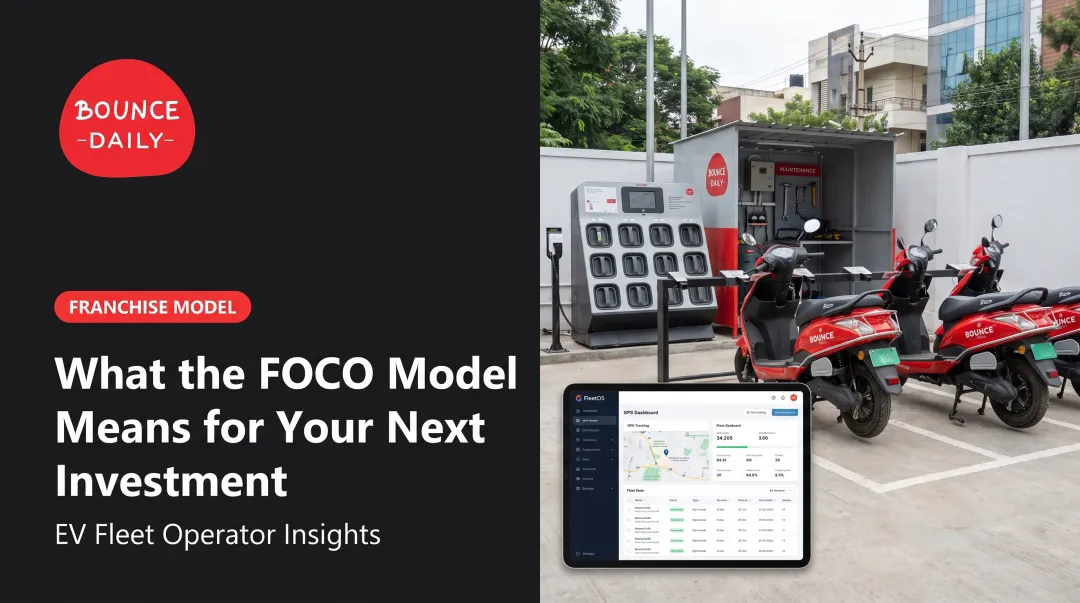
Bounce Daily's FleetOS platform illustrates this in the mobility context: a rider-facing app, a field-operations app for hub staff, and a central console that tracks bikes, KYC records, dues, and battery status in one dashboard. IoT controls even immobilise scooters automatically when a rental plan lapses.
This kind of infrastructure is what makes FOCO scalable beyond a founder's home city. Without it, "company-operated" turns into "company-overwhelmed."
What's Driving These FOCO Trends in India
Several forces are pushing brands and investors toward FOCO simultaneously in 2026:
- Technology reducing overhead: Fleet software, AI demand forecasting, and digital onboarding cut the headcount once needed to run multi-outlet networks. POS, CRM, and audit systems are now standard for multi-location operators.
- Gig-economy growth: A workforce past 10 million needs affordable, reliable transport. That favours asset-heavy, company-operated rental and quick-commerce models over franchisee-run alternatives.
- Margin pressure: Centralising procurement, staffing, and training protects unit economics as outlet counts grow. One brand negotiating for 50 locations beats 50 franchisees negotiating alone.
- Regulatory tailwinds: EV schemes like PM E-DRIVE, FSSAI licensing for food operators, and GST rules under Section 9(5) favour brands that can handle compliance centrally.
- Investor competition: Brands race to offer standardised, lower-risk structures that attract first-time investors who want returns without hands-on operational risk.
How These Trends Are Impacting the Franchise Industry in India
FOCO growth is reshaping how brands expand and what franchise investors actually do day to day.
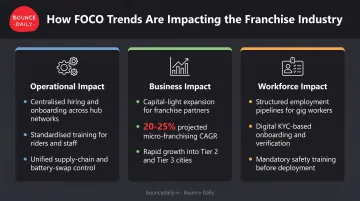
Operational Impact
Franchisors are pulling hiring, training, and supply-chain decisions into a central function. That cuts the daily burden on investors, but it also means less local control. Weigh that trade-off before you sign.
Business Impact
Brands get capital-light expansion: investors take on the financial risk of funding outlets, while the company keeps operational control. That structure is speeding entry into Tier 2 and Tier 3 cities. Franchise India projects micro-franchising could grow at 20-25% CAGR over five years, with up to 65% of new outlets potentially coming from smaller cities by 2030.
Workforce Impact
Company-operated models are building structured employment pipelines instead of relying on inconsistent, franchisee-hired staff. Bounce Daily's rider verification shows how this works in practice. Aadhaar-based digital KYC clears riders in minutes, then in-app safety briefings cover helmet use, defensive riding, and battery-handling protocols. Every hub can run the same process the same way.
Future Signals for the FOCO Model in India
FOCO's structure isn't static. Investors evaluating opportunities in the next 1-3 years should watch for:
- Sector spread into Tier 2 cities — EV mobility, quick-commerce, and healthcare/wellness brands piloting FOCO outside metros before full franchise rollouts
- Smarter verification tech — app-based partner onboarding and AI outlet dashboards already live in mobility (Bounce's FleetOS) and spreading into food and retail
- Hybrid FOCO-FOFO structures — brands keeping company control in new or high-risk markets, then shifting to franchisee-operated formats as markets mature
None of this guarantees uniform returns—sector strength, local demand, and execution still decide outcomes.
Conclusion
FOCO in India is no longer confined to food courts and retail aisles. It's showing up in EV rental hubs, quick-commerce dark stores, and salon chains: anywhere brand consistency matters more than local flexibility.
Investors who study sector-specific trends have an edge. Bounce Daily's hub-operator model for gig-worker EV rentals shows what a well-structured, company-operated franchise can look like: lower operational risk, centralised fleet and rider management, and a defined path to passive returns.
Choosing the right FOCO partnership in 2026 still comes down to homework: sector demand, the operator’s track record, and how clearly the agreement splits responsibilities. Run those checks first, then compare hub economics side by side before you commit capital.
Frequently Asked Questions
What are the best FOCO Model franchise opportunities in India?
EV mobility rentals, cloud kitchens, quick commerce, and wellness are currently the strongest FOCO categories. The right fit depends on your budget, local demand, and comfort with the sector's risk profile.
In the FOCO model, who is responsible for paying rent?
This depends on the franchise agreement. In most FOCO structures, the franchise partner who owns the outlet or infrastructure covers rent, while the company manages daily operations.
What is the difference between FOCO and FOFO franchise models?
In FOCO, the company operates the outlet while the franchisee owns it. In FOFO, the franchisee both owns and operates the outlet, taking on full day-to-day responsibility.
How much investment is needed to start a FOCO franchise in India?
Investment varies widely by sector: cloud kitchens, EV rental hubs, and retail stores each have different capital requirements. Research specific brand disclosures before committing funds.
Is the FOCO model profitable for investors in 2026?
Profitability depends on brand strength, sector demand, and operational execution by the company. FOCO typically offers steadier, lower-risk returns than fully independent ventures.
Which industries are best suited for the FOCO franchise model?
FOCO fits sectors that need tight operational consistency across locations, such as EV and gig mobility rentals, food service, retail, and wellness. Centralised management helps protect brand quality at every outlet.