Introduction
India's franchise sector has grown into a ₹800 billion industry with 4,600 active franchisors and nearly 200,000 outlets, according to a 2023 Economic Times Retail report on the FranCast Whitepaper. For entrepreneurs seeking proven business models with brand recognition, franchising offers a structured alternative to building from scratch.
Yet before you sign any agreement, one decision shapes everything that follows: FOCO (Franchise Owned, Company Operated) versus FOFO (Franchise Owned, Franchise Operated).
This choice determines whether you monitor operations from a distance or manage daily staff shifts. Your profit either flows from a fixed revenue share or hinges on controlling costs, negotiating with suppliers, and running local marketing.
The right model matches your time, operational expertise, risk tolerance, and desired control. The wrong one can turn a promising investment into a mismatched burden.
This guide clarifies both models, examines real-world examples, and gives you a decision framework based on your goals, capital, and lifestyle.
Key Takeaways
- FOCO means you invest capital while the franchisor manages daily operations; FOFO means you invest and run the business yourself
- FOCO lowers your time commitment but creates reliance on the franchisor's management capability and reporting transparency
- FOFO gives you full operational control and potentially higher margins, at the cost of hands-on management and industry experience
- Match the model to your time, expertise, capital, and control needs—not to assumptions about which is universally better
- EV rental and similar sectors often use FOCO structures to pair investor capital with specialized fleet and ops expertise
FOCO vs FOFO: Quick Comparison
Use this side-by-side view to compare ownership, daily effort, control, and investor fit before you choose a model.
| Factor | FOCO | FOFO |
|---|---|---|
| Ownership | Franchisee owns/funds the outlet | Franchisee owns/funds the outlet |
| Operations | Franchisor manages daily operations | Franchisee manages daily operations |
| Investor Involvement | Low; periodic monitoring and reviews | High; 40–60 hours weekly on-site |
| Operational Control | Limited; brand and company-led decisions | High; franchisee-led within brand guidelines |
| Initial Investment | Varies by brand, sector, and location; model choice is rarely about capital alone | Varies by brand, sector, and location; similar ticket size, higher time commitment |
| Ongoing Effort | Minimal daily commitment | Continuous operational involvement |
| Profit Structure | Fixed return or revenue-share percentage | Profit after deducting costs and royalties |
| Risk Level | Depends on franchisor competence and transparency | Depends on franchisee capability and execution |
| Best Suited For | Passive investors and time-poor professionals who want convenience over control | Hands-on operators who want direct control and will manage day-to-day variability |
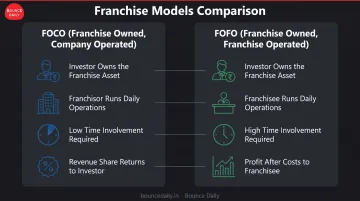
What is FOCO (Franchise Owned, Company Operated)?
FOCO stands for Franchise Owned, Company Operated. Under this model, the franchisee funds the outlet setup: property, fit-out, equipment, and initial inventory. The franchisor runs day-to-day operations—staffing, training, marketing, inventory, and customer service.
Investment structure: The franchisee funds setup; the company manages execution. In return, the franchisee typically receives a fixed return or a percentage share of outlet revenue, not variable profit.
For example, Momo Delights advertises a FOCO structure at ₹10 lakh total (₹7 lakh setup + ₹3 lakh franchise fee), no recurring royalty, and 15% of outlet revenue to the investor. That offer also states projections depend on location, demand, market conditions, and the signed agreement—seller terms, not independently verified returns.
Franchise India's 2025 sector analysis identifies quick-service restaurants, casual dining, and branded pharmacy-attached retail as current FOCO use cases. However, no authoritative national adoption rate or market-share figure for FOCO exists in available research.
Who FOCO Suits Best
Those sector patterns point to a clear investor fit: capital available, time and operating bandwidth limited.
- Passive investors with capital who cannot commit 40–60 hours a week to run an outlet
- Doctors, engineers, and corporate employees who want diversification without leaving their main career
- Investors who prefer franchisor-led execution over hands-on control
FOCO prevalence in India: The model is often called “gaining popularity,” but no published national percentage or controlled dataset backs that claim. Evidence points to sector-specific adoption, not market-wide dominance.
Performance evidence: Published FOCO deals cite fixed or predictable returns, yet no independent post-2020 case study or audited report shows realized outlet-level ROI in Indian QSR, retail, or rental franchises. Advertised revenue shares and projected IRRs remain seller claims, not proof of actual franchisee returns.

What is FOFO (Franchise Owned, Franchise Operated)?
FOFO stands for Franchise Owned, Franchise Operated—the traditional franchise model in which the franchisee both invests in and manages all daily operations. Day-to-day responsibilities typically include:
- Hiring staff and managing inventory
- Running local marketing
- Handling customer service and quality control within brand guidelines
The franchisee pays an initial franchise fee and typically an ongoing royalty (a percentage of revenue or a fixed monthly fee) while retaining full operational control. The franchisor supplies the brand, operating system, training, and ongoing support; the franchisee executes on the ground.
Franchise India describes FOFO as a common structure in India, though no authoritative national split between FOCO and FOFO is published. Royalty terms also vary widely by brand and sector.
Use Cases of FOFO
FOFO fits investors who want direct involvement:
- Hands-on entrepreneurs with sector experience who want to apply operational knowledge
- Owners who want direct control over quality, staffing, and customer experience
- Operators planning multi-unit growth after mastering one location
The Learning Curve's preschool franchise offers both FOCO and FOFO options. Under FOFO, the franchisee invests and runs daily operations with brand training and support. Its FOFO preschool model calls for at least 4–5 hours daily in the early months, which shows the real time commitment of owner-operated franchising.
Franchise India's comparison suggests FOFO can deliver higher but less stable ROI, while FOCO offers lower but more consistent returns. Treat that as qualitative guidance only: no independent case study proves that active franchisee involvement alone drives above-average returns.
FOCO vs FOFO: Which Investment Model Suits You Best?
The right model depends on your investor profile, available time, operating expertise, and tolerance for variability. Both can succeed or fail based on execution, brand strength, and market fit.
Decision Factors to Consider
1. Time Commitment
- FOCO: The company runs the outlet. Your role stays limited to periodic monitoring, performance reviews, and franchisor relationship management—built for low daily commitment.
- FOFO: You manage daily operations. Many franchisees report 40–60 hours weekly on hiring, inventory, staff, and local marketing; The Learning Curve's preschool franchise specifies 4–5 hours daily at the start.
If you cannot commit 40+ hours weekly on-site, FOCO is the more realistic choice.
2. Financial Considerations
| Financial Factor | FOCO | FOFO |
|---|---|---|
| Initial Investment | Franchisee funds setup; varies by brand and format. Momo Delights advertises ₹10L for its QSR offer. | Franchisee funds setup and operations; no universal range. Investment depends on brand, location, and format, not model label alone. |
| Ongoing Costs | Company controls staff, inventory, and operations; management charges or revenue sharing reduce investor receipts. | Franchisee bears operating execution and pays contract royalty/fees. No validated national percentage. |
| Return Pattern | More predictable but potentially lower; offer may be fixed return or revenue share. | Variable and profit-dependent; potentially higher but less stable. |
| Break-even Timeline | No authoritative India-wide benchmark. Depends on brand, location, and agreement terms. | No authoritative India-wide benchmark. Depends on execution, local market, and cost control. |
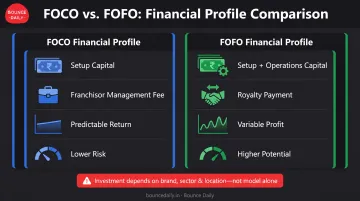
Key insight: Investment levels depend more on brand, sector, location, and format than on the FOCO/FOFO label. Both models can require substantial upfront capital. Check unit economics, existing-franchisee margins, and break-even timelines at the brand and agreement level, not model level.
3. Risk Profiles
- FOCO risk: Returns hinge on the franchisor's competence, transparency, and execution—you have limited say over staffing, service, inventory, or costs. FranCorp advises checking outlet count, closures, unit economics, and existing-franchisee margins before signing.
- FOFO risk: Your returns depend on your own operational capability, local execution, hiring decisions, and cost control. Poor management, staff turnover, or weak local marketing directly impact profitability.
If you lack operating experience in the sector, FOCO transfers execution risk to the franchisor. If you want accountability and influence, FOFO keeps risk—and control—in your hands.
4. Control vs. Convenience Trade-Off
- FOCO: Offers convenience and professional operations management but limits your ability to influence quality, adjust to local preferences, or optimize costs. You rely on the franchisor's systems and reporting.
- FOFO: Grants direct control over hiring, customer experience, inventory, local promotions, and service quality—so you can act on feedback quickly and build a hands-on relationship with your team and community.
If operational control is a priority, FOFO is the clear choice. If you value passive income and trust the franchisor, FOCO fits better.
5. Situational Recommendations
Choose FOCO if you:
- Have capital but limited time (fewer than 20 hours weekly available)
- Lack operating experience in the sector
- Prefer predictable, hands-off income over maximum profit potential
- Trust the franchisor's management capability and transparency
- Want to diversify investments without becoming a full-time operator
Choose FOFO if you:
- Can commit 40–60 hours weekly to on-site management
- Have industry experience or strong operational instincts
- Prioritize direct control over quality, staffing, and customer relationships
- Are comfortable with profit variability tied to your execution
- Want to build expertise and potentially scale to multiple outlets
Real-World Example: How Bounce Daily Approaches the Investment Model
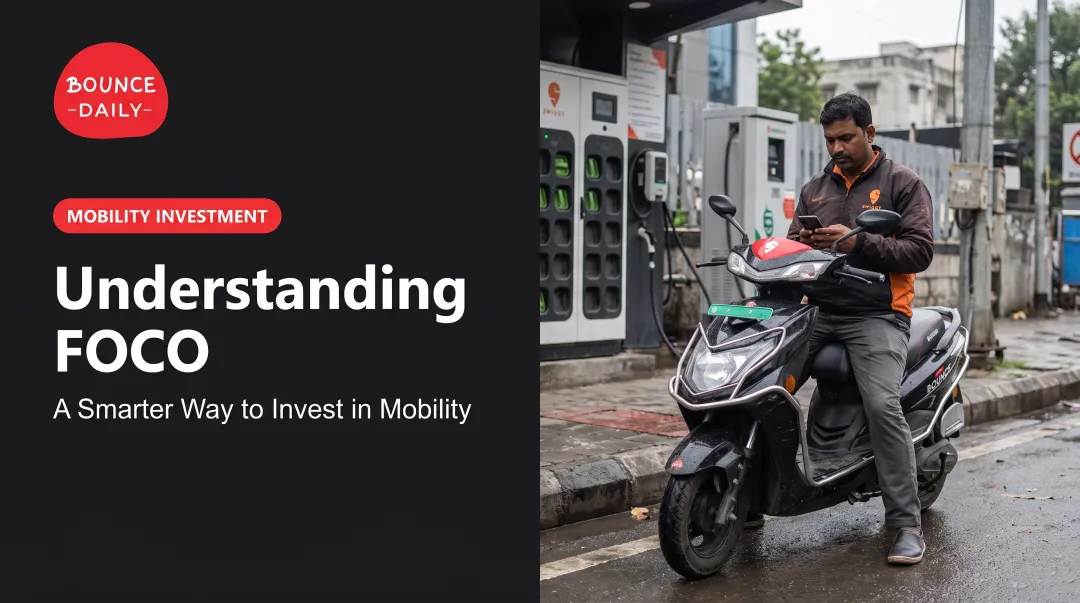
Bounce Daily, the electric scooter rental brand operated by Bounce Infinity and relaunched in April 2025, runs a FOCO-style franchise/hub-operator program in the fast-growing EV rental sector. It serves gig workers, delivery partners on major platforms, college students, and daily commuters across Bengaluru, Hyderabad, and Delhi NCR.
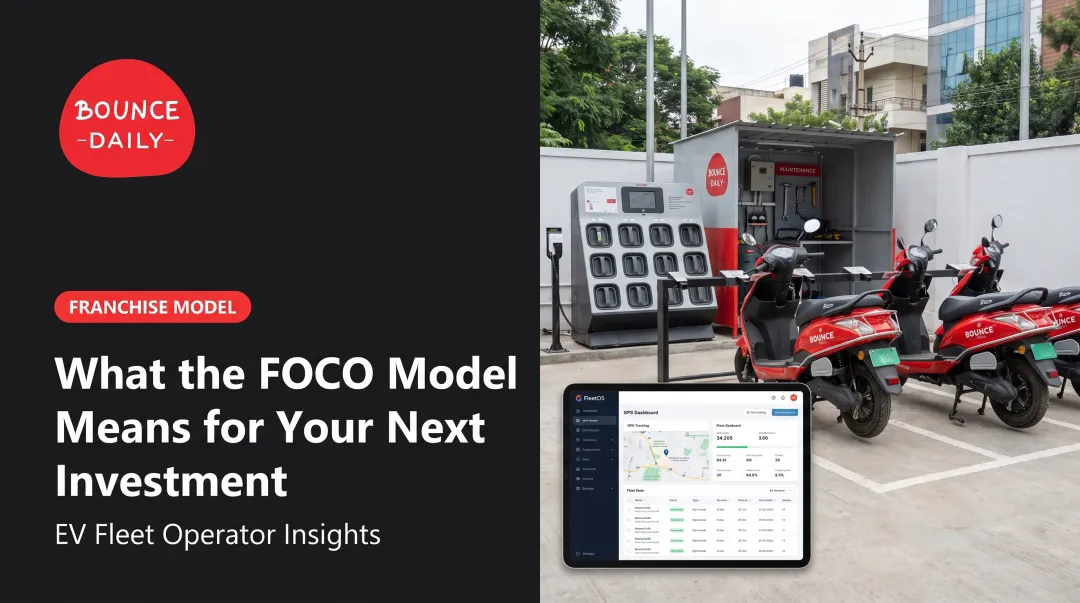
How the model works: Partners put up capital for the EV scooter fleet and a suitable local hub. Bounce Daily runs the operations:
- Fleet management: Maintenance, GPS tracking, uptime monitoring, breakdown support, battery health, and replacements
- Battery-swap operations: Central charging and unlimited swaps across the hub network—partners skip electricity costs and charging gear
- Technology platform: FleetOS runs the rider app, Aadhaar KYC, plans, hub booking, billing, field ops, and IoT lock/unlock when plans change
- Demand generation: Verified delivery-rider leads plus lead management, so partners do less acquisition work
- Partner enablement: Training for hub ops, rider onboarding, and customer handling, plus creatives and brand support
What partners contribute: Fleet capital, a hub location, and light oversight. They do not run daily ops, hire mechanics, maintain charging infrastructure, or handle insurance (bundled in rental plans).
Why this hybrid FOCO approach works in EV rentals: EV rentals need depth in battery ops, IoT fleet tools, gig-worker demand, multi-platform delivery, and real-time utilisation. Bounce's FleetOS has supported 30M+ kilometres driven and 10,000+ tonnes of CO2 avoided across live cities. Central ops keep asset ownership with the investor while delivering efficiency most solo franchisees cannot match alone.
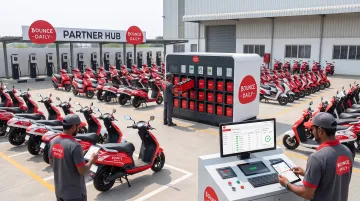
Advertised returns: Bounce Daily promotes a 14–16% IRR for its FOCO opportunity, positioning it as a passive-income investment. Investment levels, revenue-share terms, and detailed financial models are disclosed during partner onboarding.
Interested in this model? See Bounce Daily's FOCO partnership details if you want EV rental exposure without running day-to-day fleet operations.
Conclusion
The FOCO vs. FOFO decision should come from honest self-assessment, not from assuming one model is always better. Before you commit, weigh:
- Available time for day-to-day involvement
- Operational expertise you can bring
- Capital strength and funding runway
- Personal risk tolerance
FOCO can deliver steadier, hands-off income when you trust the franchisor’s capability and transparency. FOFO can unlock higher margins and control when you have the time, skill, and commitment to run daily operations.
The wrong fit turns a passive investment into an operational burden—or leaves a hands-on business under-managed. Choose the model that matches your goals and capabilities, verify unit economics with existing franchisees, and review the agreement with legal and financial advisors before you sign.
Frequently Asked Questions
What is the FOCO vs FOFO model?
FOCO (Franchise Owned, Company Operated) means you invest the capital while the franchisor runs daily operations and typically pays a fixed return or revenue share. FOFO (Franchise Owned, Franchise Operated) means you invest and run the unit yourself, keeping control and profits after costs.
Which franchise model is most profitable?
Profitability depends more on execution, brand strength, and market fit than on model type. FOFO can deliver higher margins when you control costs well; FOCO offers more predictable returns with less effort but often caps upside through revenue share.
What are the main advantages of the FOCO model?
FOCO requires minimal daily time commitment, offers professional operations management by the franchisor, and reduces your need for industry expertise. It's ideal for passive investors seeking diversification without becoming full-time operators.
What are the main advantages of the FOFO model?
FOFO grants full operational control, higher profit potential if executed well, direct customer relationships, and the ability to implement local innovations or adjustments. It suits hands-on entrepreneurs who want accountability and influence over outcomes.
Can I switch from FOCO to FOFO or vice versa?
Switches are contractually complex and uncommon. A FOCO/FOFO conversion usually needs mutual agreement and a formal contract amendment, so choose your initial model carefully.
Which model requires less initial investment?
Investment depends more on brand, sector, location, and format than on the FOCO/FOFO label. FOCO sometimes needs higher setup spend for infrastructure the franchisor will run—always compare brand-specific unit economics and agreement terms.