Introduction
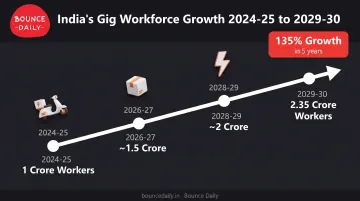
India's gig workforce is exploding. It's projected to jump from 1 crore workers in 2024-25 to 2.35 crore by 2029-30, according to the Ministry of Labour. That's more than doubling in five years, and demand for affordable, reliable two-wheelers is rising with it.
Delivery partners from Swiggy, Zomato, Amazon, and Flipkart need vehicles every day, but buying one upfront isn't always feasible. Electric scooter rentals have become the practical alternative.
Is this a genuine small-business opportunity, or market hype with thin margins and operational headaches? This article evaluates the real economics: initial capital, monthly revenues, and break-even timelines. It also weighs the risks—market saturation, fleet management complexity, and regulatory uncertainty.
Whether you're eyeing a ₹5-15 lakh investment or a franchise model like Bounce Daily, you'll get a data-backed look at what works, what doesn't, and who should (and shouldn't) jump in.
Key Takeaways
- Gig workforce set to more than double by 2029-30; ~40% lower EV TCO per km fuels rental demand
- Capital runs ₹4–17 lakh by fleet size; strong utilization often pays back in 13–18 months
- Win on location proof, >60% utilization, and tight ops—opportunity is uneven across cities
- Main risks: metro saturation, maintenance load, theft, and shifting EV subsidy policy
- Models like Bounce Daily handle ops, riders, and fleet, lowering barriers for passive investors
The Market Case: Why EV Rentals Are Growing in India
Gig Economy Explosion Drives Daily Vehicle Demand
The primary demand driver is simple: delivery partners need wheels. The Indian government projects the gig workforce will grow from 1 crore in 2024-25 to 2.35 crore by 2029-30. That's not just food delivery: it includes e-commerce last-mile logistics, quick commerce, and hyperlocal parcel services.
Platform numbers show the scale:
- Swiggy reported over 6.5 lakh delivery partners as of July 2026
- Zomato counted 500,000+ delivery partners across its network, with its monthly active EV-based delivery fleet reaching 27,884 vehicles by March 2024
- Zomato's EV fleet grew from 52,000 active EV-based delivery partners in March 2025 to over 100,000 by March 2026
Many of these workers can't afford the ₹70,000-₹1.2 lakh upfront cost of a scooter, and traditional financing often requires documentation or credit history they don't have. Daily or monthly rentals fill that gap.
Public transit in Indian cities rarely reaches logistics hubs, warehousing zones, or delivery starting points. Delivery workers need point-to-point mobility, not fixed bus or metro routes. Congestion and parking scarcity make scooters more practical than cars, and rentals avoid the maintenance burden of ownership.
Swiggy's quick-commerce GMV grew 39.8% year-on-year in July 2026, and BCG forecasts a USD 20B+ GMV opportunity by 2030, supported by a USD 2B+ logistics market. As delivery volume climbs, so does the need for affordable scooter access.
EV Cost Advantage vs. Petrol
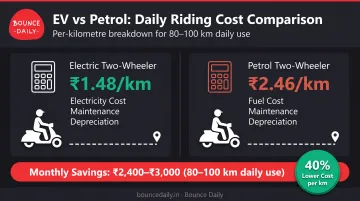
Electric two-wheelers cost significantly less to run than petrol models. CEEW's June 2025 total cost of ownership (TCO) analysis reported ₹1.48/km for electric two-wheelers versus ₹2.46/km for petrol, roughly 40% savings.
For a delivery rider covering 80-100 km daily, that translates to ₹80-100 saved per day, or ₹2,400-₹3,000 per month. For rental operators, lower fuel costs support better margins than petrol rental businesses.
Government Support Lowers Fleet Acquisition Costs
The central government's PM E-DRIVE scheme provides ₹5,000 per kWh (capped at ₹10,000 per vehicle), and commercial and corporate-registered e-2Ws qualify. The scheme was extended to 31 March 2028 in an August 2026 amendment.
State-level incentives vary:
- Delhi lists ₹5,000/kWh (capped at ₹30,000) plus a ₹5,000 scrapping incentive
- Telangana exempts battery-operated vehicles from road tax for five years
- Karnataka and Maharashtra have portals, but specific rental-fleet eligibility details aren't publicly disclosed
These subsidies reduce the effective purchase price per scooter by ₹10,000-₹30,000, helping new operators lower their break-even timeline.
Business Model Economics: Investment vs. Returns
Initial Capital Breakdown
| Item | Small Fleet (5 scooters) | Larger Fleet (10 scooters) |
|---|---|---|
| Fleet acquisition | ₹3.25-6.5 lakh | ₹6.5-13 lakh |
| RTO registration | ₹1,500-2,500 | ₹3,000-5,000 |
| Commercial insurance | ₹17,500-30,000 | ₹35,000-60,000 |
| Charging/battery swap setup | ₹50,000-1 lakh | ₹1-2 lakh |
| Marketing & onboarding | ₹20,000-50,000 | ₹50,000-1 lakh |
| Total | ₹4.14-8.8 lakh | ₹8.88-16.65 lakh |
These figures assume mid-range commercial-grade electric scooters at ₹65,000-₹1.3 lakh per unit after subsidies. Premium models or bulk discounts can shift the range.
Revenue Model
Daily rental rates vary by city and scooter tier:
- Budget/low-speed models: ₹300-500/day
- High-speed/long-range models: ₹500-800/day
Bounce Daily, for instance, advertises electric scooters starting at ₹250/day with weekly and monthly plans (exact rates shown in-app).
Assuming ₹400 average daily rate and 25 operating days per month per scooter:
- Monthly revenue per scooter: ₹10,000
- 5-scooter fleet: ₹50,000/month
- 10-scooter fleet: ₹1,00,000/month
This assumes 80-85% utilization. If utilization drops to 50%, monthly revenue per scooter falls to ₹5,000-₹6,000.
Monthly Operating Costs
| Expense | Small Fleet (5 scooters) | Larger Fleet (10 scooters) |
|---|---|---|
| Electricity/battery swaps | ₹5,000-7,500 | ₹10,000-15,000 |
| Maintenance & repairs | ₹3,000-5,000 | ₹6,000-8,000 |
| Staff (if hired) | ₹15,000-20,000 | ₹20,000-30,000 |
| Miscellaneous (admin, rent) | ₹5,000-7,500 | ₹7,500-10,000 |
| Total | ₹28,000-40,000 | ₹43,500-63,000 |
Electricity costs depend on local tariffs. Delhi, Bengaluru, Hyderabad, and Mumbai all publish regulator-approved rates, but they vary by utility, category, and consumption slab.
Break-Even Timeline
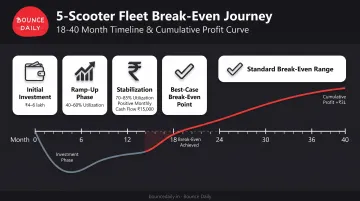
Under good utilization (70-85%), independent fleets often turn positive monthly cash flow within the first few months—but full capital recovery takes longer than many first-time operators expect.
- 5-scooter example: ₹50,000/month revenue − ~₹35,000 operating costs = ₹15,000 net/month
- Mid-range payback: ₹6 lakh investment ÷ ₹15,000/month ≈ 40 months to recover capital
- Lean best case: Capex near ₹4–5 lakh with tight costs can pull simple payback into the 18–24 month range
Poor location choice or utilization below 50% can push payback past 24 months—or block profitability entirely. Franchise payback math differs because the operator burden is shared (see comparison below).
Profit Margins
Industry operators report 25-30% gross margins under efficient operations. EVs' lower energy costs (₹1.48/km vs. ₹2.46/km for petrol) support better margins than petrol rental businesses historically achieved.
How much of that margin you keep—and how hard you work for it—depends on whether you run independently or join a franchise.
Independent Setup vs. Franchise Model
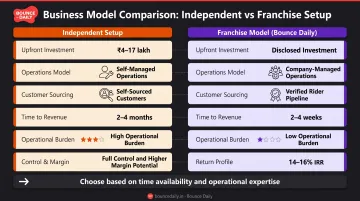
| Factor | Independent Setup | Franchise Model (e.g., Bounce Daily) |
|---|---|---|
| Upfront investment | ₹4-17 lakh | Disclosed during onboarding; fleet owned by partner |
| Operational support | Self-managed | Company-managed: fleet, maintenance, GPS, insurance |
| Customer acquisition | Self-sourced | Verified rider pipeline supplied |
| Time to revenue | 2-4 months | 2-4 weeks |
| Ongoing operational burden | High | Low (FOCO model: partner owns, Bounce operates) |
Franchise/FOCO models suit investors who want lower day-to-day involvement—Bounce Daily’s hub-operator program, for example, advertises 14–16% IRR—while independent setups offer full control and potentially higher margins if you manage operations well.
Entry Requirements: What It Takes to Launch
Location and Demand Validation
Before buying even one scooter:
- Identify high-delivery-partner areas: Industrial zones, logistics hubs, e-commerce warehouses, and quick-commerce dark stores
- Talk to delivery workers: Ask about current vehicle ownership, daily rental needs, and willingness to switch to EVs
- Assess competition: Check for existing rental operators, OEM programs, or aggregator platforms in the area
- Evaluate charging infrastructure: Confirm battery-swap stations or dedicated charging points are nearby
Testing demand with a 2-3 scooter pilot for 1-2 months can reveal utilization rates before committing to a full fleet.
Legal Compliance Requirements
- Business registration: Register as a sole proprietorship, partnership, or private limited company
- GST registration: Mandatory if annual turnover exceeds ₹20 lakh (₹10 lakh in special-category states) under CGST Act Section 22
- Trade licence: Required from municipal corporations such as Delhi MCD and Bengaluru BBMP
- Commercial vehicle registration: High-speed scooters need commercial registration; India’s RC fee waiver for battery vehicles drops mark and renewal fees, not state road tax or permits
- Commercial insurance: Motor Vehicles Act Section 146 mandates third-party cover; comprehensive policies suit rental fleets better
- Rental licence (if applicable): MoRTH’s June 2020 advisory cites the Rent-a-Motorcycle Scheme, 1997—confirm with your local transport authority
Non-compliance can result in fines, vehicle seizure, or shutdown.
Operational Infrastructure Needs
- Secured parking: Off-street space for fleet storage, ideally near your target demand zone
- Charging stations or battery-swap access: Either install dedicated chargers or partner with battery-swap networks
- Fleet tracking systems: GPS devices for real-time location, theft alerts, and usage monitoring
- Rental agreements & KYC templates: Standardized documents for Aadhaar/licence verification, terms, and liability
- Digital platform: Mobile app or web booking system for rider onboarding, payments, and plan selection
Many franchise models bundle these systems out of the box. Bounce Daily’s hub-operator program, for instance, includes tracking, battery-swap access, and digital onboarding so partners spend less time on setup.
Risk Assessment: What Could Go Wrong
Market Saturation in Metro Cities
Bengaluru, Hyderabad, Delhi NCR, and Mumbai already host established EV rental players like Bounce Daily and Zypp. Late entrants face:
- Intense price competition
- Higher customer acquisition costs
- Lower utilisation rates (often 40-50% vs. 70-85% in underserved markets)
Before launching in a metro, validate that your hub location or niche (such as exclusive quick-commerce partnerships) offers differentiation.
Fleet Utilisation Challenges
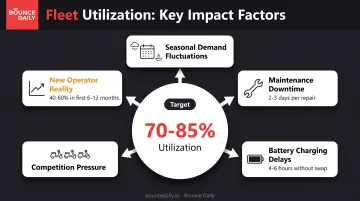
Profitability depends on maintaining 70-85% utilisation. Common utilisation drags:
- Seasonal demand fluctuations: Festivals, monsoons, and exam periods affect delivery and student rentals
- Maintenance downtime: Even minor repairs can sideline a scooter for 2-3 days
- Battery charging delays: Without swap infrastructure, 4-6 hour charging cycles reduce daily rental windows
New operators commonly achieve only 40-60% utilisation in the first 6-12 months.
Maintenance and Theft Risks
Electric scooters require:
- Regular servicing (brakes, tyres, suspension)
- Battery health monitoring and eventual replacement
- Accident and damage management
Theft risk: Public sources don't publish authoritative theft rates for India's EV rental fleets. Inadequate GPS tracking, weak rider verification, or delayed immobilisation still raise loss risk. Comprehensive insurance and real-time tracking are essential.
Regulatory Uncertainty
- Subsidy changes: FAME II ended March 2024; PM E-DRIVE offers lower per-unit incentives but enables higher annual volumes
- Commercial registration rules: State-level road tax, permit fees, and rental licensing requirements can change
- GST rates: The current GST rate for self-drive electric-scooter rentals isn't clearly set out in public guidance
Policy shifts can impact unit economics mid-operation.
Competition from Established Players and OEMs
Well-funded competitors have advantages:
- Bulk fleet procurement (lower per-unit costs)
- Brand recognition and rider trust
- Proprietary technology platforms
- National expansion capital
Independent operators must compete on local service quality, niche targeting, or pricing flexibility.
The Franchise Alternative: Bounce Daily's Model
Not every investor wants to run workshops, hire mechanics, or chase riders. Bounce Daily's Franchise Owned, Company Operated (FOCO) model is built for partners who put in capital and a hub site, then leave day-to-day rental ops to the company.
How the FOCO Split Works
Roles are narrow on purpose:
- Franchise partner: Provides capital and a suitable hub location
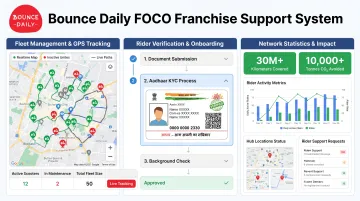
- Bounce Daily: Runs fleet operations, rider onboarding, maintenance, GPS tracking, battery swaps, insurance, billing, and marketing
You do not staff a workshop or run acquisition campaigns. Bounce owns that stack end to end.
Support Behind Each Hub
Partners plug into infrastructure already live in the network:
- Verified rider flow from Swiggy, Zomato, Blinkit, Zepto, BigBasket, Amazon, Flipkart, and logistics platforms
- Aadhaar-based KYC, same-day verification, and instant activation on the Bounce Daily Android app
- Centralised maintenance, GPS tracking, anti-theft alerts, IoT immobilisation, and uptime monitoring through FleetOS
- Unlimited battery swaps on rental plans across Bengaluru hubs, with no separate swap fees for renters
- Training on hub operations, rider onboarding, and customer handling, plus marketing creatives and brand support
Investment, Ramp-Up, and Returns
FOCO partners typically reach first revenue in 2-4 weeks, versus 2-4 months for independent setups. Exact investment, fleet size, and revenue-share terms are shared during partner onboarding. Franchise materials target a 14-16% IRR.
That offer sits on a live base: 30M+ kilometres driven and 10,000+ tonnes of CO₂ avoided to date—useful proof when you are underwriting hub-level risk.
Who Should (and Shouldn't) Consider This Business
Ideal Candidate Profile
You're a strong fit if you meet the basics:
- Have ₹5-15 lakh capital available, including 6-12 months of operating expenses
- Are located in tier-1 or tier-2 cities with visible gig-economy activity
- Have realistic expectations: 13-18 month break-even timelines, 25-30% margins
Independent setups suit operators who can run day-to-day work or hire staff—especially entrepreneurs with logistics or mobility experience and small business owners who want a recurring-revenue model.
Franchise / FOCO setups suit investors who prefer lower operational involvement and passive income, with fleet management handled centrally.
Red Flags and Disqualifying Factors
Do NOT enter if you:
- Lack sufficient capital for 6-12 months of operating expenses beyond initial investment
- Expect passive income from an independent setup (it requires active management)
- Are in a location without strong delivery-partner demand (rural areas, small towns with minimal quick commerce)
- Cannot handle regulatory compliance (GST, licensing, insurance, commercial registration)
- Expect 50%+ margins or 6-month break-even
Alternative Paths to Entry
- Pilot with 5 scooters for 2-3 months to test demand before scaling
- Join an existing operator as a capital partner and share profits without day-to-day involvement
- Choose a FOCO-style franchise (such as Bounce Daily) if you want lower operational burden—training, maintenance, and marketing support are handled for you
If your capital, city demand, and time commitment don’t line up on an independent build, use a pilot or franchise path instead of forcing a full rollout.
Frequently Asked Questions
Do I need a licence to drive an electric scooter in India?
High-speed electric scooters (above 25 km/h and 250W) require a valid driving licence. Low-speed variants (under 25 km/h and 250W) typically do not. Bounce Daily offers hub-based driving licence assistance for Low Speed riders for a nominal ₹200–₹230 fee.
Is electric scooter rental profitable in India?
Profitability depends on achieving 70-85% fleet utilization, maintaining low operating costs, and choosing locations with strong gig-worker demand. Typical gross margins are 25-30% under efficient operations, with break-even in 13-18 months.
How much investment is needed to start an EV rental business?
Initial investment ranges from ₹4-17 lakh depending on fleet size (5-10 scooters), covering vehicles, registration, insurance, charging infrastructure, and initial operating capital. Franchise models use different cost structures, shared during onboarding.
What are the biggest risks in the scooter rental business?
Low fleet utilization (below 60%), maintenance and theft losses, metro market saturation, and regulatory shifts on EV subsidies or rental licensing. Weak location choice or loose operations amplify all of these.
Can I start this business part-time?
The first 2-3 months require significant time investment for setup, rider onboarding, and learning operations. After stabilization, daily work often drops to 2–3 hours or can be delegated—so part-time is realistic for smaller fleets and franchise models.
How long does it take to break even in EV scooter rental?
Most operators break even in 13–18 months at 70–85% utilization. Poor location or weak operations can push that past 24 months; franchise support can shorten the path via faster rider acquisition.