Introduction
Ask most people what fleet management means, and they'll picture a logistics giant with hundreds of trucks. That's only part of the picture.
Fleet management applies just as much to a food delivery rider on a rented scooter, a small business running three delivery vans, or a franchise partner operating an EV rental hub. Any organisation or individual responsible for multiple vehicles faces the same core challenges.
Unmanaged fleets bleed money. Fuel and maintenance costs creep up, vehicles sit idle when they should be earning, compliance paperwork gets missed, and driver behaviour goes unchecked.
India's registered vehicle base has crossed 389.77 million as of early 2025, according to government data reported through the Press Information Bureau — a scale that makes structured fleet oversight non-negotiable.
This guide breaks down what fleet management actually is, how it works day to day, and why India's gig-economy and EV delivery fleets are rewriting the rules entirely.
Key Takeaways
- Fleet management spans the full vehicle lifecycle: acquisition, maintenance, tracking, compliance and disposal
- Telematics and GPS software give fleet managers real-time visibility for faster decisions
- Well-run fleets cut fuel and maintenance spend while improving driver safety
- EV rental models in India's gig economy now shift fleet management from riders to specialised providers
What Is Fleet Management?
Fleet management is the process of overseeing, maintaining and optimising an organisation's vehicles across their entire lifecycle, from the day they're acquired to the day they're sold or retired. Done well, it controls costs, keeps vehicles running efficiently, and keeps operators on the right side of regulation.
Investopedia defines it simply as maintaining vehicles so they operate efficiently and smoothly, which includes regular servicing. But the scope goes well beyond routine upkeep.
"Fleet" doesn't just mean trucks. It covers:
- Cars, vans and light commercial vehicles
- Two-wheelers and scooters
- Electric vehicles (EVs) of every category
- Non-powered assets like trailers, containers and equipment
Fleet management can run in-house under a dedicated manager or team, or it can be outsourced to a specialist provider. Many gig-economy platforms and small delivery operators choose the latter, handing operations to rental or franchise partners built for this purpose.
At its foundation, fleet management rests on five interconnected pillars:
- Vehicle lifecycle planning
- Telematics and tracking
- Driver management
- Maintenance and fuel (or charging)
- Regulatory compliance
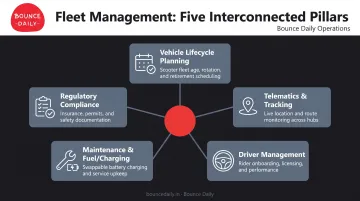
India's vehicle base is nearly 390 million. NITI Aayog notes the commercial segment is heavily fragmented, with roughly 70% of truck operators running five vehicles or fewer. Structured management matters even for the smallest operators.
We'll unpack each of these pillars next.
How Does Fleet Management Work?
Fleet management works by combining physical, hands-on processes (buying vehicles, servicing them, inspecting documents) with digital tools that feed data into a central dashboard. That dashboard is where decisions actually get made.
Vehicle Acquisition & Lifecycle Management
Every fleet decision starts with acquisition. Businesses assess their operational needs, then choose between buying, leasing or renting based on usage patterns and budget.
Total cost of ownership (TCO) calculations factor in more than the sticker price:
- Vehicle make, model and expected lifespan
- Annual mileage and depreciation curves
- Maintenance, repairs and infrastructure needs
- Capital outlay versus ongoing lease payments
Some government leasing frameworks (for example, the US GSA model) bundle acquisition, maintenance, accident management and disposal into one service. That is lifecycle planning with a third party holding the risk. Fleet managers apply the same logic: plan the exit before the entry.
Vehicle Tracking & Telematics
GPS and IoT-enabled devices installed in vehicles transmit real-time data on location, speed and diagnostics straight to fleet management software. This is the nervous system of modern fleet operations.
India's AIS-140 telematics standard, mandatory for public and commercial transport vehicles, requires devices to capture:
- Date, time and GPS coordinates
- Speed and heading
- Ignition status
- Emergency alerts
Transmission can occur as often as every 5 seconds during operation and at least every 10 minutes when idle, giving fleet managers near-continuous visibility.
Maintenance & Fuel/Charging Management
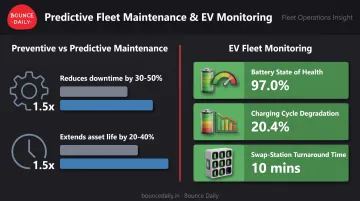
Preventive maintenance follows a fixed schedule; predictive maintenance uses sensor data to flag issues before they cause breakdowns. Cross-industry research from McKinsey found predictive approaches can cut equipment downtime by 30–50% and extend asset life by 20–40%. Those figures come from manufacturing but are increasingly applied to fleet operations.
For EVs, fuel tracking gives way to battery and charging metrics. Fleet managers monitor:
- Battery state of health and remaining useful life
- Charging cycles and degradation patterns
- Swap-station availability and turnaround time
NITI Aayog's EV report notes that battery swapping specifically helps reduce downtime for commercial fleets — a detail that matters enormously for delivery riders working long shifts.
Driver Management & Safety
Telematics doesn't just track vehicles — it tracks behaviour. Harsh braking, speeding, rapid acceleration and excessive idling all get logged and used for coaching, training and performance-based incentives.
New York City's fleet programme reported that speeding alerts cut excessive speeding among city vehicles by more than half. Controlled studies elsewhere have shown accident reductions ranging from 0% to 30%, depending on how consistently coaching is applied. The technology only works if management follows through.
Compliance & Documentation
In India, the Motor Vehicles Act, 1988 is the legal backbone. Core duties include:
- Section 39: vehicle registration
- Section 56: valid fitness certificate
- Section 66: permits
- Section 146: compulsory third-party insurance
Fleet managers also track registration renewals, insurance validity, driver licensing and permit conditions to avoid penalties and keep vehicles roadworthy.
What Does a Fleet Manager Do?
A fleet manager is the single point of accountability for a fleet's performance, safety and cost efficiency. When something goes wrong—a breakdown, a missed compliance deadline, a fuel-cost spike—it lands on their desk.
Core day-to-day responsibilities include:
- Vehicle procurement: sourcing, negotiating and acquiring vehicles that match operational needs
- Maintenance scheduling: coordinating preventive and predictive servicing to minimise downtime
- Driver oversight: monitoring behaviour, running training, and managing performance incentives
- Budgeting and contract management: controlling fuel, insurance, leasing and repair spend
- Compliance monitoring: tracking registration, permits, licensing and insurance renewals
The US Bureau of Labor Statistics describes this role broadly as overseeing drivers, staff and resources to keep delivery operations efficient and safe. That definition holds whether you're managing 500 trucks or five scooters.
In smaller operations, and increasingly in India's gig economy, this role doesn't sit with an individual business at all. Instead, a specialised rental or franchise provider absorbs the function, running fleet management as its core service rather than a support task.
What Are the Benefits of Fleet Management?
Good fleet management pays for itself. Research and field data show clear gains across cost, safety, productivity, and sustainability.
Fuel and routing are the fastest cost levers. The US Department of Energy found that feedback on speeding, idling, and harsh braking can lower fleet fuel use by 10–25%.
Route optimisation adds more. A National Renewable Energy Laboratory study of California routes found 4.5% fleet-wide fuel-saving potential, rising to 12% on the least efficient routes.
Safety and compliance gains show up just as clearly:
- Real-time monitoring flags risky driving before it causes an accident
- Automated document tracking prevents fines from expired permits or lapsed insurance
- Road crashes cost India an estimated 5–7% of GDP annually (World Bank), a burden structured monitoring can reduce
Optimised routing and better vehicle utilisation also lift productivity. Fleets get faster deliveries, higher uptime, and fewer missed windows when breakdowns drop.
Sustainability reporting gets easier too. EV fleets can use emissions tracking to show progress against environmental targets. NITI Aayog data shows trucks make up just 3% of India's vehicle fleet but generate 34% of transport CO2 emissions, which is where electrification and monitoring have the largest impact.
Fleet Management for Gig Economy & EV Delivery Fleets
Here's where fleet management gets personal. A gig delivery rider doesn't have a fleet department. They have one vehicle, and if it breaks down or runs out of charge mid-shift, they simply don't earn.
Owning and financing a vehicle independently is expensive and operationally demanding, especially with an EV. Battery health and charging logistics stack on top of the usual maintenance headaches.
Fairwork's 2023 review of Indian gig platforms found that fuel, maintenance, insurance and data costs consistently erode take-home pay. In one documented case, a rider spent nearly half her first month's earnings on bike rent and fuel alone.
EV rental models flip this arrangement. Instead of the rider carrying acquisition, servicing, battery management and compliance, a specialised provider absorbs all of it.
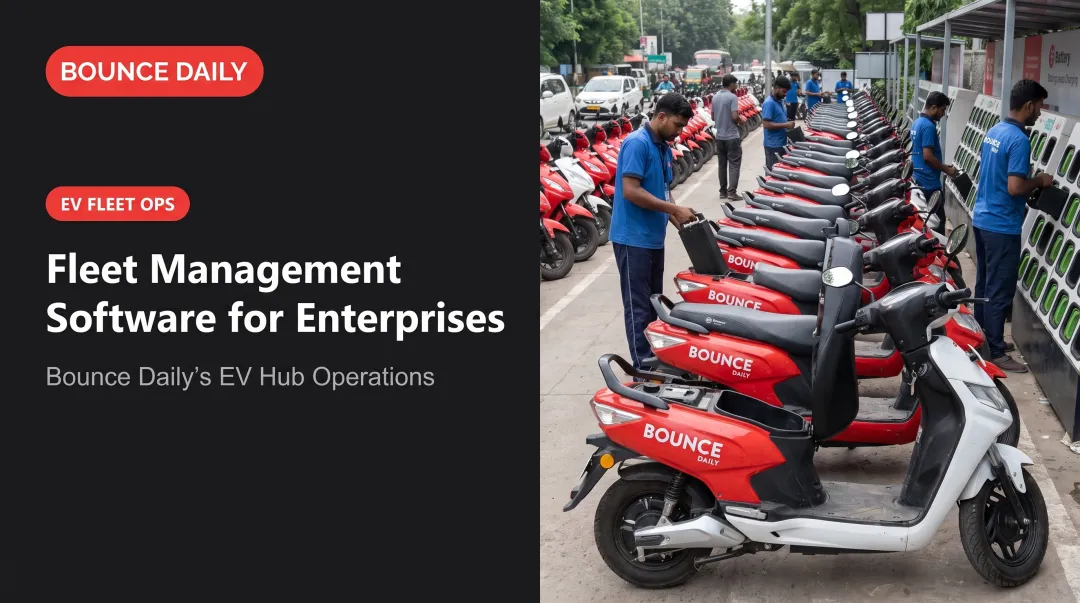
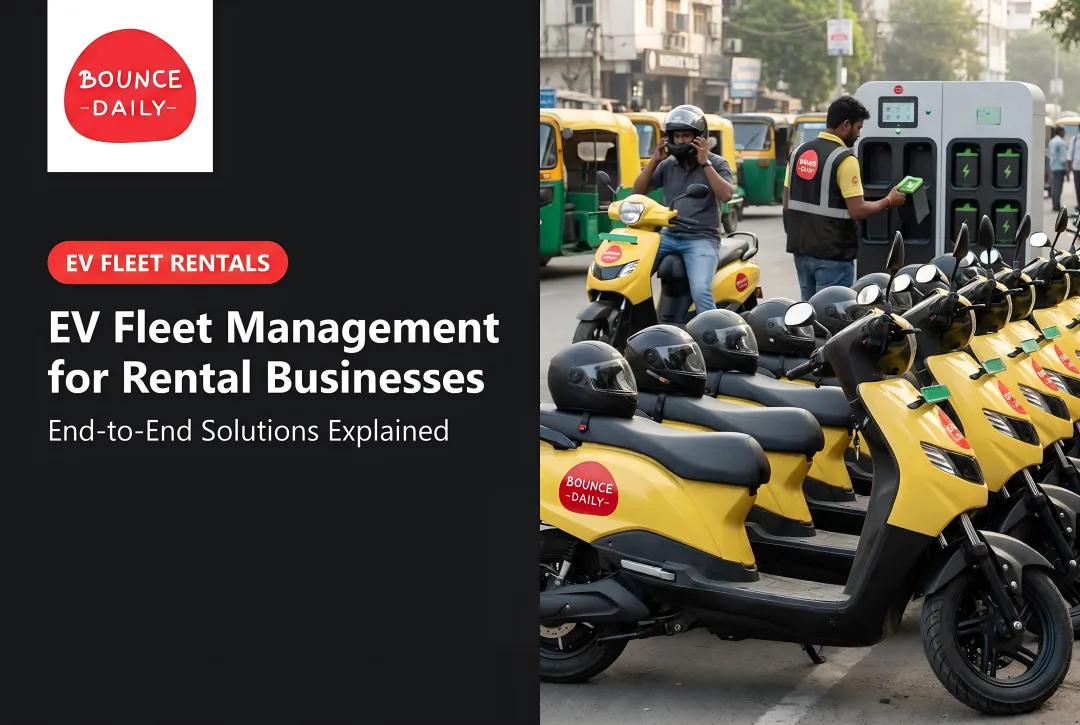
Bounce Daily, Bounce Infinity's EV scooter rental service relaunched in Bengaluru in April 2025, is built around exactly this model. Riders access either a High Speed scooter (55 km/h, 70 km range) for licensed multi-zone delivery work, or a Low Speed variant (25 km/h, 85 km range) for hyperlocal routes and first-time riders. Bounce Daily handles:
- Acquisition — no EMI, no upfront purchase, no ownership burden
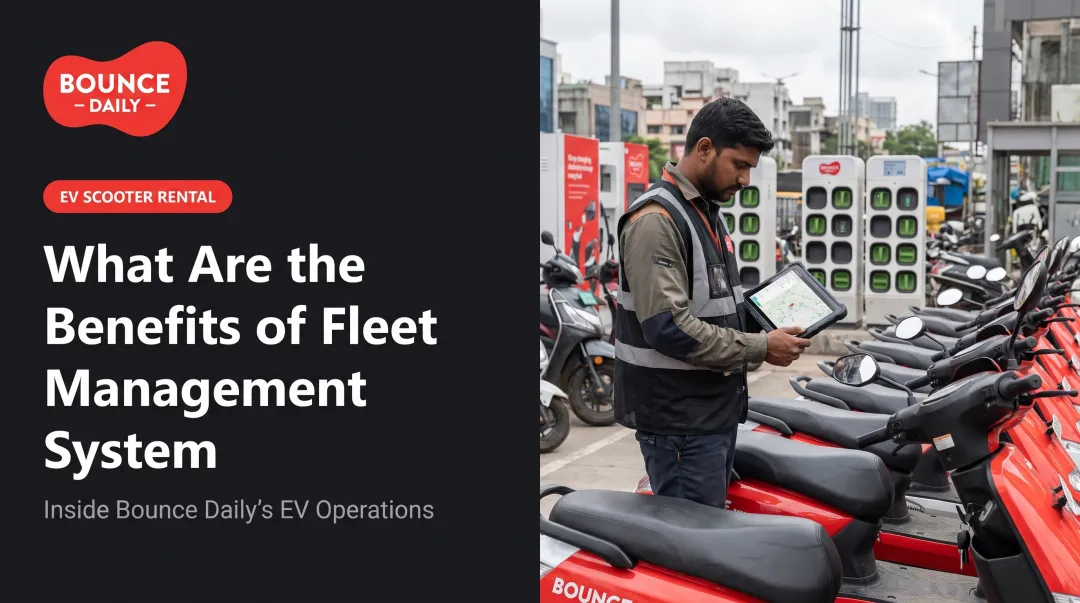
- Servicing — scheduled maintenance, breakdown support and GPS-tracked uptime
- Battery swapping — hub network for minute-level swaps; unlimited swaps on active rentals
- Onboarding — Aadhaar-based digital KYC through the app, with same-day rental activation
Bounce Daily reports 30 million-plus kilometres driven and more than 10,000 tonnes of CO2 avoided to date across its fleet. Bounce Task, its rider-aggregation layer, also connects delivery partners to Swiggy, Zomato, Blinkit, Zepto, and other platforms across Bengaluru, Hyderabad and Delhi NCR.
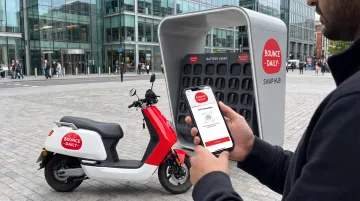
For franchise partners, the same logic applies at hub level. Bounce Daily's FOCO-style hub-operator programme gives partners professional fleet management without building in-house expertise from scratch:
- Quick digital onboarding with no lengthy documentation
- Steady flow of verified riders
- End-to-end support spanning hub operations training, rider onboarding, and marketing creatives
Frequently Asked Questions
What does fleet management do?
Fleet management oversees vehicle acquisition, maintenance, tracking, driver management and compliance to keep a fleet running safely, efficiently and within budget. It applies to any group of vehicles, not just large commercial fleets.
What are the benefits of fleet management?
It reduces fuel and maintenance costs, improves driver safety through behaviour monitoring, helps avoid compliance fines, and increases productivity through better routing and vehicle uptime. EV fleets also gain sustainability tracking benefits.
What does a fleet manager do?
A fleet manager handles vehicle procurement, maintenance scheduling, driver oversight, budgeting, contract management, and compliance tracking. They're the single point of accountability for how a fleet performs.
What is a fleet management system?
It's software paired with telematics hardware (GPS, IoT sensors) that centralises vehicle data for tracking, maintenance scheduling and reporting. It gives fleet managers a single dashboard to make decisions from.
How is fleet management different for EV and two-wheeler delivery fleets?
EV fleets require monitoring battery health, charging cycles and swap-station access instead of fuel levels. Two-wheeler delivery fleets also add a heavier focus on fast rider onboarding and licence verification.
Is fleet management only necessary for large companies with many vehicles?
No. Even a single gig worker on a rented scooter benefits from fleet management principles, typically through rental or franchise models like Bounce Daily that handle maintenance, tracking and compliance on their behalf.